
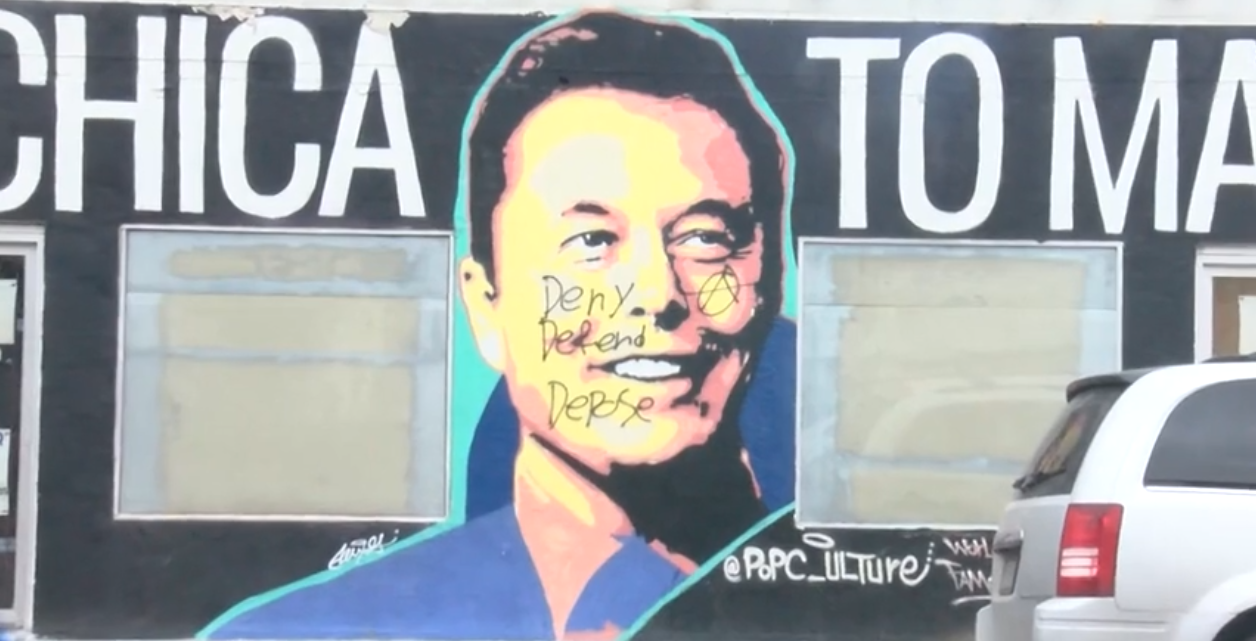
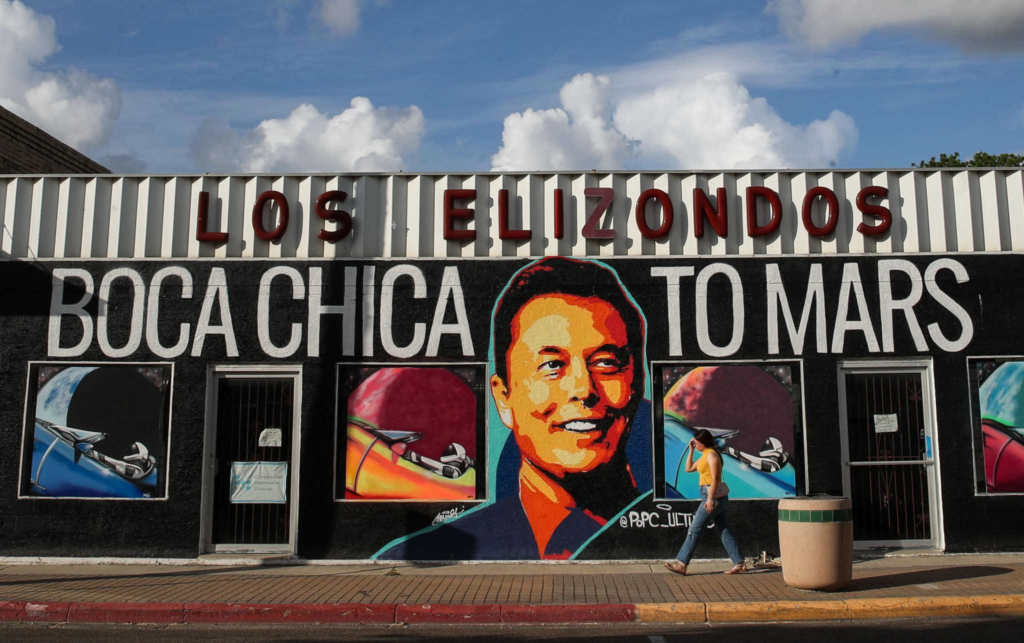
Billionaire entrepreneur has found himself at the center of controversy once again, this time with Elon Musk Mural Vandalised in Texas.
The mural, located outside Los Elizondos, was defaced with the phrase “Deny, Defend, Depose” along with an anarchist symbol on Musk’s face. This incident has sparked widespread speculation and debate, especially given the broader political climate surrounding Musk and his involvement with the Trump administration.
The vandalism appears to be more than just an act of defacement—it reflects deeper grievances against Elon Musk’s growing influence in government and his association with contentious policies.
Elon Musk Mural Vandalised in Texas
The phrase “Deny, Defend, Depose” carries significant weight, particularly in light of recent events. It was notably found engraved on bullet shell casings at the fatal shooting site of UnitedHealthcare CEO Brian Thompson.
The fact that the same phrase was used to deface Elon Musk’s mural has led many to question whether there is a deeper connection or symbolic intent behind the act.
While there has been no official police report filed regarding the vandalism, and no arrests have been made as of Tuesday morning, the act has stirred conversations about Musk’s role in the Trump administration and his expanding presence in the government.
Critics argue that Musk’s increasing influence over policy is problematic, as it grants him a level of authority typically reserved for public officials.
Read : US Congresswoman Alexandria Ocasio-Cortez Calls Elon Musk ‘One of Most Unintelligent Billionaires’
This isn’t the first time that Elon Musk has been at the receiving end of public outrage. His polarizing personality, controversial business decisions, and political affiliations have made him a frequent target for criticism.
However, the intensity of this backlash, as reflected in the Texas mural incident, suggests that his presence in the political arena is being met with increasing resistance.
Elon Musk’s Controversial Role in the Trump Administration
One of the major factors fueling public discontent is Musk’s appointment as a “special government employee” within the Trump administration. According to reports, Elon Musk has been given a government email and office space, allowing him to work with the administration without being a full-time federal employee.
His department, known as the DOGE department, is tasked with slashing federal funding—an initiative that has drawn sharp criticism from those who view it as a means of consolidating power and reducing government transparency.
The White House has defended Musk’s position, stating that he has complied with all federal laws. However, the lack of clarity regarding his security clearance and background check has raised concerns.
As a “special government employee,” Elon Musk is permitted to work up to 130 days a year without receiving a federal salary, which some argue gives him an outsized influence without accountability.

His involvement in the Trump administration has also been linked to the breakdown of USAID, a key agency responsible for international development and humanitarian assistance. Critics believe that Musk’s presence has accelerated the dismantling of such programs, further fueling public outrage.
Opponents argue that Elon Musk is leveraging his business empire to shape policy in ways that serve his personal and corporate interests rather than the public good.
Growing Backlash and Public Demonstrations
The vandalism of Musk’s mural in Texas is just one example of the growing backlash against him. Public protests and online criticism have intensified, with many questioning his loyalty and intentions.
One of the most striking demonstrations against Musk took place in Milan’s Piazzale Loreto on January 21, where his effigy was hanged upside down. This was a symbolic reference to the fate of Benito Mussolini, the former Italian dictator, whose body was displayed in the same location in 1945 after his execution.
The demonstration was reportedly a response to Musk’s hand gesture during President Trump’s inauguration, which some critics compared to a Nazi salute.
While Musk has dismissed the allegations as a “tired” attack, the incident underscores the level of animosity directed toward him. The effigy display in Milan was not just an isolated act but part of a broader pattern of opposition to Musk’s perceived alignment with authoritarian tendencies.
Despite the mounting criticism, Musk continues to be a prominent figure in both business and politics. His defenders argue that he is a visionary leader pushing technological innovation and economic growth. However, his detractors see him as a billionaire with unchecked power, using his influence to shape policies that primarily benefit the elite.
The vandalism in Texas, along with the effigy incident in Milan, highlights the polarizing nature of Musk’s public persona. Whether he is viewed as a forward-thinking entrepreneur or a controversial political figure, one thing is clear: Musk’s actions and associations are under intense scrutiny, and the resistance against him is unlikely to subside anytime soon.