

Tesla has found itself at a precarious crossroads, grappling with a combination of financial setbacks, public backlash, and geopolitical tensions.
The company’s recent quarterly report revealed a 71 percent plunge in net income, reflecting not just operational and sales-related challenges, but also the growing controversies surrounding CEO Elon Musk’s political affiliations and his role within the Trump administration’s Department of Government Efficiency (DOGE).
Musk has now announced that he will begin scaling back his involvement with DOGE starting next month to focus more heavily on stabilizing Tesla. This pivot comes at a critical juncture, as Tesla’s image has suffered severe damage in the public eye.
A recent CNBC poll found that nearly half of Americans now view both Elon Musk and Tesla unfavorably, with many attributing the company’s declining fortunes to its CEO’s high-profile political engagements and controversial decisions.
The backlash has been intense and, in some cases, violent. Tesla showrooms have been defaced, and vehicles have been targeted in acts of vandalism that reflect a growing frustration from climate activists and other interest groups.
Financial Performance and Market Reaction
The company’s Q1 performance was disappointing on multiple fronts. Tesla missed both revenue and earnings expectations, reporting earnings per share of $0.27, significantly below the estimated $0.39.
Total revenue came in at $19.34 billion, falling short of the projected $21.11 billion. The resulting 71 percent drop in net income was the lowest the company has posted since the third quarter of 2021, marking a stark departure from the growth story investors had come to expect.
Despite the grim financial picture, Tesla stock managed a slight bounce in after-hours trading, rising four percent. However, this minor recovery is not enough to offset the broader downward trend—the stock remains down by approximately 40 percent year-to-date.
Investor confidence has been shaken, with many questioning whether Tesla’s long-term goals around artificial intelligence, robotaxis, and humanoid robots are enough to counterbalance the short-term turbulence. Tesla’s automotive division, which accounts for the bulk of its revenue, saw a 13 percent slump in sales.
This is particularly concerning given the simultaneous delay of its much-anticipated affordable EV in the U.S. market. Originally scheduled for release in the first half of the year, the project has now been pushed back, adding further uncertainty about the company’s ability to compete in an increasingly crowded EV landscape.
Political Tensions, Tariffs, and Tesla’s Global Positioning
Elon Musk’s dual role as a top adviser in the Trump administration and CEO of Tesla has raised eyebrows since the beginning. His involvement with DOGE was intended to root out inefficiencies in the federal government, but it has come at a cost to Tesla.
Elon Musk admitted during Tuesday’s earnings call that the time demands of this position have distracted him from Tesla at a time when the company desperately needs strong leadership. Tesla’s troubles were compounded after the Trump administration’s announcement of steep tariffs on Chinese imports.

In retaliation, China slapped a 125 percent tariff on U.S.-made electric vehicles, effectively forcing Tesla to halt new orders for its Model S and Model X in China. Though Elon Musk was once seen as a beneficiary of Trump’s tariff war, Tesla now finds itself caught in the geopolitical crossfire.
The company’s global operations rely heavily on a complex supply chain that includes components from both China and Mexico—regions now targeted by U.S. tariffs. Executives acknowledge that these financial and logistical headwinds are hampering Tesla’s ability to scale production and maintain competitive pricing.
While Elon Musk reaffirmed that most of a Tesla vehicle is manufactured in the United States, the reliance on foreign parts makes it difficult for the company to insulate itself from international economic pressures.
Public Perception and Civil Unrest
Perhaps most alarming for Tesla is the growing hostility from the public. Demonstrations, acts of vandalism, and highly charged rhetoric have taken a toll on the brand’s image. Just hours before the earnings call, climate activists spray-painted “F*** DOGE” on a Tesla showroom in Manhattan, a clear indication that Musk’s political alignment is increasingly shaping how the brand is perceived.
Violence has escalated to the point where the U.S. Department of Justice announced the formation of a task force specifically focused on investigating attacks against Tesla vehicles and infrastructure. A viral image of a Tesla car destroyed in New Mexico captured national attention, further symbolizing the volatile climate Tesla is now navigating.
Musk addressed these issues during the earnings call, suggesting that many of the demonstrations were not spontaneous but “paid for” by those benefiting from what he described as “wasteful largesse.” While he didn’t name specific actors, his comments implied a belief that political adversaries and special interests are actively working to undermine Tesla’s credibility.
Shifting Focus and the Road Ahead
In response to the growing crisis, Musk declared that he would begin stepping back from his advisory role in DOGE starting in May. While he intends to maintain a limited presence—about one or two days a week—he emphasized that his priority will now return to Tesla. This decision marks a notable shift in Musk’s allocation of time and may help reassure investors and employees that leadership is refocusing on the company’s core mission.
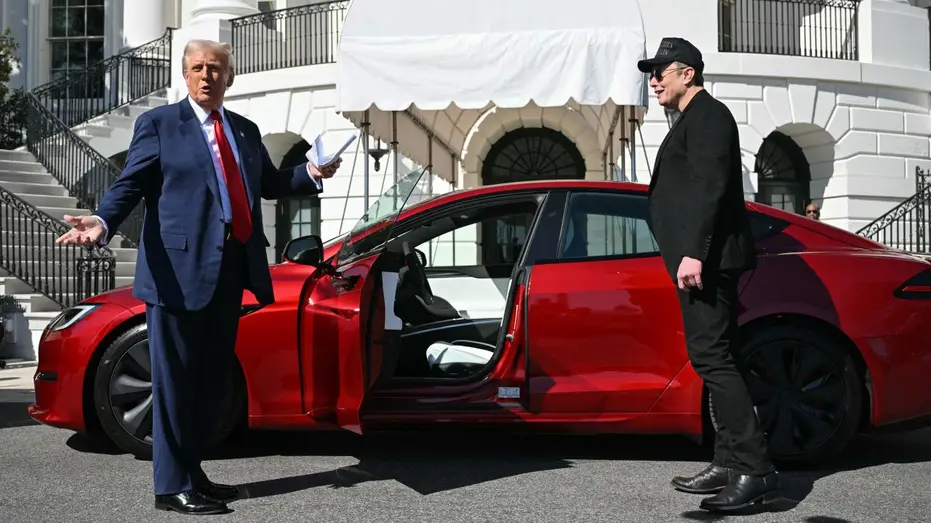
Looking ahead, Musk painted a picture of a future powered by autonomous technology. He reiterated Tesla’s ambitions to lead the charge in robotaxi development and humanoid robotics, projects he believes could revolutionize the transportation and labor sectors. The company is set to debut its first robotaxi pilot in Austin, Texas, this June—a milestone that Musk says will showcase Tesla’s innovative edge.
Still, the immediate future remains uncertain. The EV market is becoming increasingly competitive, with legacy automakers and startups alike pushing aggressively into the space. Tesla must not only contend with external challenges like tariffs and protests but also internal issues like delayed product rollouts and declining customer satisfaction.
Musk closed his earnings call on an optimistic note, urging stakeholders to “look beyond the bumps and potholes of the road immediately ahead” and instead envision a “bright, shining citadel on a hill.” Whether this vision can materialize depends largely on the company’s ability to navigate its current crisis and return to strong, consistent growth.
In the coming months, all eyes will be on Tesla as it attempts to stabilize operations, win back public trust, and deliver on its futuristic promises. For now, Musk’s decision to step back from politics and focus on Tesla could be the first step in a long road to recovery.