
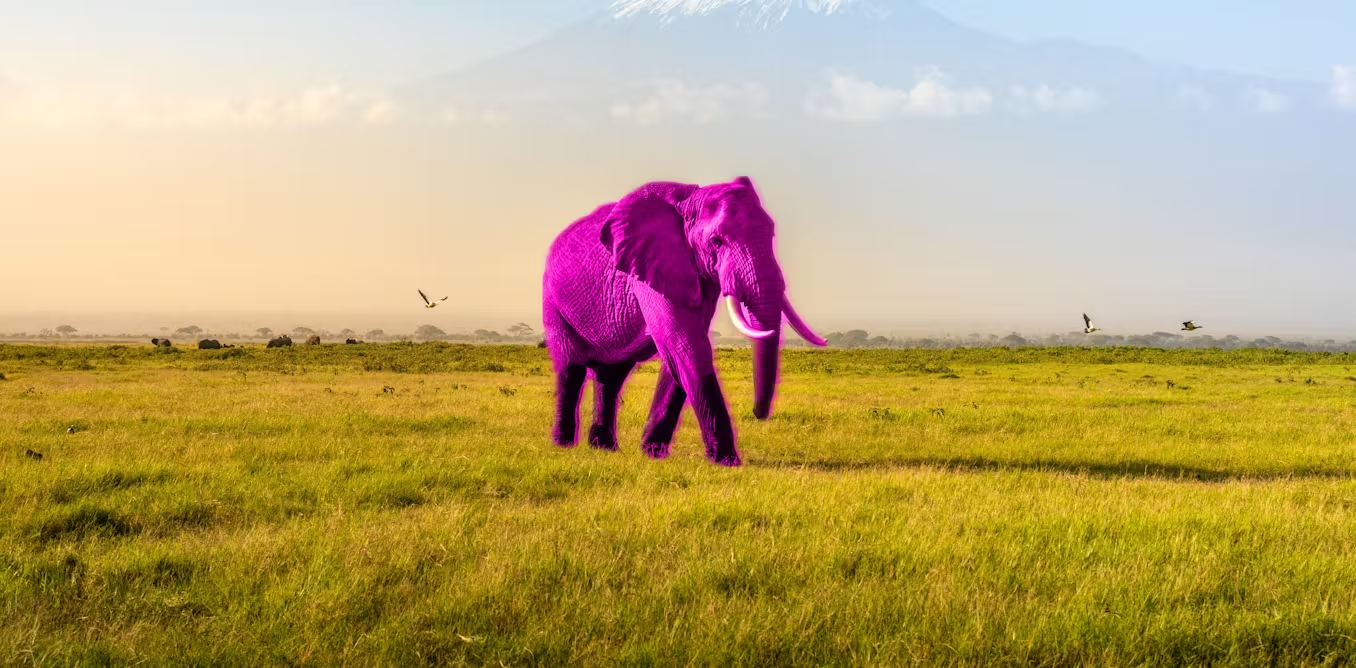
The “pink elephant test” has become an iconic reference in psychology and everyday conversation, representing how hard it can be to suppress unwanted thoughts. Originating from Curt Siodmak’s 1974 novel City in the Sky, the simple instruction—“Don’t think of a pink elephant”—reveals the human mind’s paradoxical challenge.
When told not to visualize something, most people find themselves picturing it anyway. But is this universal? Recent research suggests otherwise, particularly when we consider the experiences of people with aphantasia.
Aphantasia is a condition where individuals cannot voluntarily generate visual images in their minds. For them, the pink elephant remains a conceptual idea, never manifesting as a vivid mental picture.
This unique way of processing thoughts offers fascinating insights into the diversity of human cognition and how our minds deal with voluntary and involuntary imagery. So, what does psychology say about this phenomenon? Let’s explore.
Understanding Aphantasia: When the Mind’s Eye Stays Closed
Aphantasia is characterized by an inability to visualize images. If someone with aphantasia is asked to imagine a sunset or a pink elephant, they cannot conjure up a visual representation.
Instead, they might think of the concept or use words to describe it, but no image appears in their “mind’s eye.” This condition, often unnoticed until adulthood, highlights the broad spectrum of human cognitive experiences.
For many, discovering aphantasia can be both surprising and disheartening. Realizing that others can vividly imagine scenes, characters from books, or the faces of loved ones can lead to a sense of loss.
Read : Richest Person on Earth Preparing to Launch AI Gaming Studio
However, what aphantasics lack in visualization, they may compensate for in other ways. Some report stronger verbal, auditory, or tactile thinking. Others find comfort in the absence of intrusive visual thoughts.
Read : The Top Ten Most Beautiful PINK Sand Beaches in the World
Interestingly, aphantasia isn’t a defect but part of the natural diversity in cognitive processing. Some people have extraordinarily vivid visual imaginations, while others fall in the middle. Aphantasics sit at one end of this spectrum, offering a different perspective on how the brain handles information and emotion.
The Link Between Visual Imagery and Suppression
One of the key findings in recent research is that people with more vivid visual imaginations struggle more to suppress unwanted images. This is where the pink elephant test becomes particularly revealing.
For individuals with strong mental imagery, being told not to think of something often makes it harder to avoid. The image becomes intrusive, popping up even when they try to push it away.
This phenomenon is rooted in how the brain processes suppression. Attempting to block a thought requires monitoring whether that thought is present—ironically making it more likely to surface.
For those with vivid imaginations, the visual component adds an extra layer of difficulty. The more detailed and vibrant the image, the harder it is to dismiss.

On the other hand, people with weaker visual imaginations, including those with aphantasia, don’t face this challenge. Without the ability to visualize, there’s nothing to suppress.
If asked not to think of a pink elephant, they might consider the idea briefly but can easily move on. Their minds are more likely to wander to unrelated topics, such as what they’ll have for dinner.
This difference in mental processing suggests that aphantasia might offer a kind of cognitive shield. Without vivid images, aphantasics are less prone to intrusive visual thoughts.
This could have significant implications for understanding and treating conditions like post-traumatic stress disorder (PTSD), where unwanted visual memories play a central role.
Aphantasia, Daydreaming, and Mind-Wandering
If aphantasics can’t visualize, does that mean their minds are more peaceful? Not necessarily. While they may be resistant to visual intrusions, they are not immune to mind-wandering. In fact, research suggests that aphantasics often experience daydreams in different forms.
For instance, Derek, an aphantasic, describes his daydreams as purely auditory. Instead of seeing images, he imagines conversations and sounds.

This auditory focus shapes his mental landscape, creating a different kind of rich, internal experience. Loren, another aphantasic, experiences thoughts as sensations of texture and movement. Her mind-wandering involves imagined feelings rather than visual or auditory content.
This diversity highlights that daydreaming isn’t solely about visual imagery. The mind can wander in many ways, engaging different senses and thought processes.
For aphantasics, daydreams might be less about seeing and more about hearing, feeling, or conceptualizing. This challenges the traditional view of daydreaming as a primarily visual activity.
The ability to turn away from unwanted thoughts also varies. While aphantasics may not visualize a pink elephant, their minds might drift to other topics, like planning their next meal or recalling a conversation. So, rather than having more peaceful minds, they simply navigate thoughts differently.
Resilience to Trauma and Intrusive Thoughts
One intriguing question is whether aphantasia provides resilience against traumatic memories. PTSD often involves vivid, intrusive visual flashbacks. If someone cannot visualize, does that mean they are less affected by traumatic events? The answer is complex and still being explored.
Initial evidence suggests that aphantasics may be less susceptible to visual flashbacks. However, trauma is not limited to visual experiences. Aphantasics might still relive events through other senses or thought patterns. Instead of seeing a traumatic event, they might replay it as an internal dialogue or a series of conceptual memories.

This difference in processing could offer new avenues for therapeutic approaches. Understanding how aphantasics experience and recall trauma might help develop strategies for managing intrusive thoughts in others.
It also underscores the importance of recognizing the diversity in how people process experiences. What works for one person might not work for another.
The pink elephant test reveals much more than the difficulty of suppressing thoughts. It highlights the incredible diversity of human cognition. Some people see vivid images; others don’t.
Some struggle to suppress unwanted thoughts; others can easily shift their focus. Aphantasia is just one example of this diversity, offering a unique perspective on how the mind works.
Rather than viewing aphantasia as a deficit, we can see it as a different way of experiencing the world. Aphantasics might miss out on visual daydreams, but they also avoid intrusive visual thoughts. Their minds wander in different ways, engaging other senses and thought processes.
Ultimately, the pink elephant test is not universal. For some, the pink elephant is an unavoidable mental image. For others, it’s just an idea, easily set aside. This difference reminds us that there is no single way to think or experience the world. Embracing this diversity can lead to a deeper understanding of ourselves and others.