

In a story that has stirred national attention and added fuel to a growing debate over transgender inclusion in sports, Stephanie Turner, a fencer competing at a USA Fencing-sanctioned regional tournament at the University of Maryland, was disqualified after refusing to face her transgender opponent.
The decision by USA Fencing has generated polarized reactions across social media and within the sports community, reflecting broader societal divisions over gender identity, fairness, and inclusion in women’s sports.
Turner’s actions, which she described as a protest on principle, have been hailed by some as a stand for women’s rights and condemned by others as an act of exclusionary discrimination.
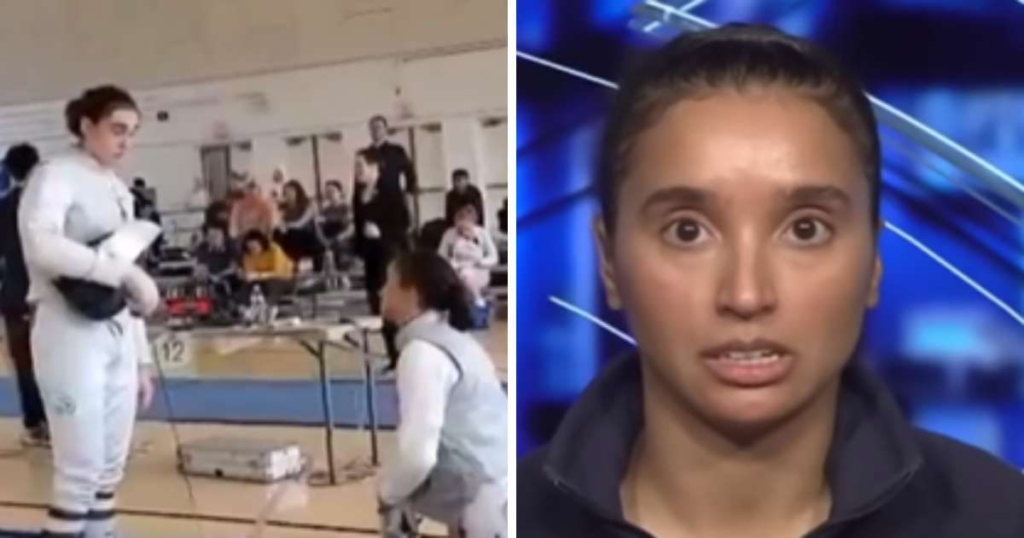
The disqualification took place on Sunday during a women’s fencing tournament at the university campus. Turner, facing a match against Redmond Sullivan, a transgender woman, chose to take a knee before the bout and refused to engage in the match.
As per USA Fencing regulations, she was shown a black card—an automatic disqualification from the tournament. Although this ruling applies only to the event in question and does not disqualify her from future competitions, it marks a significant moment in the ongoing discourse surrounding sports, gender, and identity in the United States.
The Incident and Its Immediate Aftermath
Stephanie Turner’s protest did not go unnoticed. Before the start of her scheduled match, she knelt and declined to take position on the fencing strip, a symbolic act intended to challenge the participation of transgender women in women’s competitions.
Speaking to Fox News after the tournament, Turner explained her actions by stating, “I told them that I was refusing to fence because this person is a man, and I’m a woman, and this is a women’s tournament and I refuse to fence on principle.”
Her statement underscores a belief held by many who argue that the inclusion of transgender women in women’s sports is fundamentally unfair due to perceived biological advantages.
Read : Philadelphia Eagles Fan Tyler Sabapathy Dies After Falling from Light Pole
The tournament officials responded swiftly. In accordance with USA Fencing’s Code of Conduct, which mandates that all athletes must compete against any properly entered participant, Turner was shown a black card. This level of penalty is typically reserved for the most serious offenses in the sport, such as deliberate refusal to fence or misconduct.
Read : Man Surgically Adds Four Extra Nipples To His Body, Find Out The Fascinating Story Behind it
USA Fencing released a statement emphasizing the importance of fairness and inclusion in their policies. “A fencer is not permitted to refuse to fence another properly entered fencer for any reason,” the organization said. “Under these rules, such a refusal results in disqualification and the corresponding sanctions. This policy exists to maintain fair competition standards and preserve the sport’s integrity.”

While Turner has not been banned from other tournaments, the ruling sends a clear message from the governing body. USA Fencing’s position aligns with its broader policy implemented in 2023, which affirms the rights of transgender and non-binary athletes to compete in accordance with their gender identity, regardless of the gender associated with their sex assigned at birth.
USA Fencing’s Inclusion Policy and the Broader Landscape
The USA Fencing policy on gender identity is one of several similar initiatives being adopted by sports organizations both nationally and globally. Their guidelines allow transgender and non-binary individuals to participate in divisions consistent with their expressed gender identity, not their assigned sex at birth.
The policy explicitly states that no discrimination will be tolerated based on gender identity or expression. In the eyes of the organization, Turner’s refusal to compete was a violation of this inclusive framework and an affront to the values of respect and equality that underpin modern competitive sports.
“We understand that the conversation around transgender participation is evolving,” USA Fencing said in its official statement. “USA Fencing will always err on the side of inclusion, and we’re committed to amending the policy as more relevant evidence-based research emerges, or as policy changes take effect in the wider Olympic & Paralympic movement.”

This stance places the organization in alignment with entities such as the International Olympic Committee (IOC), which in recent years has encouraged federations to adopt inclusion-focused policies while continuing to study and refine criteria related to fairness and competitive balance.
USA Fencing’s move reflects a wider cultural moment where inclusion efforts are clashing with long-standing beliefs about biology, identity, and fairness in sports. However, the tension surrounding such decisions is palpable.
Supporters of trans inclusion argue that gender identity is a critical aspect of a person’s identity and that sports should be a welcoming space for all.
On the other side, critics claim that biological differences create an uneven playing field and that female athletes are being disadvantaged. Stephanie Turner’s protest brings these arguments into sharp relief, demonstrating how the issue is not just about policy but also about deeply held beliefs and values.
Political and Cultural Undercurrents Fueling the Debate
Turner’s disqualification comes amid a broader political climate that is increasingly polarized on transgender issues. Former President Donald Trump has made opposition to transgender inclusion a prominent part of his political rhetoric.
Earlier this year, he signed an executive order declaring that there are only two sexes—male and female—and vowed to “defend women’s rights” through policies that enforce biological definitions of sex. This executive order came after a string of anti-trans measures introduced at the state and federal level, many of which target participation in sports and access to gender-affirming care.
The cultural context surrounding Turner’s protest is thus not isolated—it is part of a larger national conversation. Her actions resonate with those who see transgender inclusion in women’s sports as a threat to female athletes and as a broader erosion of sex-based rights.
At the same time, her protest has been sharply criticized by LGBTQ+ advocacy groups and supporters of inclusive sports, who view such actions as discriminatory and harmful.
For Redmond Sullivan, the transgender athlete at the center of the controversy, the event has been a deeply personal one. While Sullivan has not publicly commented on the match, the scrutiny and media coverage inevitably put a spotlight on trans athletes who already face immense pressure and discrimination in competitive sports environments.
As this debate continues to unfold, it becomes increasingly clear that there are no easy answers. The intersection of sport, identity, fairness, and inclusion presents complex ethical and legal questions. Should competition be governed solely by biology, or should it also recognize lived experience and gender identity? Can a sport be both fair and inclusive, or are those goals sometimes in conflict?
Stephanie Turner’s disqualification is likely to have ramifications beyond the fencing community. It may encourage other athletes who feel similarly to voice their beliefs, perhaps even through similar forms of protest.
It may also prompt governing bodies to reexamine and clarify their policies to reduce ambiguity and prepare for future incidents. But at the core of the story remains a single moment of refusal, one that echoes far beyond the fencing strip and into the heart of one of the most contentious cultural debates of our time.