
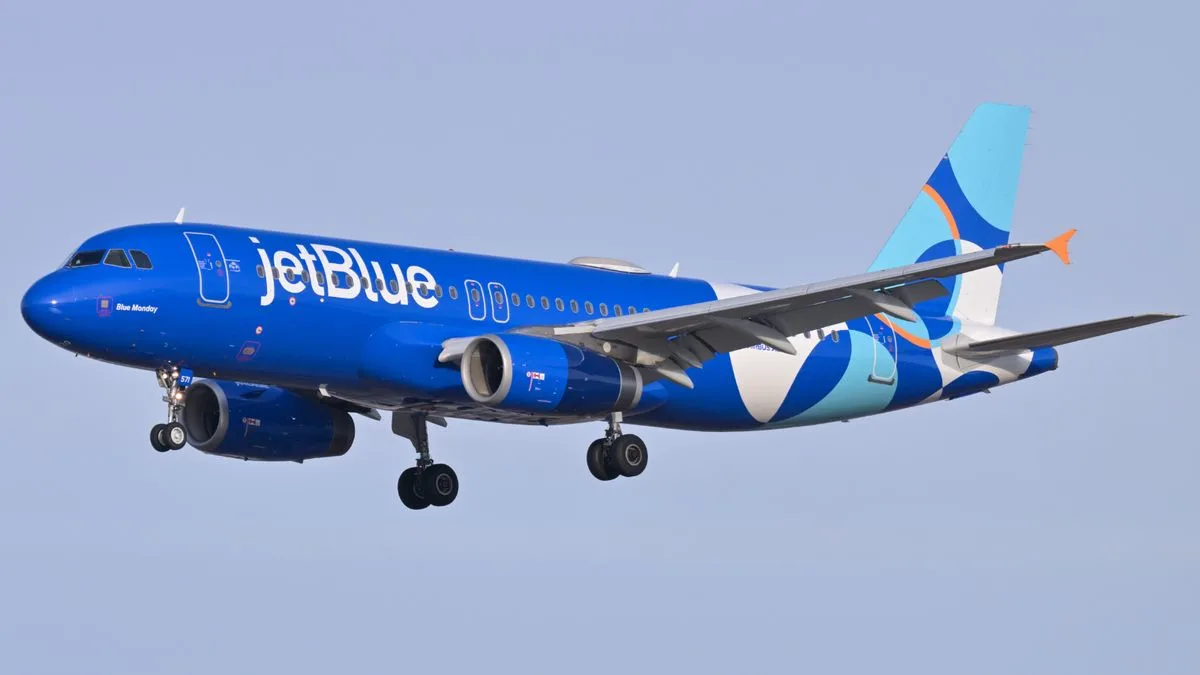
Air travel is typically governed by carefully scripted announcements, safety briefings, and standardized communication designed to maintain neutrality and professionalism in a shared public space. Yet a recent incident aboard JetBlue Flight 2010, traveling from Los Angeles to Palm Beach, Florida, disrupted that expectation and ignited a nationwide conversation about political expression in customer-facing workplaces.
What might have been an ordinary Presidents’ Day flight instead became a flashpoint for public debate after a flight attendant reportedly thanked President Donald Trump and his cabinet during an onboard announcement. The remark, delivered as part of a holiday acknowledgment, quickly spread beyond the aircraft cabin, triggering strong reactions from passengers, public figures, and social media users.
The event has since raised broader questions about workplace conduct, corporate neutrality, and the boundaries of personal expression in professional environments where audiences are diverse and often deeply divided in their political views. The incident came to public attention through a passenger account shared online, and from there it evolved into a widely discussed controversy.
Some observers framed the announcement as inappropriate political messaging in a commercial setting, while others viewed the backlash itself as an overreaction to a brief holiday comment. The episode illustrates how even short, unscripted moments in public-facing roles can reverberate far beyond their immediate context, especially in an era where social media rapidly amplifies personal experiences into national debates.
The Announcement That Sparked the Controversy
The situation began when a passenger on Flight 2010 described hearing a message over the aircraft’s announcement system that included thanks directed toward President Donald Trump and members of his administration. According to the account, the remark was presented as part of a Presidents’ Day acknowledgment delivered during the flight. What might have been intended as a simple expression of recognition for the holiday was instead perceived by some passengers as a political endorsement delivered in a professional setting.
Photographer James Weir was among those who publicly described the experience. He stated that the comment surprised him and prompted immediate concern about the appropriateness of political references in airline announcements. His account suggested that the message was not part of a standardized script but rather a decision attributed to a senior member of the cabin crew.
He further indicated that another flight attendant privately expressed disagreement with the decision and reportedly communicated concerns about repeating such remarks on a return flight. The description of internal disagreement among crew members added another dimension to the incident. It suggested that the announcement may not have reflected a unified stance or company directive, but rather an individual choice made within the confines of a highly visible professional role.
That distinction became central to much of the public discussion that followed, as observers debated whether responsibility rested with the individual employee, company policy, or broader cultural norms regarding workplace expression. Once the passenger’s account circulated online, reactions spread rapidly. Social media platforms amplified the story, transforming what had occurred within the enclosed environment of an aircraft cabin into a public controversy involving thousands of voices.
Hey @Jetblue Your flight attendant chose to begin the flight by specifically thanking President Trump and his cabinet for all that they do. This will be the last time I choose your airline, and I will tell everyone about my experience. And oh yeah, fuck off
— Chip Franklin.com (@chipfranklin) February 17, 2026
For many observers, the central issue was not merely the content of the message but the setting in which it was delivered. Airlines operate in shared spaces where passengers cannot easily disengage, and where expectations of neutrality are often assumed. The idea that a political message had been delivered in such a context became the focal point of the growing debate.
Public Reaction and Escalating Social Media Debate
The response to the announcement quickly became polarized, reflecting broader national divisions surrounding political expression. Some individuals expressed anger and disappointment, arguing that passengers should not be subjected to political messaging while traveling. Others dismissed the criticism as exaggerated, contending that acknowledging political leaders on a national holiday was not inherently inappropriate.
Public figures joined the discussion, amplifying the controversy further. American talk show host and writer Chip Franklin publicly condemned the incident, stating that it would influence his future travel choices and urging others to take similar action. His response reflected a broader pattern of consumer activism in which personal experiences with companies are shared widely and framed as reasons to support or boycott particular brands.
Legal and professional concerns were also raised. Attorney Karen Myatt criticized the announcement and argued that political speech by airline staff could violate internal conduct standards designed to ensure neutrality. She emphasized that many corporate employee manuals restrict overt political expression while on duty, particularly in roles that involve direct interaction with customers.
Read : 23-Year-Old Lucy Harrison Shot Dead by Father After Argument Over Donald Trump
Her comments highlighted a key dimension of the controversy: whether the issue was primarily about personal opinion or about adherence to professional guidelines governing workplace communication. Online reactions extended beyond criticism. Some users defended the flight attendant’s remark, framing the backlash as evidence of excessive sensitivity to political expression.
These supporters argued that recognizing political leadership during a national holiday was not fundamentally different from other forms of ceremonial acknowledgment. Their responses reflected a broader cultural debate about what constitutes acceptable public speech and whether neutrality should be strictly enforced in all professional environments.
As the conversation unfolded, the incident became less about a single announcement and more about competing expectations regarding public behavior. Social media transformed the event into a symbolic example used by different groups to illustrate broader concerns—either about political intrusion into everyday spaces or about perceived intolerance toward differing viewpoints. The rapid expansion of the debate demonstrated how modern communication platforms can convert isolated experiences into widely interpreted cultural moments.
Workplace Neutrality and the Broader Implications for Public-Facing Roles
Beyond the immediate controversy, the incident prompted renewed discussion about the expectations placed on employees in public-facing positions. Airlines, in particular, operate under strict safety, service, and communication protocols designed to create consistency across flights. Announcements typically follow standardized language precisely because they reach diverse audiences with varying backgrounds, beliefs, and sensitivities.
Professional neutrality in such settings serves several purposes. It helps maintain an environment where all passengers feel equally respected, and it minimizes the risk of conflict in confined spaces where individuals cannot easily remove themselves from uncomfortable situations. For this reason, many service industries emphasize clear boundaries between personal opinion and professional communication.
Read : Who is Thomas Sabula, the Ford Worker Who Heckled President Trump During Factory Visit?
The Flight 2010 announcement raised questions about how strictly those boundaries should be enforced and how companies respond when they are crossed. Observers debated whether the remark represented a breach of professional conduct or simply a personal expression that carried unintended consequences. The discussion also highlighted the challenges employers face when individual actions by staff members are quickly interpreted as representing institutional positions.
Another key issue involves consistency. If employees express personal views in one instance, should all viewpoints be permitted equal expression? If not, who determines which forms of expression are acceptable? These questions illustrate the complexity of maintaining neutrality in environments where personal beliefs inevitably intersect with public roles.
The incident also reflects the evolving nature of corporate reputation management. In previous decades, a single announcement on a domestic flight might have remained largely unnoticed beyond those present. Today, passenger accounts shared online can reach millions within hours, compelling companies to respond rapidly to situations that escalate before internal review processes are complete. The speed of public reaction often shapes the narrative before official statements are issued.
For employees, the episode underscores the heightened visibility of everyday professional actions. A brief comment delivered over an aircraft speaker system can become the subject of national debate, scrutinized not only for its content but also for what it suggests about institutional values. For employers, it demonstrates the importance of clear communication policies and training designed to address evolving expectations in a politically sensitive environment.
The discussion surrounding Flight 2010 continues to resonate because it touches on broader tensions that extend far beyond a single airline or holiday announcement. It reflects ongoing societal questions about the role of personal belief in professional settings, the responsibilities of organizations to maintain neutrality, and the power of social media to transform momentary interactions into enduring public controversies.