

The recent suspension of Colonel Sheyla Baez Ramirez from her role as the garrison commander of Fort McCoy in Wisconsin has stirred nationwide attention and discussion.
This development follows an incident involving the removal—or failure to display—official photos of President Donald Trump, Vice President JD Vance, and Secretary of Defense Pete Hegseth on the base’s command board, a standard military protocol to reflect the chain of command.
Though the U.S. Army Reserve Command clarified that the suspension is not tied to personal misconduct, the issue has raised significant political and institutional questions.
A Rising Leader in the U.S. Army
Col. Sheyla Baez Ramirez assumed command at Fort McCoy in July 2024, bringing with her an impressive military résumé. Before this high-profile appointment, she served as the Chief of the Reserve Program within the United States Army Intelligence and Security Command at Fort Belvoir, Virginia. Her leadership trajectory included several notable roles across active duty and reserve capacities, reflecting her deep experience and commitment to service.
Ramirez’s career has been defined by professionalism, discipline, and a strong record of performance. Her assumption of the garrison command at Fort McCoy marked another significant milestone in her career.
The role of a garrison commander is vital; it entails oversight of the installation’s daily operations, mission support, and ensuring that the base functions effectively to support national defense objectives. Fort McCoy itself plays a crucial role in U.S. military operations as a training and mobilization center.
Read : NYPD Officers Justin McMillan and Justin Colon Suspended for Forcibly Touching Sex Worker
Her suspension, therefore, represents not only a personal setback but also a pause in what had been seen as a promising and progressive military leadership career.
Read : Kim Jong Un’s Sister Calls South Korea’s Live-Fire Drills ‘Suicidal Hysteria’
Many observers are awaiting the results of the ongoing investigation to determine the precise circumstances that led to the incident and whether there were lapses in command responsibilities or internal miscommunication.
The Chain of Command Wall Controversy
At the heart of the controversy is a wall at Fort McCoy that typically displays the photos of the current Commander-in-Chief, the Vice President, and the Secretary of Defense—symbolizing the chain of command that military personnel follow.
This is a long-established tradition across military installations, serving both symbolic and administrative purposes. The wall’s absence of updated leadership photos following the Trump administration’s return to power raised alarms within the Department of Defense.
It was discovered that the slots where Trump, Vance, and Hegseth’s images were supposed to be were left empty. While the specifics remain under investigation, this apparent oversight triggered swift action from military higher-ups and political voices.
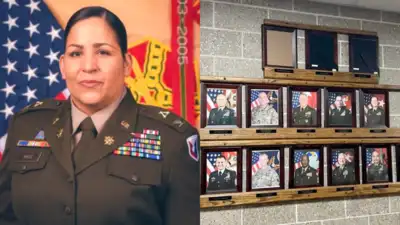
Social media, particularly X (formerly Twitter), saw a resurgence of attention when Defense Secretary Pete Hegseth reshared a post confirming the suspension and pointing to the missing images.
The Department of Defense acted quickly to remedy the visual lapse. In a rapid update, photos were installed in the previously empty frames. A statement from the Defense Department’s rapid response team read, “Regarding the Ft. McCoy Chain of Command wall controversy…. WE FIXED IT! Also, an investigation has begun to figure out exactly what happened.”
This response indicates that while the issue may have initially seemed procedural or symbolic, the underlying concern lies in the possible failure to comply with what are considered foundational practices of military protocol. In a time of heightened political sensitivity, especially with renewed scrutiny over military loyalty and political impartiality, such deviations—intentional or accidental—are taken seriously.
Wider Military Leadership Shake-Ups and Political Sensitivities
The suspension of Col. Ramirez is not an isolated incident in the broader landscape of recent military personnel changes. Just weeks before, Col. Susannah Meyers was relieved of her command at Pituffik Space Force Base in Greenland.
That action was attributed to her comments following Vice President JD Vance’s visit, in which she expressed disagreement with political sentiments shared during the visit. The Space Force cited a “loss of confidence in her ability to lead,” further stating that commanders must “adhere to the highest standards of conduct, especially as it relates to remaining nonpartisan.”
These back-to-back leadership changes reflect an increasingly charged environment within military ranks, where traditional norms of political neutrality are being closely monitored. With the Trump administration’s reinstated leadership in Washington, there appears to be a renewed push to ensure visible and explicit loyalty across the armed forces’ leadership.
The fact that the suspension of Ramirez came without any mention of misconduct is telling. It points more toward institutional messaging and the importance of optics, especially in how military installations present and align themselves with the chain of command.
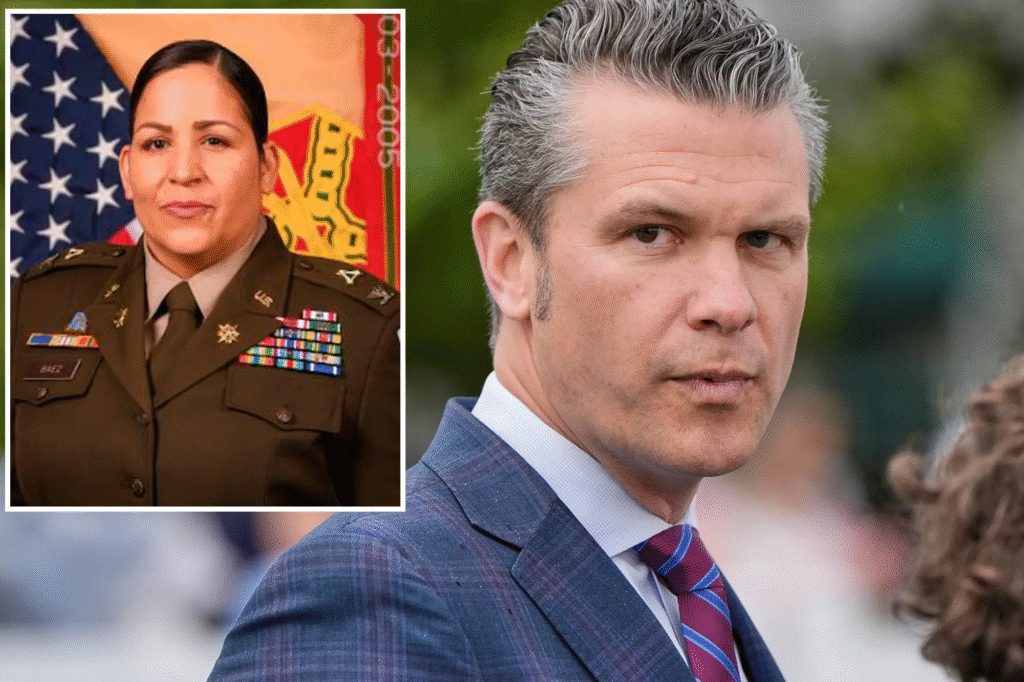
The command board may be a visual detail, but in military culture, such symbols matter. They represent structure, obedience, and the acceptance of civilian leadership over the military.
For Col. Ramirez, the investigation’s outcome will be pivotal in determining whether this was a procedural failure, a miscommunication within her team, or an act viewed as intentional defiance of protocol. Until the review is complete, questions will continue to swirl about the motivations and implications of her suspension.
Col. Sheyla Baez Ramirez’s suspension from her post as Fort McCoy’s commander has opened a window into the complex interplay between military structure, political dynamics, and institutional accountability.
Her decorated career, now temporarily stalled, will be subject to the findings of an ongoing investigation centered around what may appear a minor infraction—but one that cuts to the core of military tradition and expectation.
The chain of command wall at Fort McCoy has now been updated, but the fallout from this incident remains a live matter. The military’s insistence on strict adherence to protocol, especially in a politically polarized era, is becoming ever more visible.
While Ramirez awaits the final decision regarding her professional fate, this situation serves as a case study on the visibility of leadership roles, the importance of seemingly symbolic duties, and the consequences that may arise when even minor lapses are perceived as political statements.