
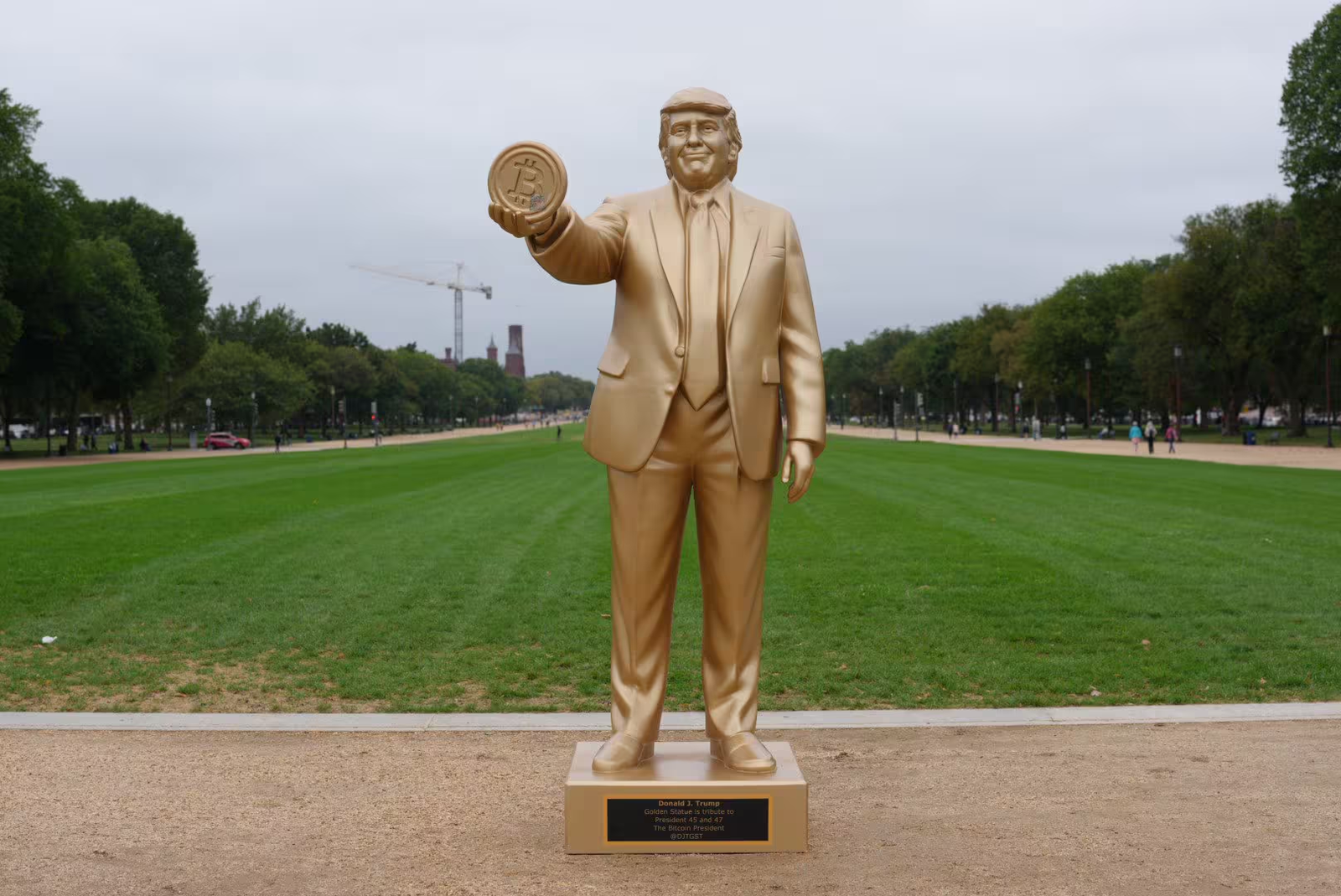
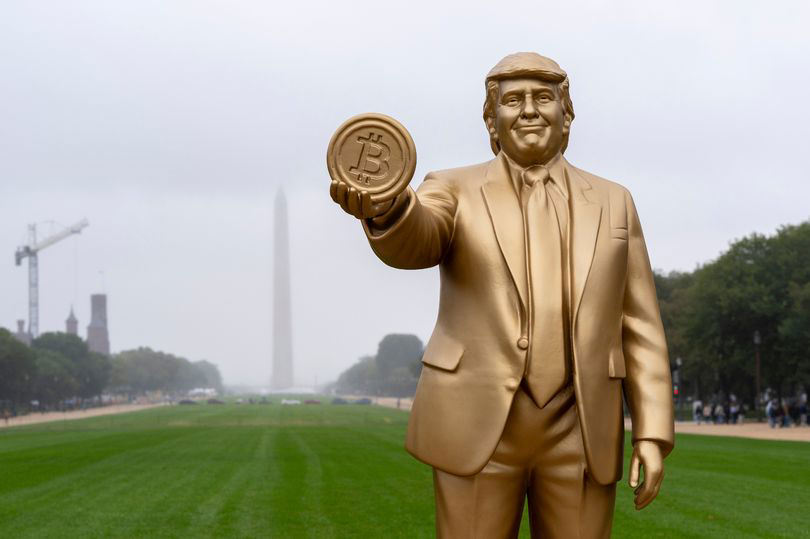
In a bold fusion of politics, finance, and digital innovation, a towering 12-foot Golden Statue of President Trump cradling a Bitcoin symbol was unveiled outside the U.S. Capitol on September 17, 2025. The installation, positioned prominently on 3rd Street just opposite Union Square, has ignited a firestorm of reactions across Washington, D.C., and beyond. Crafted in shimmering gold, the statue depicts the 45th and 47th President in a dynamic pose—arm extended triumphantly, holding the iconic orange Bitcoin emblem aloft as if proclaiming a new era of economic freedom.
This unexpected artwork, which appeared mere hours before the Federal Reserve’s announcement of a 25-basis-point interest rate cut, marks a provocative statement on cryptocurrency’s rising influence in American governance. As crowds gathered under the crisp autumn sun, smartphones flashed and murmurs rippled through the throng, capturing a moment that blends reverence with ridicule. For supporters, it’s a gleaming tribute to Trump’s pro-crypto pivot; for critics, a garish emblem of unchecked ambition. Either way, the statue stands as a gilded mirror reflecting the nation’s divided soul on money, power, and the future.
The unveiling unfolded with theatrical flair, livestreamed on platforms like Pump.fun to an audience of crypto enthusiasts and political junkies. At precisely 2 p.m. Eastern Time, a small group of organizers—clad in casual attire emblazoned with Bitcoin logos—draped back a velvet curtain to reveal the sculpture. Towering at 12 feet and weighing several hundred pounds, the statue gleams under the D.C. sunlight, its surface meticulously polished to evoke both opulence and optimism.
Trump’s likeness, captured in mid-stride with his signature windswept hair and resolute gaze, grips the Bitcoin with a firm yet visionary hand, as if bestowing it upon the Capitol dome in the background. The base bears a simple inscription: “To the Bitcoin President—Advancing Freedom Through Innovation.” This phrase, etched in elegant script, underscores the artwork’s intent, drawing from Trump’s recent speeches where he hailed digital assets as “the gold standard of the 21st century.”
Eyewitnesses described the scene as electric. “It was like watching history remix itself,” said one onlooker, a tech worker from nearby Virginia, who snapped photos amid the growing crowd. Security was light but vigilant, with Capitol Police monitoring from a distance to ensure the permitted installation remained peaceful. The event’s timing was no accident: It preceded the Fed’s 2 p.m. press conference by just 30 minutes, where Chair Jerome Powell confirmed the rate reduction from 4.25-4.50% to 4.00-4.25%, citing cooling inflation and robust job growth.
Oh, a bold new landmark has risen right in front of the U.S. Capitol! 😮
— 鳳凰資訊 PhoenixTV News (@PhoenixTV_News) September 18, 2025
A 12-foot golden statue of Donald Trump holding a Bitcoin appeared outside the U.S. Capitol, a nod from crypto investors to his March 2025 executive order creating a Strategic Bitcoin Reserve. pic.twitter.com/L4IZjYRc2l
As Powell’s words echoed through financial news feeds, the statue became an instant symbol—bullish for risk assets like Bitcoin, which surged 3% in after-hours trading to hover above $68,000. Organizers timed the reveal to amplify this synergy, positioning Trump as the catalyst for monetary policies that favor innovation over regulation. By evening, social media buzzed with hashtags like #GoldenTrump and #BitcoinCapitol, amassing millions of views and shares, turning a static sculpture into a viral phenomenon.
The Minds Behind the Gilt: Origins and Organizers
At the heart of this audacious display is the Donald J. Trump Golden Statue (DJTGST) project, a collective effort spearheaded by a loose alliance of cryptocurrency investors and memecoin enthusiasts. Funded through anonymous donations and crypto wallets totaling over $250,000 in Ethereum and Bitcoin contributions, the initiative began as a tongue-in-cheek online campaign in early 2025.
The lead organizer, a Tunisian-American developer named Amir Zaghdoudi, emerged as the public face during the livestream. “This isn’t just art; it’s a statement,” Zaghdoudi declared, his voice steady against the hum of D.C. traffic. He credited the statue’s creation to a team of sculptors from Brooklyn, who molded the figure using high-density foam coated in 24-karat gold leaf over a steel armature for durability. The Bitcoin prop, a oversized replica weighing 50 pounds, was 3D-printed and embedded with LED lights that pulse faintly, mimicking the blockchain’s heartbeat.
Read : Big Mermaid Statue Set to Be Removed from Public View After Critics Describe It Ugly
Zaghdoudi’s motivation stems from Trump’s evolving stance on crypto. Once skeptical, the President has since 2024 embraced digital currencies, vowing in his inaugural address to establish a national Bitcoin reserve and ease SEC oversight on exchanges. “Without President Trump, we wouldn’t have seen Wall Street giants like BlackRock stacking sats,” Zaghdoudi told reporters post-unveiling, referencing institutional Bitcoin purchases that topped 1 million coins this year.
The DJTGST project, tied loosely to a memecoin on Solana, raised funds via NFT sales depicting Trump in various crypto-themed vignettes—from mining rigs to laser-eyed portraits. Permits for the temporary installation, valid for 72 hours, were secured through standard D.C. public art channels, complete with insurance and safety inspections. Organizers emphasized its ephemerality: The statue is slated for removal by September 20, potentially relocating to a crypto conference in Miami.
Yet, the project’s grassroots vibe belies deeper ambitions. Participants hail from decentralized autonomous organizations (DAOs) focused on policy advocacy, viewing the statue as lobbying-by-art. “We’re showing Congress that crypto isn’t fringe—it’s the future,” one anonymous donor shared via a project Telegram channel. This blend of whimsy and strategy echoes past stunts, like the 2017 “Fearless Girl” statue opposite Wall Street’s Charging Bull, but with a distinctly Trumpian flair. As the sun dipped below the horizon on unveiling day, spotlights bathed the figure in ethereal glow, drawing late-night admirers who posed for selfies, turning the Capitol lawn into an impromptu gallery.
Echoes of Gold: Public Reactions and Broader Ripples
The statue’s debut has cleaved public opinion sharper than a blockchain fork. Supporters, numbering in the hundreds by midday, erupted in cheers, chanting “USA! Bitcoin!” and waving MAGA hats alongside laser-eyed sunglasses. For this contingent, the artwork immortalizes Trump’s role in crypto’s mainstream ascent—from his 2024 campaign promise to “make America the crypto capital of the planet” to executive orders shielding miners from energy regulations.
Online, pro-Trump forums lit up with memes superimposing the statue onto Mount Rushmore, while crypto traders credited it for the day’s market pump. “It’s genius marketing—Bitcoin’s up, and Trump’s legacy shines brighter,” tweeted a prominent influencer, garnering 50,000 likes. Critics, however, decried it as vulgar excess. Democratic lawmakers, including Senate Minority Leader Chuck Schumer, labeled it “a tacky distraction from real economic woes,” pointing to persistent inflation in housing and groceries despite the Fed’s cut.
Protests simmered on the fringes, with a small anti-crypto contingent from environmental groups decrying Bitcoin’s energy footprint—equivalent to Argentina’s annual consumption. One Reddit thread in r/Fauxmoi spiraled into 1,000 comments, branding it “peak greed” and linking it to biblical warnings against idolatry. Media coverage amplified the divide: CNN aired a segment questioning permit ethics, while Fox News hailed it as “patriotic artistry.” By nightfall, Capitol Police reported minor scuffles, but no arrests, as the installation’s novelty kept tensions in check.
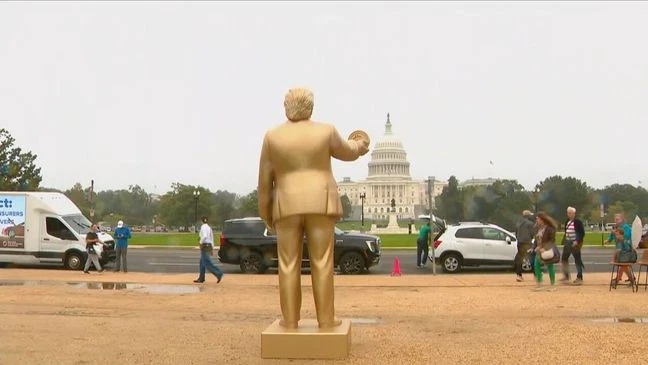
Beyond the spectacle, the statue underscores cryptocurrency’s entwinement with politics. Unveiled amid the Fed’s dovish pivot, it spotlights debates over central bank digital currencies (CBDCs), which Trump has vowed to veto. Economists note the rate cut could inject $100 billion into markets, bolstering assets like Bitcoin, now held by 15% of U.S. households per recent surveys. As the sculpture gleams against the Capitol’s marble facade, it prompts soul-searching: Is this a celebration of innovation or a commodification of leadership? In Trump’s America, where golden hues tint both triumphs and controversies, the answer glitters ambiguously.
Legacy in Bronze and Bytes: What Comes Next?
As the 72-hour permit ticks down, questions swirl about the statue’s fate. Organizers hint at a touring exhibition, eyeing stops at Nashville’s Bitcoin Conference and Trump’s Mar-a-Lago estate. Zaghdoudi envisions a permanent home in a proposed “Crypto Hall of Fame” museum, funded by DAO votes. Meanwhile, the artwork has spurred legislative chatter: House Republicans floated a bill for tax incentives on digital asset holdings, citing the statue’s “inspirational” timing.
In the grander scheme, this gilded giant signals crypto’s maturation from niche hobby to national imperative. Trump’s affinity—evident in his personal wallet’s rumored seven-figure BTC stash—positions him as a bridge between fiat orthodoxy and decentralized dreams. Detractors fear it heralds deregulation risks, like unchecked pump-and-dumps, but proponents argue it’s evolution: Just as gold rushes built empires, Bitcoin could forge a resilient economy.
As dawn broke on September 18, the statue endured, weathering morning dew and skeptical glances from commuting staffers. It stands not just as art, but as augury—a 12-foot prophecy that in the marketplace of ideas, the boldest bids win. Whether dismantled or deified, its gleam lingers, challenging America to reckon with the currencies that define its destiny. In the shadow of democracy’s dome, Trump’s golden grip on Bitcoin reminds us: Power, like value, is what we choose to hold.