
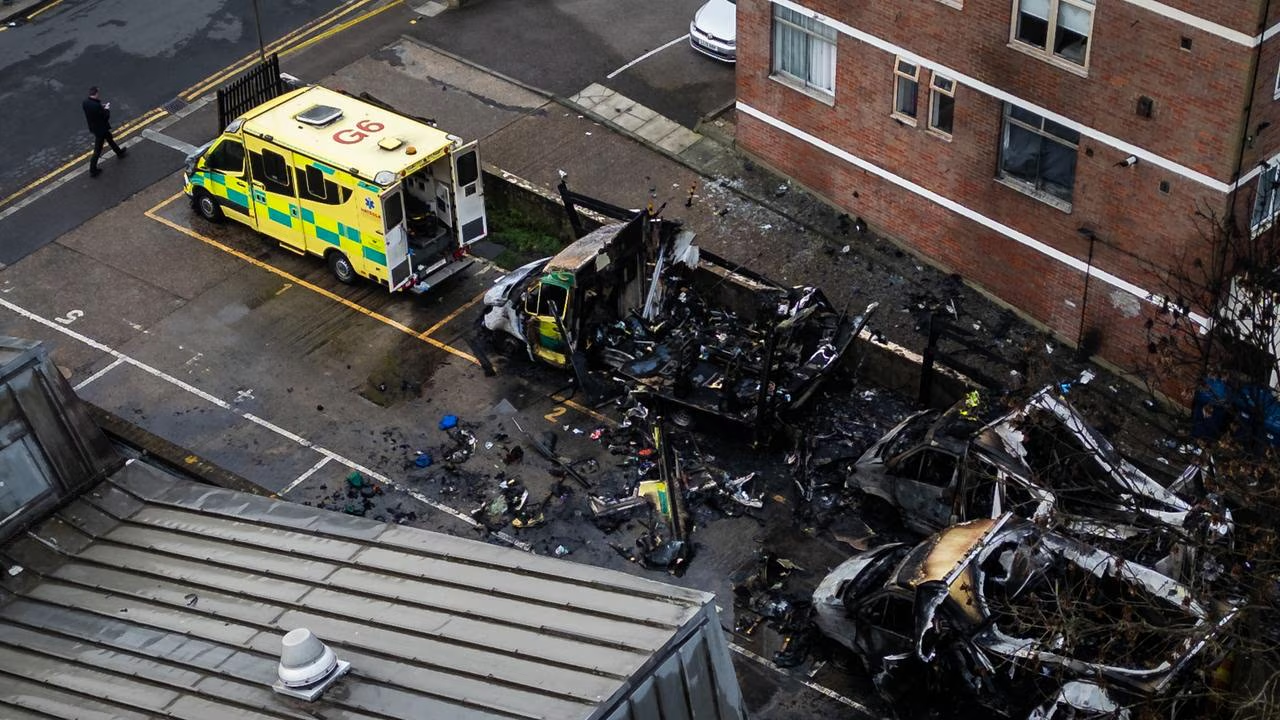
A disturbing incident in northwest London has drawn renewed attention to the evolving landscape of extremist threats in Europe. The arson attack on four Jewish community ambulances in Golders Green has not only shaken local residents but also raised broader concerns about coordinated antisemitic violence across multiple countries.
While authorities are still working to verify the claims, a relatively unknown group calling itself Harakat Ashab al-Yamin al-Islamia has emerged as a central focus of the investigation after circulating a statement and video online taking responsibility. The development has prompted security agencies and policymakers to examine whether this represents an isolated case of opportunistic extremism or part of a more structured and transnational campaign targeting Jewish communities.
Origins and Identity of Harakat Ashab al-Yamin al-Islamia
Harakat Ashab al-Yamin al-Islamia, often abbreviated as HAYI, appears to be a newly surfaced entity with little publicly documented history prior to the recent wave of incidents. Its name, translated as the “Islamic Movement of the Companions of the Righteous,” reflects ideological undertones that align with religiously framed militant narratives. Despite the lack of long-term visibility, early assessments from officials and analysts suggest that the group may not be entirely independent. Instead, it is suspected of having connections to broader networks that operate within a pro-Iranian geopolitical sphere.
One of the most notable aspects of HAYI’s emergence is the speed with which it has attempted to establish a digital presence. Its Telegram channel, reportedly created just days before the London incident, features a collection of videos and statements that claim responsibility for multiple attacks. These posts include unverified footage of explosions and surveillance-style imagery, indicating an effort to project operational capability and generate psychological impact. Such tactics are consistent with modern extremist strategies that prioritize online visibility and propaganda alongside physical acts.
Analysts have also pointed out similarities between HAYI’s branding and that of established Iranian-aligned militant groups. This includes visual elements such as logos and stylistic presentation, as well as naming conventions that echo known organizations. While these parallels do not constitute definitive proof of direct affiliation, they contribute to the growing suspicion that the group may function as part of a decentralized network rather than a standalone entity.
BREAKING 🔴🔴
— Open Source Intel (@Osint613) March 23, 2026
An IRGC terror group in the UK, called Ashab al-Yamin takes responsibility for torching 4 ambulances belonging to a Jewish volunteer EMT services in Golders Green, London last night.
The terrorists are on the loose.
The UK is dealing with a serious problem. pic.twitter.com/z728w4R17d
Another significant observation is the possibility that HAYI operates through loosely connected cells or individuals. Reports indicate that attacks attributed to the group may have been carried out by local actors acting under remote direction or inspiration. This model allows for flexibility and reduces the risk of centralized disruption, making it more difficult for law enforcement agencies to trace command structures or prevent future incidents. The use of such decentralized tactics has become increasingly common among groups seeking to expand their reach without maintaining a visible organizational footprint.
Claims of Responsibility and the Golders Green Attack
The arson attack in Golders Green has become the most high-profile incident linked to HAYI so far. The targeted vehicles belonged to a Jewish community ambulance service, and the deliberate nature of the act has led authorities to treat it as an antisemitic hate crime. Surveillance footage reportedly shows individuals pouring accelerant on the ambulances before setting them ablaze and fleeing the scene. The precision and coordination suggested by these actions have added to concerns about planning and intent.
Shortly after the incident, a video surfaced on HAYI’s Telegram channel claiming responsibility. The footage reportedly included a mix of mapping imagery, photographs of the targeted ambulances, and clips purporting to show the aftermath of the attack. While the authenticity of the video has not been confirmed, its production indicates a deliberate attempt to link the group’s identity to the event and amplify its message.
In its statement, the group claimed that its intended target extended beyond the ambulances themselves, referencing a nearby synagogue and framing the attack within a broader ideological narrative. The mention of political figures and international alignments in the statement further suggests that the group seeks to position its actions within a global context, rather than as isolated acts of local hostility. By doing so, it aims to reinforce a narrative of resistance or retaliation that resonates with its intended audience.

Authorities have been cautious in their response to these claims. While counterterrorism units are actively investigating the online material, officials have emphasized that verification is still ongoing. This measured approach reflects the challenges of distinguishing between genuine operational claims and opportunistic or fabricated assertions that are common in the digital age. Nonetheless, the seriousness of the incident has ensured that the possibility of an organized network is being thoroughly examined.
The psychological impact of the attack is also significant. By targeting emergency vehicles associated with a specific community, the perpetrators have sent a message that extends beyond physical damage. Such actions are often designed to instill fear, disrupt daily life, and create a sense of vulnerability among targeted populations. This aligns with broader patterns of intimidation that have been observed in similar incidents across Europe.
A Pattern of Attacks Across Europe
The Golders Green incident is not an isolated case in the narrative surrounding HAYI. The group has also claimed responsibility for several other attacks targeting Jewish sites in different European countries within a short timeframe. These include incidents in Belgium and the Netherlands, where synagogues and educational institutions were reportedly targeted with explosive devices and arson attempts. Although the details of these events vary and verification remains ongoing, the clustering of such claims has raised concerns about a coordinated campaign.
Read : 26-Year-Old Declan George-Candiani Jailed Over Possession of Extreme Right-Wing Terrorist Material
In one reported case, an explosion occurred at a synagogue in Belgium, while another incident involved an arson attack on a synagogue in Rotterdam. Additionally, a device was set off at a Jewish school in Amsterdam, causing damage but no reported casualties. Each of these incidents, if confirmed, reflects a pattern of targeting locations that hold symbolic and communal significance. This suggests an intent to maximize psychological impact and attract attention beyond the immediate site of the attack.

There are also indications that similar activities may have occurred in other parts of Europe, including Greece. While direct links have not been conclusively established, the possibility of a broader operational footprint is being taken seriously by authorities. The recurrence of similar tactics across multiple countries within a narrow timeframe points to either a coordinated effort or a shared source of inspiration and guidance.
Officials have described these developments as part of a “disturbing pattern,” emphasizing the need for increased vigilance and cooperation among European security agencies. The potential involvement of networks with international backing adds another layer of complexity to the situation. If such connections are confirmed, it would underscore the transnational nature of modern extremist threats and the challenges of addressing them through traditional law enforcement approaches.
Another key aspect of this pattern is the use of digital platforms to claim responsibility and disseminate content. By leveraging online channels, groups like HAYI can rapidly amplify their message, reach a global audience, and inspire copycat actions. This digital dimension has become a critical component of contemporary extremist activity, blurring the lines between physical operations and information warfare.
The broader implications of these incidents extend beyond immediate security concerns. They highlight the vulnerability of minority communities to targeted violence and the importance of robust protective measures. They also raise questions about the effectiveness of existing counterterrorism frameworks in addressing decentralized and digitally enabled threats. As investigations continue, the focus will likely remain on identifying the individuals involved, verifying the group’s claims, and determining whether a larger network is at play.
In the meantime, the emergence of Harakat Ashab al-Yamin al-Islamia serves as a reminder of how quickly new actors can appear in the extremist landscape. Whether it proves to be a short-lived entity or part of a more enduring structure will depend on the findings of ongoing investigations. What is already clear, however, is that the combination of targeted attacks, ideological messaging, and digital amplification has the potential to create significant disruption and fear, even when the group behind it remains largely unknown.