
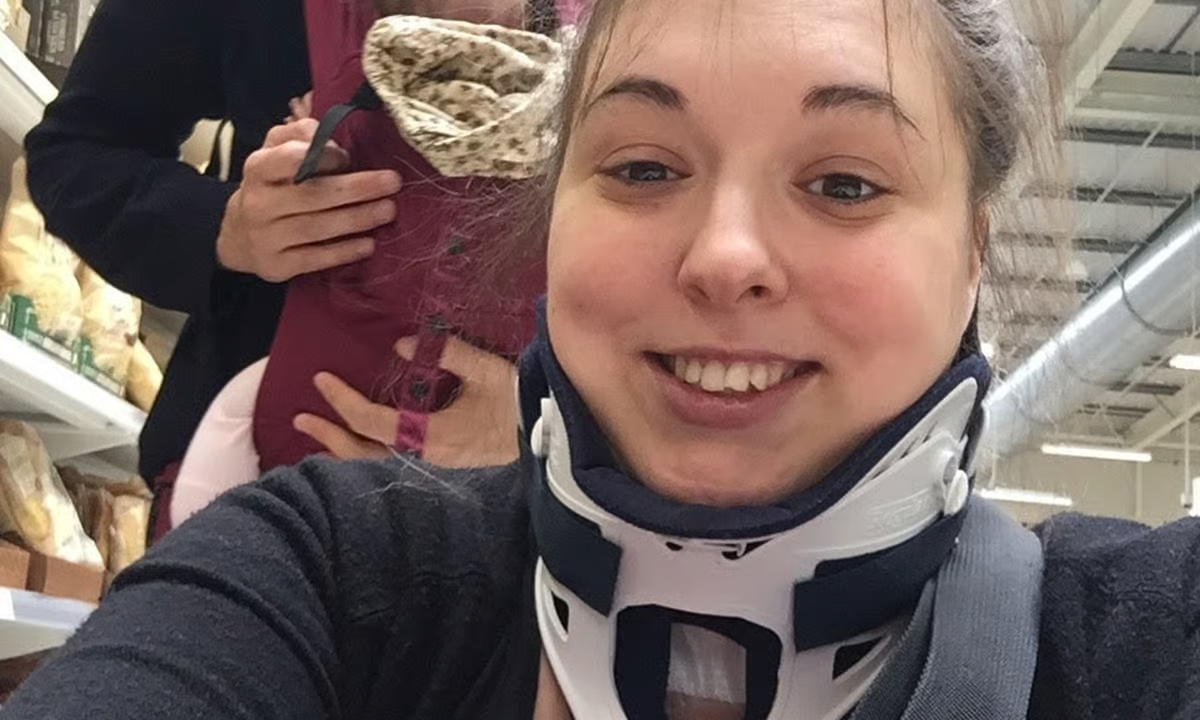
In the quiet hours of a typical morning, what begins as an innocent yawn can sometimes spiral into a life-altering nightmare. For Hayley Black, a 36-year-old mother of two from Milton Keynes, Buckinghamshire, one such moment unfolded in 2016, turning a routine start to her day into a harrowing battle for survival. As a former emergency call handler, Hayley was no stranger to high-stakes situations, but nothing could have prepared her for the moment when a simple yawn and stretch left her partially paralyzed, her neck fractured, and her future hanging in the balance. medical intervention, and the enduring impact on her life.
The Shocking Incident: A Morning Yawn Turns to Terror
Hayley Black’s story began on an ordinary early morning in 2016, when the world was still cloaked in pre-dawn darkness. At just 5 a.m., she stirred awake to tend to her newborn daughter, Amelia, who was fussing for her bottle. As any new parent knows, these moments are a blend of exhaustion and instinct, driven by the unbreakable bond between mother and child. Hayley Black, bleary-eyed but devoted, glanced over at little Amelia, who let out a wide, contagious yawn—a sight that tugged at her heartstrings.
“They say yawns are contagious,” Hayley later recounted in her emotional TikTok video, her voice steady but laced with the weight of memory. “I woke up at 5 a.m. and looked over and saw my daughter yawning. Instinctively, I yawned and stretched to get up and make her a bottle.” It was a gesture so mundane, so universal, that Hayley Black never imagined it could unravel her world. But in that split second, as her jaw stretched wide and her neck extended backward in a deep arch, something catastrophic occurred deep within her cervical spine.
What Hayley Black describes next is the stuff of nightmares: an “immediate electric shock sensation” that ripped through half her body, starting from her neck and surging down her right side like a bolt of lightning. Her right arm froze mid-air, locked in an unnatural position, as waves of excruciating pain radiated through her limbs. “It was like having a seizure down half of my body,” she shared.
“I jumped up in shock, but I couldn’t move properly. My arm got stuck in the air, and these electric spark sensations kept firing off.” Panic set in almost immediately. Hayley Black, drawing on her professional background in emergency services, recognized the gravity of the situation. She wasn’t just in pain; her body was betraying her in ways that screamed neurological emergency.
Desperate and terrified, Hayley Black turned to her husband, Ian Black, a 39-year-old steadfast partner who was roused from sleep by her cries. “Call an ambulance,” she urged him, her voice trembling with urgency. Ian, initially dismissing it as possible overreaction amid the sleep-deprived haze of new parenthood, soon realized the severity as Hayley’s symptoms intensified. Her right side began to go numb, her movements sluggish and uncoordinated. Within minutes, paramedics arrived, stabilizing her as best they could and rushing her to the nearest hospital. Little Amelia, oblivious to the chaos, was handed off to Ian, who was left grappling with the sudden shift from family routine to crisis mode.
Read : 51 Incredible Benefits of Eating Yogurt Daily
At the hospital, the initial assessment painted a deceptively calm picture. Standard scans showed no obvious fractures or anomalies, leading some medical staff to question whether Hayley was exaggerating her symptoms—a skepticism that stung deeply given her expertise in the field. “Nobody was listening to me,” Hayley recalled. “I was screaming in pain all night. They gave me medication for pain and gas and air, but it wasn’t enough. I was trying to hit myself in the head to knock myself out because I was in so much agony.”
Trapped in a body that refused to cooperate, Hayley Black lay there, her right side increasingly paralyzed, as hours ticked by in a blur of frustration and fear. It wasn’t until advanced imaging—more detailed MRIs and CT scans—were ordered that the horrifying truth emerged: the forceful yawn had caused two vertebrae in her neck, specifically the C6 and C7 bones, to “shoot forward” into her spinal cord, crushing it and fracturing her neck in a freak misalignment.

This condition, known medically as a cervical subluxation or dislocation, is exceedingly rare but devastating when it occurs. The spinal cord, that vital highway of nerves running through the vertebrae, had been compressed to the point of partial paralysis on her right side. Hayley Black could no longer feel or control much of her arm and leg, a terrifying limbo that amplified her maternal instincts—she worried not just for herself, but for the family she might never fully embrace again. As news of her condition spread quietly among the medical team, the atmosphere in the ward shifted from doubt to urgency. Hayley was prepped for what would become the fight of her life.
Emergency Surgery: A 50/50 Gamble for Survival
With the diagnosis confirmed, the medical team wasted no time. Hayley Black was wheeled into emergency surgery, a high-stakes procedure to realign the displaced vertebrae and relieve the pressure on her spinal cord. The surgeon, pulling aside Ian and Hayley’s mother for a grim consultation, delivered the news with clinical precision: “It was worse than they had thought,” Hayley later paraphrased.
“They gave me a 50/50 chance—not just of walking again, but of surviving the surgery at all.” The operation involved meticulously maneuvering the fractured C6 and C7 vertebrae back into place, fusing them with hardware to prevent further slippage, all while navigating the delicate spinal cord that controlled her every movement and sensation.
The procedure was a marathon of tension, lasting several grueling hours under anesthesia. Risks abounded: infection, further nerve damage, or even complete paralysis if the cord was nicked. For Hayley, slipping into unconsciousness was both a mercy and a terror; she later admitted to fleeting thoughts of her children—Amelia, then just months old, and her older son Archie, aged five at the time—as the drugs took hold. Ian paced the waiting room, clutching photos of his family, while Hayley’s mother whispered prayers for a miracle.
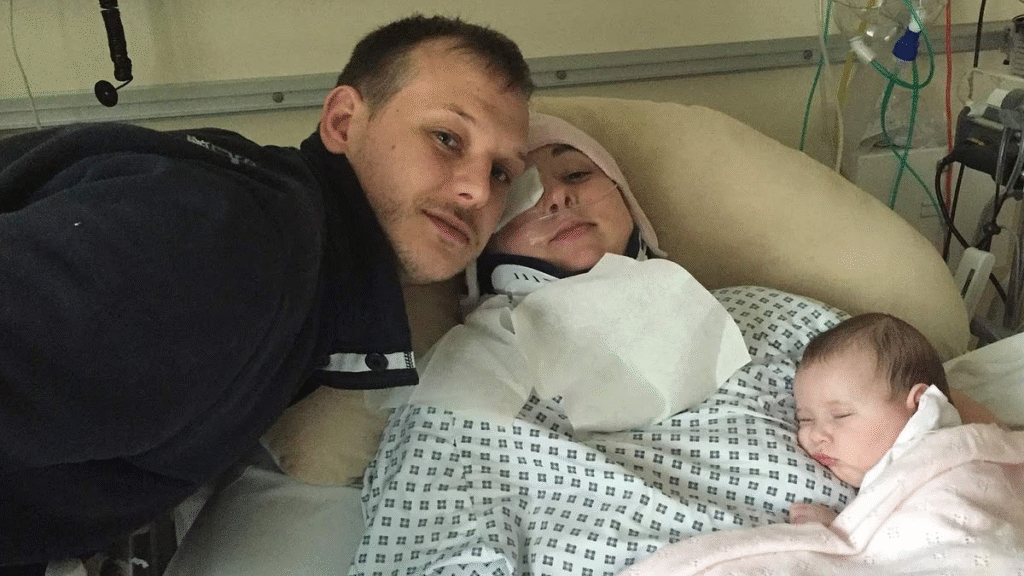
When Hayley finally awoke in recovery, groggy and disoriented, the initial relief washed over her like a tide. “When I woke up, I’d had emergency surgery, and they told me they’d managed to restore all my functions,” she said, her voice cracking with gratitude even years later. The paralysis had lifted; she could wiggle her toes, flex her fingers, and feel the gentle pressure of Ian’s hand in hers. It was, in the words of her medical team, nothing short of a miracle. The fusion had held, the cord was decompressed, and vital signs stabilized.
But as the anesthesia wore off, so did the full scope of the trauma sink in. A prominent scar now traced her neck, a permanent badge of her brush with death, and the knowledge that her spine would never be the same. Post-surgery, Hayley spent weeks in rehabilitation, relearning the simplest tasks amid a cocktail of painkillers and physiotherapy sessions. The hospital staff, now her staunchest advocates, monitored her closely for complications like blood clots or infections. Ian juggled work, childcare, and hospital visits, becoming her rock in a storm that threatened to upend their lives.
“I’m so lucky, but I’m still really traumatized,” Hayley reflected. The surgery had saved her mobility, but it couldn’t erase the what-ifs that haunted her nights. How had a yawn—a biological reflex meant to oxygenate the brain—unleashed such destruction? Medical experts later explained it as an extreme case of hyperextension injury, where underlying spinal vulnerabilities, perhaps from posture or minor degeneration, met an unlucky force. For Hayley, though, the why mattered less than the will to move forward.
Lasting Scars: Living with Permanent Spinal Damage
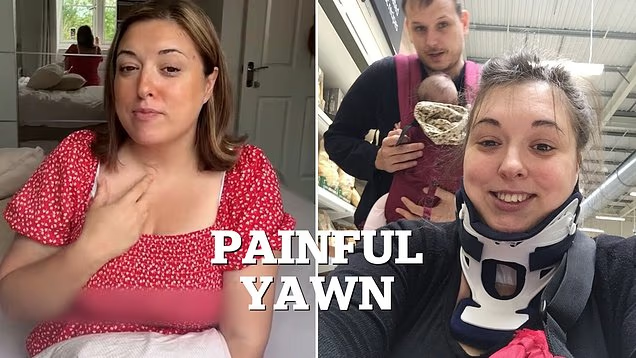
Nine years on, Hayley’s life bears the indelible marks of that fateful yawn. While she walks unaided and chases after her now nine-year-old Amelia and 14-year-old Archie, the victory is bittersweet. The spinal fusion has left her with chronic compression, a condition that manifests in daily battles against pain and limitation. “My spine is now compressed,” she explains matter-of-factly in her TikTok clip, overlaying footage of her younger self in a neck brace cradling newborn Amelia. “I developed fibromyalgia as a result, which causes chronic pain and fatigue.”
Fibromyalgia, a disorder amplifying musculoskeletal pain through the central nervous system, has woven itself into her routine, turning ordinary activities into calculated efforts. Simple joys, like a full night’s sleep or a spontaneous hug, come with caveats. Hayley Black admits to a deep-seated phobia of yawning: “I can’t yawn without panic. Every time I feel one coming, I try to stifle it. It still affects me every single day.” This involuntary reflex, once innocuous, now triggers flashbacks of that electric shock, sending her heart racing and her body tensing in anticipation of pain.
She’s adapted with mindfulness techniques, learned in therapy, and a custom orthotic collar for flare-ups, but the psychological toll lingers. As a mother, the incident reshaped her priorities; she savors every milestone with her children, from school plays to family hikes, knowing how close she came to missing them.
Hayley Black’s story, shared vulnerably on social media, has resonated far beyond her living room. The video, captioned simply “I broke my neck yawning,” has sparked conversations about invisible injuries and the importance of trusting one’s instincts in medical settings. Viewers flood the comments with empathy, sharing their own tales of dismissed symptoms, while Hayley responds with quiet strength: “I thank the surgeons every day with the fact I’m here to be with my children and do the things that I can do. The fact I’m not in a wheelchair is a miracle, and I’m eternally grateful.”
Yet, in quieter moments, Hayley Black grapples with the permanence of it all. Her career as an emergency call handler, once a source of purpose, had to be set aside due to the ongoing pain, leading her to pivot toward advocacy and creative outlets like TikTok. With Ian’s unwavering support, she’s built a life of resilience, but the scar on her neck serves as a daily talisman—a reminder that life’s fragility can strike in the blink of an eye, or the stretch of a yawn. Hayley’s journey isn’t one of flawless recovery but of fierce adaptation, a testament to the human spirit’s capacity to endure. As she continues to share her truth, she hopes to empower others: listen to your body, advocate fiercely, and never underestimate the power of a single breath.
My brother suggested I might like this website He was totally right This post actually made my day You cannt imagine just how much time I had spent for this information Thanks