

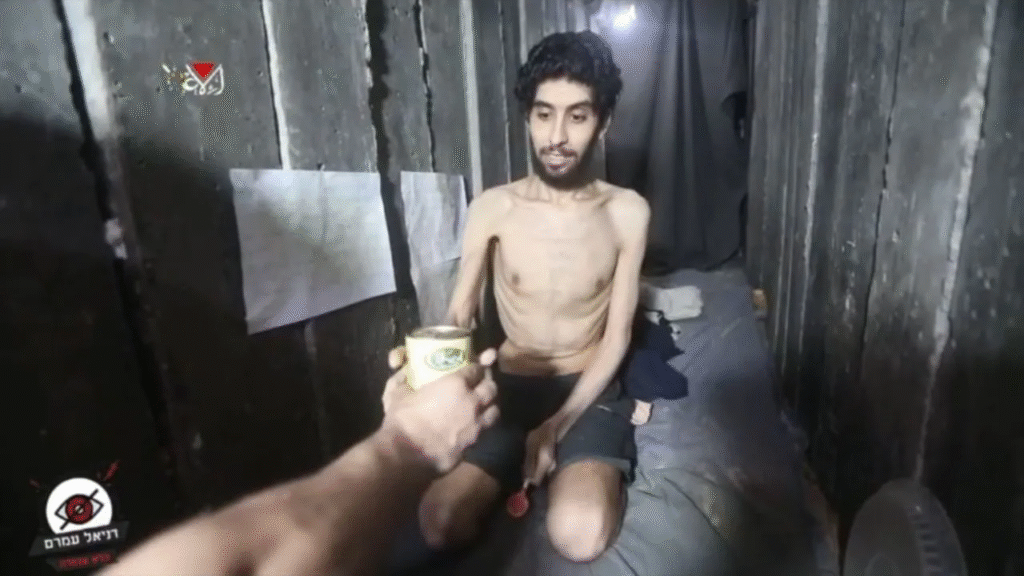
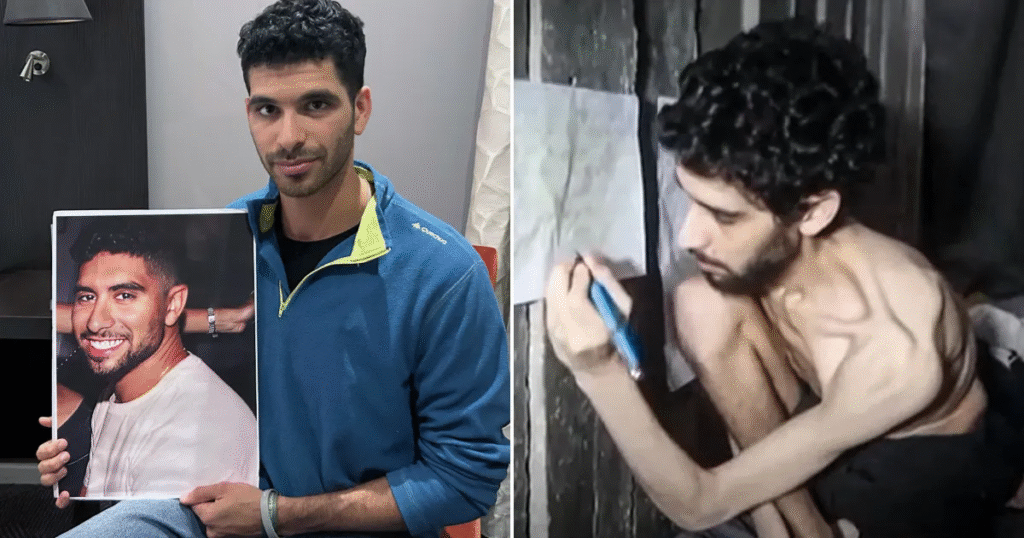
The face of war is rarely as hauntingly humanized as in the latest video released by Hamas—a clip that shows a visibly emaciated young man, identified as 24-year-old Israeli hostage Evyatar David, digging his own grave in a dark tunnel in Gaza. Speaking in weak, trembling Hebrew, David says, “What I’m doing now is digging my own grave… Every day my body becomes weaker.” The starkness of this footage has sent waves of shock, sorrow, and outrage throughout Israel and the international community.
David was kidnapped on October 7, 2023, during the brutal assault by Hamas militants on the Nova music festival in southern Israel. That day marked one of the darkest chapters in recent Israeli history, with over 1,200 people killed and more than 240 individuals abducted by Hamas. For nearly two years, David has remained in captivity under inhumane conditions in the tunnels of Gaza, a symbol of the prolonged agony endured by many families whose loved ones were taken.
A Living Skeleton in Gaza’s Underground Tunnels
The most recent footage of David marks the second such video circulated within 48 hours, showing a man whose body has clearly wasted away. His appearance—skeletal, frail, and barely able to speak—has drawn global concern. In the video, he is seen in an underground tunnel, weakly wielding a shovel, his voice faint as he utters the heartbreaking truth: he is digging his own grave.
“What I’m doing now is digging my own grave,” he says. “I’m walking directly to my grave. There is the grave where I am going to be buried. Time is running out to be released and sleep in my bed with my family.”
These words are not just a cry for help; they are a chilling reminder of the physical and psychological torment that hostages endure in captivity. His family has issued a public plea, describing him as a “living skeleton, buried alive” in Gaza’s underground network. They beg the Israeli government and international actors to act before it’s too late.
Hamas released a video showing an Israeli hostage being forced to dig his own grave. #Hamas #Israel #hostage pic.twitter.com/flj6IZdyZb
— Observer(互fo互❤️) (@BLiang75609) August 4, 2025
The release of such footage, while likely intended to exert psychological pressure, has reignited a national and global outcry for the release of the remaining hostages—49 of whom, according to Israeli authorities, are still believed to be held in Gaza. For many in Israel, David’s image in the tunnel has become the face of the hostage crisis: gaunt, terrified, and on the edge of death.
The Aftermath of October 7 and the Prolonged Gaza War
The October 7, 2023 attack by Hamas was unprecedented in scale and brutality. Militants stormed into southern Israel from the Gaza Strip, launching coordinated assaults on border communities and civilian gatherings, including the Nova music festival. What followed was a bloodbath that left 1,219 Israelis dead and triggered one of the longest and deadliest conflicts between Israel and Hamas in history.
Read : 23-year-old Dominic Garcia Held Girlfriend’s Family Hostage for 6 Months Over Fake Cartel Threat
Since that day, Israel has carried out a sustained military campaign against the Gaza Strip, aimed at dismantling Hamas’s infrastructure and rescuing the hostages. But the toll of this war has been catastrophic. According to local health officials in Gaza, more than 60,000 people have been killed as of August 2025. The destruction has been widespread, displacing hundreds of thousands and reducing entire neighborhoods to rubble.
Humanitarian access has been severely restricted. Since March 2, aid agencies have reported near-total blockades, and food and medical supplies are running out. Children are dying from hunger, starvation, and malnutrition, as reported by United Nations agencies. At aid distribution centers, violence has become common. Israeli military forces have been accused of opening fire during aid operations, killing civilians trying to access food.
Amid this chaos, the plight of the hostages has been somewhat eclipsed by the broader devastation. Yet, with the release of videos like that of Evyatar David, public attention has once again shifted to those still trapped underground, suffering in silence.
A Pattern of Psychological Warfare and Desperation
The strategy behind releasing hostage videos is not new. Militants often use such footage to instill fear, sow division, and gain leverage in negotiations. The release of Evyatar David’s video, alongside that of another hostage—21-year-old Rom Braslavski—appears to follow this logic.
Braslavski, too, appeared in a recent video, looking pale and exhausted as he begged for help. His family says he is starving and has been denied access to necessary medical treatment. “He has been broken,” they said in a public statement.
The emotional toll on the families of the hostages cannot be overstated. They live with daily uncertainty, torn between hope and despair. Every new piece of footage brings both a strange sense of relief—their loved ones are still alive—and unimaginable pain at seeing them suffer. Rallies and demonstrations have become common in Israeli cities, with families demanding more action from the government.
Some Israelis accuse the government of prioritizing military goals over the lives of the remaining hostages. Others defend the ongoing campaign, saying that Hamas cannot be allowed to continue operating with impunity. This tension has fed into a broader national debate over the ethics and effectiveness of the current war strategy.
Meanwhile, inside Gaza’s underground tunnels, time continues to tick for hostages like Evyatar David.
The International Response and Growing Pressure
International response to the hostage crisis has been mixed. While countries like the United States, Germany, and France have publicly called for the immediate release of all hostages, tangible diplomatic progress has been slow. Qatar and Egypt have served as intermediaries in past hostage releases, but negotiations have frequently stalled due to deep mistrust and shifting demands.
Rights groups and humanitarian agencies are increasingly vocal about the situation. Amnesty International and Human Rights Watch have both condemned the use of hostages as bargaining chips. At the same time, these groups also criticize Israel for its disproportionate military response, which they say amounts to collective punishment of Gaza’s civilian population.
The United Nations has repeatedly urged for a ceasefire, calling the humanitarian conditions in Gaza catastrophic. But resolutions are often blocked in the UN Security Council due to geopolitical divisions. Meanwhile, the suffering continues—both above ground in Gaza’s destroyed neighborhoods and below in its dark, suffocating tunnels.
Will Evyatar David Be Saved?
As the image of a young man digging his own grave spreads across media platforms, one question echoes louder than any other: Can Evyatar David be saved before it’s too late?
His video is not just a glimpse into personal despair; it’s a broader metaphor for a region trapped in cycles of violence, retribution, and political failure. It reflects the human cost of decisions made in war rooms and cabinet meetings. David is a symbol not only of Israeli suffering but of the shared torment of both Palestinians and Israelis caught in a conflict that has gone on for generations.
Every day that passes makes rescue more difficult. Every day without food or medicine chips away at his strength. His faint plea—”Time is running out to be released and sleep in my bed with my family”—should not be dismissed as mere performance. It is a dying man’s final hope.
Whether that hope can be fulfilled will depend on political will, military capabilities, and a measure of compassion on all sides. But for now, the world watches helplessly as another life hangs in the balance, buried not just by dirt but by a conflict that shows no signs of ending.