
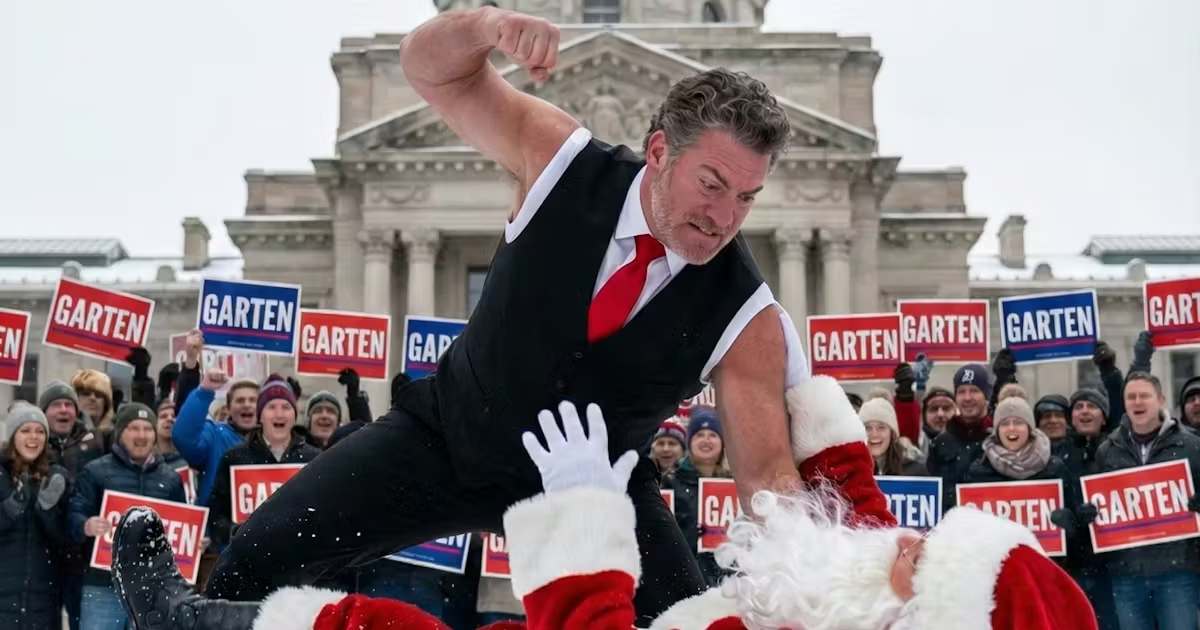
Indiana Senate Majority Floor Leader Chris Garten drew widespread attention and criticism on Christmas Day after posting a series of AI-generated images depicting himself violently attacking Santa Claus on the steps of the Indiana Statehouse. The images, shared on X early on Christmas morning, showed the Republican lawmaker portrayed with exaggerated muscular features, physically assaulting the traditional holiday figure in various poses, including kicking Santa down stone steps, pinning him to the ground while punching him, and leaping into what appeared to be a wrestling-style elbow drop.
In another image, Chris Garten is shown riding bareback on a reindeer, fist raised in the air, flanked by supporters holding campaign-style signs marred by visible AI-generated spelling errors.
Accompanying the images was a politically charged caption in which Chris Garten framed the violent holiday imagery as a metaphorical rejection of what he described as bureaucratic intrusion. “When you find out the North Pole is trying to bring more bureaucratic overreach & unfunded mandates down the chimney disguised as ‘Christmas cheer.’ Not on my watch. We The People run Indiana, not the bureaucrats,” Garten wrote. He concluded the post with, “Take it back to the North Pole big guy. Merry Christmas, Hoosiers!”
The post quickly circulated across social media platforms, prompting sharp reactions from constituents, political observers, and critics who questioned the appropriateness of violent imagery, particularly involving a universally recognized cultural figure, shared by a senior state leader on a major holiday. While some supporters defended the post as satire or political humor, others argued that it reflected a broader trend of increasingly aggressive political messaging amplified by artificial intelligence tools.
The Content and Context of the AI-Generated Images
The images posted by Chris Garten were unmistakably artificial in nature, with visual distortions common to generative AI, including exaggerated musculature, inconsistent facial features, and misspelled slogans on signs held by background figures. Despite their obvious fabrication, the scenes depicted clear acts of violence. In one image, Santa Claus is shown tumbling backward down the snowy steps of the Indiana Statehouse as Garten delivers a kick. In another, Santa is pinned to the ground as Garten throws a punch. A third depicts Garten midair, descending toward Santa in a dramatic elbow drop, evoking professional wrestling theatrics rather than subtle satire.
The setting of the Indiana Statehouse grounds further anchored the imagery in real political space, blending fictional violence with an identifiable seat of government. This choice intensified reactions, as critics argued that associating violent imagery with public institutions risks normalizing hostility within civic life. The decision to publish the post on Christmas Day, a holiday typically associated with goodwill, generosity, and family traditions, also contributed to the backlash.
Chris Garten’s caption made clear that the images were intended as a symbolic political statement rather than a literal threat. By portraying Santa Claus as an agent of “bureaucratic overreach,” Garten repurposed the holiday figure into a stand-in for federal or institutional authority. The reference to “unfunded mandates” echoed language commonly used in conservative critiques of government policy, suggesting the images were designed to resonate with a politically aligned audience.
When you find out the North Pole is trying to bring more bureaucratic overreach & unfunded mandates down the chimney disguised as "Christmas cheer." Not on my watch. We The People run Indiana, not the bureaucrats.
— Chris Garten (@Sen_ChrisGarten) December 25, 2025
Take it back to the North Pole big guy. Merry Christmas,… pic.twitter.com/iZDsl1DME0
Nevertheless, the use of violence as a visual metaphor raised concerns even among those familiar with sharp-edged political satire. Critics noted that while exaggerated political cartoons have long been a feature of American discourse, the realism enabled by AI-generated imagery blurs the line between caricature and simulated physical harm. The increasingly accessible nature of such tools has prompted broader debates about ethical boundaries, especially when used by public officials with large followings.
Political Reactions and Public Response
Reaction to Garten’s post was swift and polarized. On social media, some users applauded the senator for what they described as irreverent humor and a bold stand against government bureaucracy. Supporters framed the images as intentionally absurd, arguing that no reasonable viewer would interpret them as endorsing real violence. Several defended the post as no different from provocative political cartoons or memes that have circulated for decades.
However, many responses were sharply critical. Detractors accused Chris Garten of trivializing violence and undermining the dignity of his office. Some questioned whether depicting physical assault, even against a fictional character, was appropriate conduct for a senior legislative leader. Others expressed concern about the broader implications of elected officials embracing violent imagery at a time of heightened political polarization.
Read : Australian Senator Pauline Hanson Faces Backlash for Wearing Burqa in Parliament
The fact that the images were AI-generated added another layer to the controversy. Artificial intelligence has increasingly been used in political communication, from campaign ads to satirical content, but its capacity to produce hyper-realistic scenes has raised alarms about misinformation and the erosion of trust. While Chris Garten did not attempt to present the images as real, critics argued that normalizing AI-generated violence contributes to a culture in which fabricated visuals can be weaponized more maliciously.

Some political observers noted that the post fit into a wider pattern of confrontational messaging aimed at energizing partisan bases through outrage and spectacle. By combining holiday symbolism, populist rhetoric, and exaggerated physical dominance, the images were seen by analysts as a calculated effort to project strength and defiance. Whether intentional or not, the resulting attention ensured that the post reached far beyond Garten’s usual audience.
Within Indiana political circles, reactions were more muted publicly, though several commentators suggested privately that the episode risked distracting from legislative priorities. As Majority Floor Leader, Garten holds a significant role in shaping the state Senate’s agenda, and critics argued that such controversies could undermine public confidence in state governance. No formal disciplinary action was announced in response to the post, and Garten did not issue a public apology or clarification in the immediate aftermath.
AI, Political Messaging, and the Escalation of Symbolic Violence
The incident involving Chris Garten underscores the evolving role of artificial intelligence in political communication and the challenges it presents for ethical standards. AI image generators allow users to create vivid, detailed scenes with minimal technical skill, dramatically lowering the barrier to producing provocative content. For politicians, this capability offers both opportunity and risk, enabling rapid engagement while amplifying the potential for backlash.
Read : Senator Alex Padilla Forcibly Removed, Handcuffed, and Pinned to the Ground at DHS News Conference
Historically, political imagery has relied on illustration, caricature, or metaphor to convey critique. The transition from hand-drawn cartoons to AI-generated scenes marks a significant shift in tone and impact. Unlike traditional cartoons, AI images can simulate photographic realism, making depictions of violence feel more immediate even when they are clearly fictional. This realism can intensify emotional responses and blur the distinction between satire and simulated aggression.
The use of Santa Claus as a target also carries cultural significance. Santa is widely regarded as a symbol of generosity, childhood innocence, and seasonal goodwill rather than political authority. By recasting the figure as an agent of bureaucratic intrusion, Garten’s imagery deliberately subverted these associations. Critics argued that this choice risked alienating audiences who view holiday traditions as apolitical and unifying, while supporters saw it as an effective way to dramatize ideological opposition.
Beyond the specific content, the episode highlights the absence of clear norms governing AI use by public officials. While campaign finance laws, advertising standards, and ethical guidelines exist for traditional media, AI-generated content occupies a relatively unregulated space. As more politicians experiment with these tools, questions arise about responsibility, transparency, and the potential normalization of violent symbolism in public discourse.
The Garten post also reflects broader tensions within contemporary politics, where performative displays increasingly compete with substantive policy discussion for attention. In an environment driven by engagement metrics and viral potential, provocative imagery can overshadow nuanced debate. Critics worry that this dynamic incentivizes escalation, pushing political actors toward ever more extreme representations to capture public attention.
As artificial intelligence continues to reshape communication, incidents like this serve as case studies in both the power and peril of new technologies. Whether viewed as tasteless satire or calculated provocation, Chris Garten’s Christmas Day post demonstrates how quickly AI-generated imagery can ignite controversy and force a reckoning with the boundaries of acceptable political expression in the digital age.
If you just wanna chill and play a simple game, then y8888game is the site for you! Check it out and see if it’s your jam: y8888game. You might just like it.