
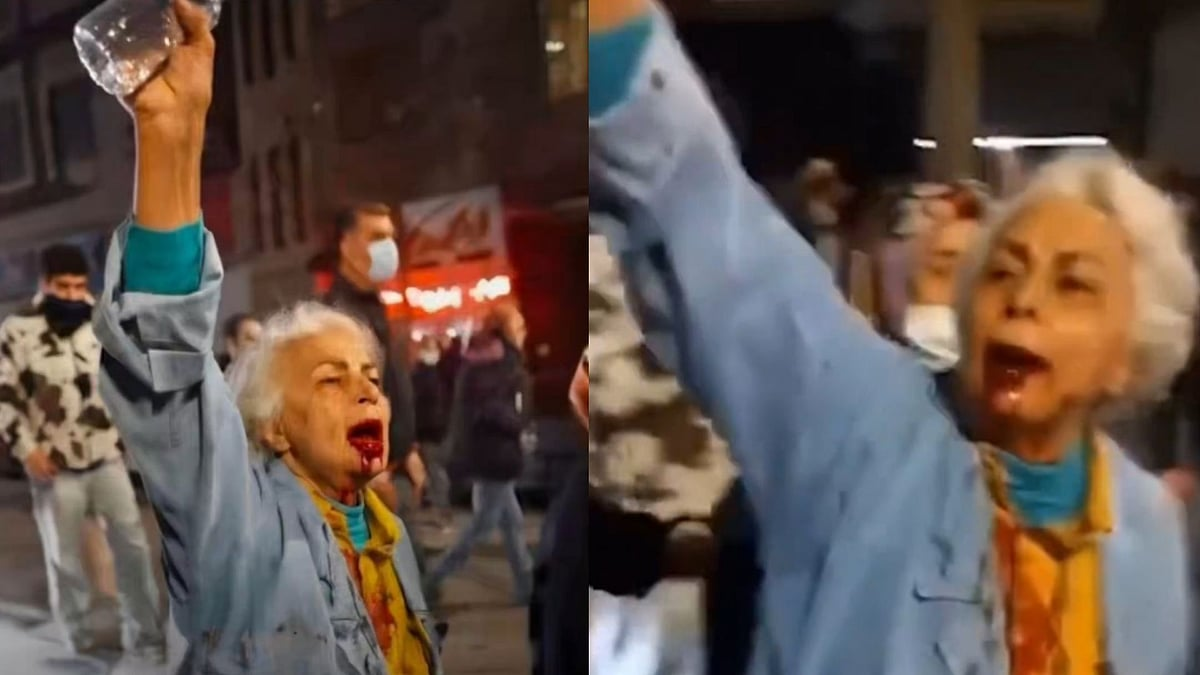
A short but harrowing video emerging from Iran has captured global attention, crystallizing the intensity of the country’s latest wave of unrest. In the clip, an elderly woman walks forward through a public space, blood visible on her mouth, as she confronts security forces and passers-by without hesitation. Her defiance is not expressed through slogans alone but through a stark declaration that has resonated far beyond Iran’s borders: “I’m not afraid. I’ve been dead for 47 years.”
Shared widely on social media and amplified by activists and journalists in exile, the footage has become a potent symbol of accumulated anger, exhaustion, and resistance among Iranians who have lived their entire adult lives under the Islamic Republic. The video’s impact lies not only in its visceral imagery but also in how it encapsulates decades of political repression, economic hardship, and social control that have fueled repeated cycles of protest since the 1979 Islamic Revolution.
A Statement Rooted in Revolution and Loss
The woman’s words have been widely interpreted as a reference to the Islamic Revolution of 1979, which took place 47 years ago and fundamentally reshaped Iran’s political and social order. That revolution overthrew Shah Mohammad Reza Pahlavi, ending a monarchy that was closely aligned with Western powers, and replaced it with a Shiite Islamic republic under the leadership of Ayatollah Ruhollah Khomeini. For supporters at the time, the revolution promised independence, justice, and dignity. For many others, particularly women, minorities, and political dissidents, it marked the beginning of a long period of curtailed freedoms and state-enforced ideology.
By declaring herself “dead” for 47 years, the woman in the video appears to be articulating a sense of life lived without agency or voice since the establishment of the current system. Her statement suggests that fear has lost its power because everything meaningful was taken long ago. This framing has struck a chord with many Iranians who see their own lives reflected in her words, especially those who have endured decades of compulsory dress codes, censorship, surveillance, and punishment for dissent.
The video was shared prominently by Iranian-American journalist and activist Masih Alinejad, a longtime critic of the Islamic Republic who has documented women’s resistance to mandatory hijab laws and other forms of repression. Alinejad described the footage as a raw expression of public frustration, writing that it represents the voice of a woman who has reached the limits of endurance. Her commentary framed the moment as part of a broader awakening, arguing that people rise when they believe they have nothing left to lose.
Last night in Iran, during protests against the Islamic Republic,
— Niyak Ghorbani (نیاک) (@GhorbaniiNiyak) January 8, 2026
a woman with blood on her mouth said:
‘I am not afraid. I am not afraid.
At forty-seven, I have already died.’ pic.twitter.com/4yKjDdgggL
Beyond individual interpretation, the scene reflects a pattern seen repeatedly in Iran’s protest movements: ordinary citizens, often with no formal leadership role, becoming powerful symbols through spontaneous acts of courage. From students and workers to grieving mothers and elderly women, these figures have come to embody resistance precisely because they stand outside traditional political structures. Their defiance challenges the state’s narrative that protests are driven solely by foreign interference or organized opposition groups.
Escalating Crackdown and the Mechanics of Control
The viral spread of the video coincides with a renewed and intensified crackdown by Iranian authorities. As demonstrations have grown in frequency and intensity, the government has responded with familiar tools of repression, including mass arrests, lethal force, and restrictions on communication. Reports indicate that internet access has been curtailed in multiple regions, while international telephone calls have been cut or severely limited, isolating protesters from the outside world and making independent verification of events more difficult.
These measures are not new. Iran has repeatedly shut down or throttled internet access during periods of unrest, most notably during nationwide protests in 2019 and again in subsequent waves of demonstrations. Such blackouts serve a dual purpose: they hinder coordination among protesters and prevent graphic images and videos from reaching international audiences. The fact that the elderly woman’s video still managed to circulate widely underscores both the persistence of activists and the limits of state control in an era of decentralized digital communication.
The current protests have also been marked by calls to action from figures outside the country. Iran’s exiled crown prince, Reza Pahlavi, has urged citizens to engage in nighttime demonstrations, including shouting slogans from windows and rooftops, a tactic historically used to signal dissent while reducing immediate risk. In several areas, residents reportedly responded to these calls, with some gatherings escalating into street protests despite the heavy presence of security forces.
According to reports from human rights organizations such as Iran Human Rights (IHR), more than 1,000 people have been arrested nationwide during the latest unrest. In one particularly deadly incident in Ilam province, at least six protesters were reportedly killed in a single day. While Iranian authorities often dispute casualty figures or attribute deaths to other causes, the cumulative toll of past crackdowns lends credibility to concerns raised by rights groups.
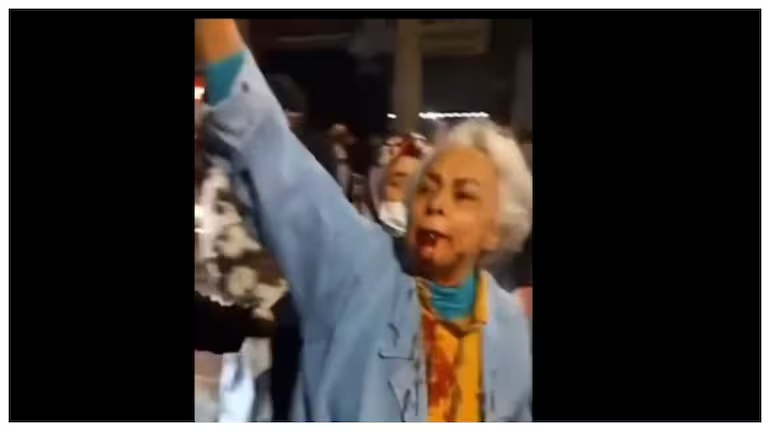
The image of an elderly woman bleeding yet advancing toward security forces highlights the asymmetry between state power and individual protest. It also complicates official narratives that portray demonstrators as violent agitators. Instead, it draws attention to the human cost of repression and the extent to which even those least likely to pose a physical threat are willing to confront authority openly.
Economic Desperation and the Broadening of Protest
While political repression remains a central grievance, the current wave of protests is also deeply rooted in economic distress. Iran’s economy has been battered by years of international sanctions, domestic mismanagement, and corruption. Inflation has soared, eroding purchasing power and pushing basic necessities out of reach for many households. The national currency has lost significant value, and the cost of food, housing, and fuel has risen sharply, intensifying everyday hardship.
These economic pressures have created fertile ground for unrest, particularly among working-class communities and retirees who rely on fixed incomes. In recent years, protests have erupted over delayed wages, pension shortfalls, water shortages, and rising fuel prices. What distinguishes the current moment is the way these economic grievances have merged with broader political demands, transforming localized protests into wider anti-government demonstrations.
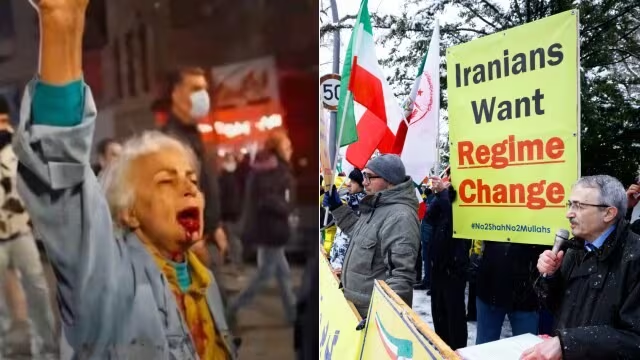
The woman in the video can be seen as a representative of this convergence. As an elderly individual, she likely belongs to a generation that lived through the revolution, the Iran-Iraq War, and decades of sanctions and isolation. Her visible injuries suggest recent confrontation, while her words point to a lifetime shaped by the consequences of political decisions made long ago. This intergenerational dimension adds depth to the protests, countering the notion that dissent is limited to youth or urban elites.
International reaction to the video has been swift, with commentators and activists describing it as evidence of “actual resistance” and a reminder of the risks faced by protesters inside Iran. At the same time, geopolitical tensions continue to shape responses from governments, many of which balance expressions of concern with strategic considerations related to regional stability, nuclear negotiations, and energy markets.
Within Iran, the spread of such imagery can have unpredictable effects. On one hand, it may inspire others to overcome fear and join demonstrations. On the other, it can provoke harsher repression as authorities seek to deter what they perceive as growing defiance. Historically, cycles of protest and crackdown have alternated without producing immediate systemic change, yet each wave leaves a lasting imprint on public consciousness.
The elderly woman’s march, captured in a brief and chaotic clip, does not offer a roadmap for Iran’s future. What it does provide is a stark snapshot of a society under strain, where decades of accumulated grievances can erupt in moments of raw, personal defiance. As protests continue and the state responds with force, the image of a bloodied woman declaring herself unafraid stands as a reminder that beneath statistics and political analysis lie individual lives shaped by history, courage, and loss.