
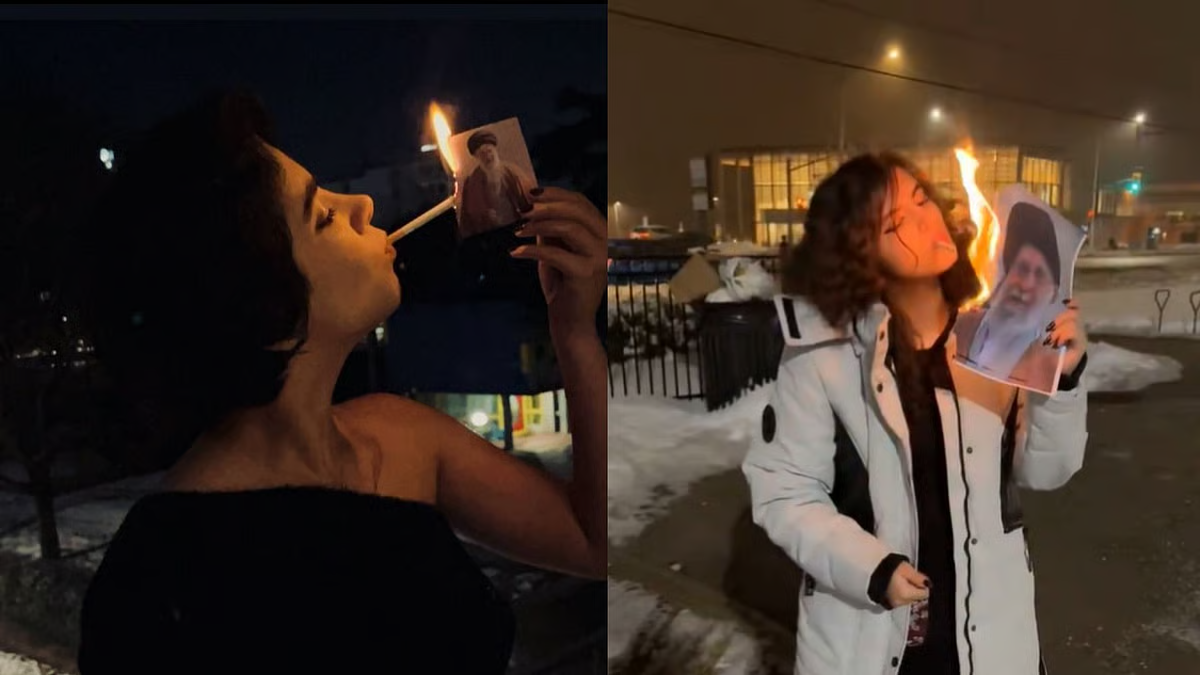
The circulation of videos showing Iranian women lighting cigarettes with burning photographs of Supreme Leader Ayatollah Ali Khamenei has triggered intense international discussion, not only because of the provocative nature of the act but also because of what it reveals about the current state of dissent inside Iran. Shared widely across social media platforms, the footage captures a moment that is visually simple yet politically loaded, compressing decades of frustration, repression, and resistance into a single gesture.
In a country where reverence for the Supreme Leader is enforced by law and dissent is met with severe punishment, such images carry extraordinary symbolic weight. The trend reflects how protest in Iran has adapted under pressure, moving away from mass street demonstrations toward acts of individual defiance that can be instantly amplified in the digital sphere. The videos do not emerge in isolation. They are part of a broader pattern of symbolic resistance that has developed since the nationwide protests sparked by the death of Mahsa Amini in 2022.
As state authorities intensified surveillance and crackdowns on public gatherings, activists and ordinary citizens increasingly turned to smaller, more personal forms of protest that are harder to predict and suppress. The act of burning an image of the Supreme Leader, combined with the deliberate choice of smoking, brings together political, social, and gendered dimensions of dissent. It challenges not only the authority of Iran’s leadership but also the moral and cultural controls imposed on women’s bodies and behavior.
A digital symbol of resistance
The viral spread of these videos highlights the growing role of digital platforms as spaces of protest for Iranians. Clips shared on X, Instagram, Reddit, and Telegram have reached audiences far beyond Iran’s borders, transforming a local act of defiance into a global statement. Analysts note that this form of protest is particularly potent because it relies on imagery rather than slogans or organized demonstrations. A single visual, easily understood without translation, can communicate resistance more powerfully than lengthy explanations, especially in an environment where traditional media is tightly controlled.
Under Iranian law, defacing or burning images of the Supreme Leader is considered a serious criminal offense, often carrying heavy prison sentences. The willingness of women to engage in such acts, even if filmed anonymously or partially obscured, underscores the depth of public anger and disillusionment. By recording and sharing these moments, participants are not only expressing personal dissent but also inviting others to witness and replicate the act, creating a decentralized form of protest that does not rely on formal leadership or organization.
The digital nature of this resistance makes it more resilient. Street protests can be dispersed, leaders can be arrested, and public spaces can be closed, but online symbols are far harder to erase once they gain traction. Even when authorities block platforms or slow internet access, content often finds alternative routes through VPNs, encrypted messaging apps, and diaspora networks. In this way, the act of lighting a cigarette with a burning photograph becomes both a protest and a message, designed to circulate, provoke discussion, and challenge the narrative promoted by the state.
🚨🇮🇷 A young Iranian woman sets a photo of Ayatollah Khamenei ablaze and lights her cigarette with it. This fearless act is sparking a growing trend across Iran. Young women are leading the uprising, reshaping the story of resistance for a whole generation. pic.twitter.com/qiRWCFXCw8
— Defense News (@defensesignal) January 10, 2026
The visual language of the protest also matters. Fire has long been associated with rebellion and purification in political movements, while the cigarette introduces an element of everyday life, suggesting that defiance has become woven into ordinary routines. The combination creates an image that feels both intimate and confrontational, blurring the line between personal expression and political action. This is precisely what gives the trend its power and explains why it has resonated so strongly online.
Challenging social and religious restrictions
Beyond its political implications, the protest directly confronts deeply rooted social and religious norms governing women’s behavior in Iran. Smoking by women, while not illegal, has historically been stigmatized and discouraged, particularly in public, as incompatible with state-imposed ideals of morality and femininity. By openly smoking in these videos, participants are rejecting not only political authority but also the cultural expectations that seek to regulate their appearance, conduct, and autonomy.
The act gains further significance when viewed against the backdrop of mandatory hijab laws and moral policing. Since the Islamic Revolution of 1979, Iranian women have lived under a legal framework that tightly controls dress codes and public behavior, enforced by morality police and informal social pressure. Protests against these restrictions have intensified in recent years, particularly after Mahsa Amini’s death while in custody for an alleged hijab violation. The current viral trend can be seen as a continuation of that struggle, using symbolism to assert bodily autonomy and personal freedom.
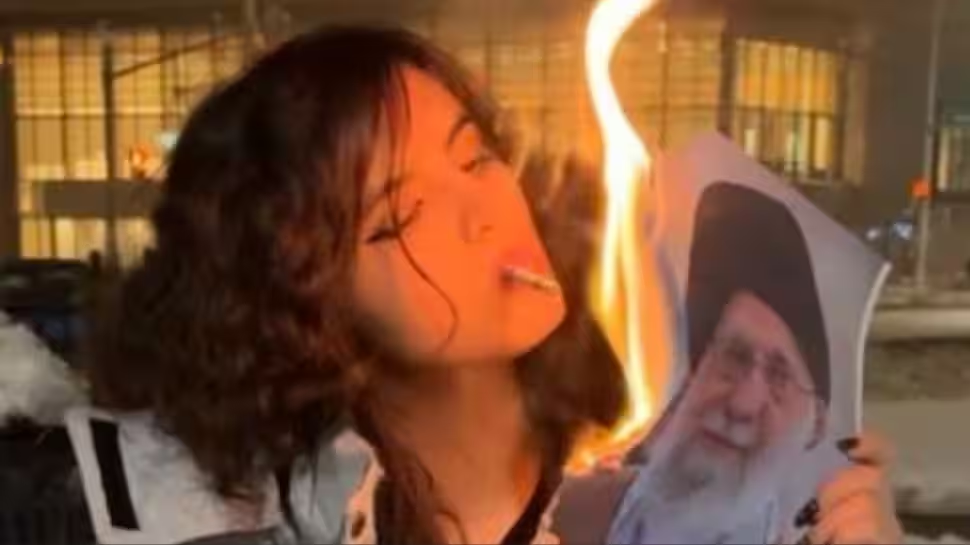
Destroying an image of the Supreme Leader while engaging in a socially taboo act amplifies the message of defiance. It signals a refusal to accept the hierarchy that places political authority and religious doctrine above individual rights. For many viewers, especially within Iran, the videos resonate because they reflect experiences of daily resistance, whether through small acts of non-compliance, subtle rule-breaking, or private expressions of dissent that rarely make headlines.
Internationally, the imagery has drawn attention to the ongoing challenges faced by Iranian women, reminding audiences that resistance did not end with the suppression of street protests. Human rights advocates note that such symbolic acts often carry significant personal risk, even when identities are concealed. The willingness to take that risk reflects both desperation and determination, suggesting that fear of punishment no longer outweighs the desire to be heard.
The trend also highlights generational shifts in how dissent is expressed. Younger Iranians, in particular, are more comfortable using digital tools and visual storytelling to communicate political messages. Their protests are often less formal, less hierarchical, and more culturally subversive, drawing on irony, symbolism, and everyday practices to undermine authority. In this context, the cigarette becomes more than an object; it becomes a statement about choice, agency, and resistance.
Economic pressure and the evolution of protest tactics
The emergence of this protest trend coincides with worsening economic conditions across Iran, which have intensified public frustration and eroded confidence in the ruling establishment. Skyrocketing inflation, a sharply devalued rial, and rising costs of food, fuel, and housing have placed immense strain on households. For many Iranians, economic hardship is inseparable from political grievances, reinforcing perceptions that systemic mismanagement and international isolation have left ordinary citizens to bear the cost.
Read : Ribvar Karimi Who Once Served as a Sniper in the Iranian Army Detained by ICE
In recent months, reports have surfaced of sporadic acts of vandalism, including the burning of images of senior officials and damage to statues associated with the ruling system. These incidents, while smaller in scale than mass protests, indicate a persistent undercurrent of anger. The viral videos of women burning the Supreme Leader’s photograph fit within this broader pattern, reflecting a shift toward low-cost, high-impact actions that can be carried out individually yet resonate collectively.
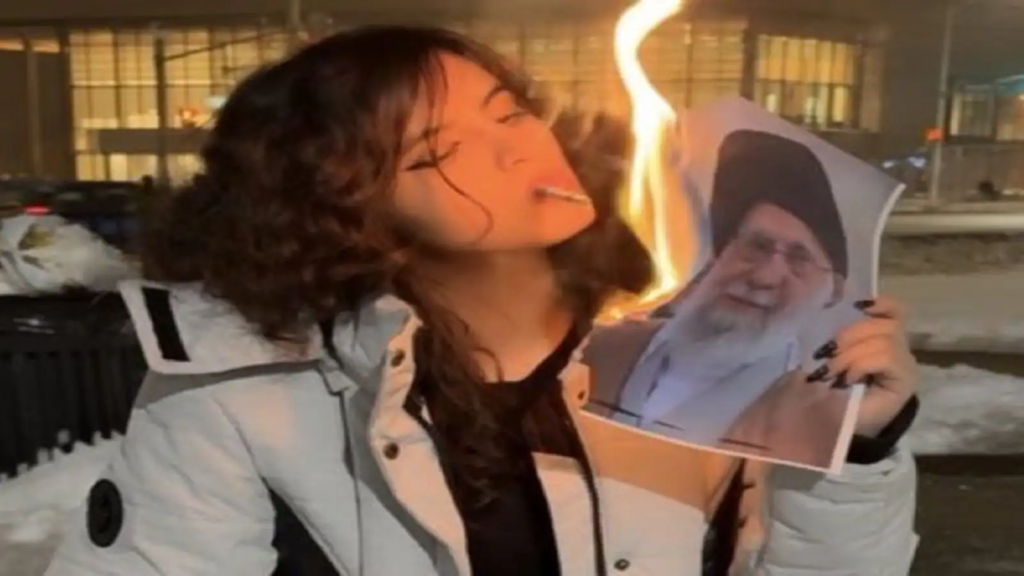
This evolution in protest tactics is partly a response to the harsh crackdowns that followed the 2022 demonstrations. With security forces employing arrests, surveillance, and internet restrictions to suppress large gatherings, activists have adapted by decentralizing resistance. Symbolic acts, shared online, allow individuals to participate without the logistical challenges of organizing protests, while still contributing to a visible culture of dissent.
Economic pressure has also reshaped the motivations behind protest. While demands for social freedoms and women’s rights remain central, they are increasingly intertwined with concerns about livelihoods and future prospects. For younger generations facing unemployment and limited opportunities, acts of defiance serve as both political statements and expressions of personal frustration. The symbolism of burning a revered image can be interpreted as a rejection of a system perceived as failing to provide stability or hope.
At the same time, the global reach of these videos underscores the role of the Iranian diaspora and international audiences in amplifying domestic dissent. Shared and discussed abroad, the imagery places additional pressure on authorities by drawing scrutiny to ongoing repression and economic mismanagement. While such attention does not immediately translate into policy change, it contributes to a narrative that challenges official portrayals of unity and control.
Taken together, the viral trend illustrates how protest in Iran continues to adapt under constraint, blending political defiance, social rebellion, and economic grievance into a single, powerful image. The act of lighting a cigarette with a burning photograph may appear fleeting, but its impact lies in its repetition, visibility, and capacity to inspire discussion. It reflects a society in which resistance has not been extinguished, but reshaped, finding new forms to persist despite formidable obstacles.