

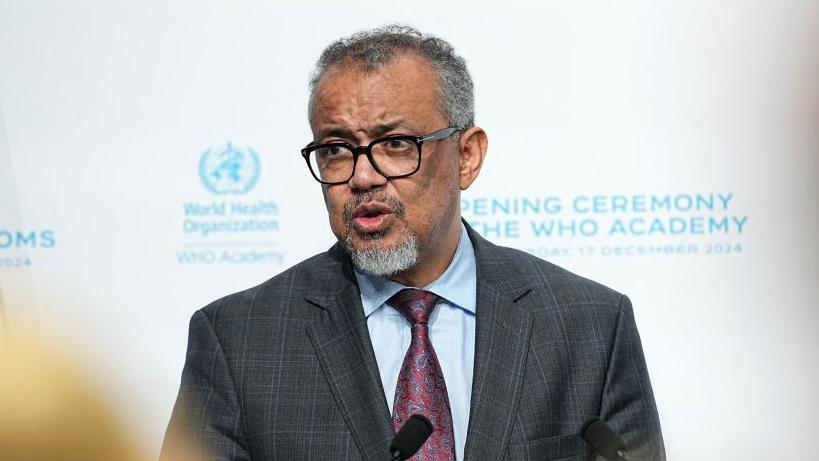
The recent escalation of violence in the Middle East took a dangerous turn when an Israeli airstrike hits Yemen airport, narrowly missing the World Health Organization (WHO) Director-General, Tedros Adhanom Ghebreyesus, who was about to board a flight.
This incident underscores the intensifying hostilities in the region, raising concerns over civilian safety, humanitarian operations, and regional stability.
An Airstrike Too Close for Comfort
As the WHO chief prepared to board a flight from Sanaa airport on Thursday, the airport was suddenly subjected to aerial bombardment.
Tedros Adhanom Ghebreyesus shared details of the harrowing experience on social media, describing the attack as perilously close. “The air traffic control tower, the departure lounge – just a few metres from where we were – and the runway were damaged,” he stated.
While Tedros and his team were unharmed, the strike injured a crew member of their plane and caused significant destruction to the airport infrastructure.
Read : Is Yemen the Next Battleground in Israel’s Campaign Against Iranian-Backed Militias?
Reports from the Houthi-controlled Saba news agency indicated that three people lost their lives in the airport strike, with additional casualties reported in subsequent attacks on the port city of Hodeidah.
Amid rising tensions over Israel's war on Gaza, Israeli warplanes launched airstrikes in Yemen, targeting strategic sites including Sanaa airport, the port of Al-Hudaydah, and a power plant in Hudaydah on the Red Sea coast https://t.co/j45j9c35Q3 pic.twitter.com/JwRpqVzeDd
— Anadolu English (@anadoluagency) December 26, 2024
The Israeli military claimed the strikes targeted infrastructure used by Yemen’s Houthi forces for smuggling Iranian weapons and facilitating the movement of Iranian officials. This justification aligns with Israel’s broader campaign against groups it perceives as threats due to their links to Iran, an arch-rival in the region.
Escalation of Hostilities in Yemen
The airstrike on Sanaa airport represents a significant escalation in the conflict involving Israel and the Iran-backed Houthi forces in Yemen.
The Houthis have launched repeated drone and missile attacks on Israel in recent weeks, framing these actions as solidarity with Palestinians in Gaza. These strikes have prompted a robust Israeli response, including targeting key infrastructure in Yemen.

Israeli Prime Minister Benjamin Netanyahu’s remarks indicate a determination to intensify the campaign against the Houthis. “We are just getting started with them,” Netanyahu said, signaling a prolonged conflict.
The Houthis, on the other hand, have vowed retaliation, with their spokesperson warning that the group would meet “escalation with escalation.” This rhetoric, coupled with their missile and drone launches, suggests a cycle of violence that could further destabilize the region.
Raiman al-Hamdani, a Yemeni researcher, noted that the Houthis’ continued targeting of Israel and other interests in the Red Sea corridor risks severe repercussions. “They are playing with fire,” he commented, highlighting the group’s limited capacity to withstand a prolonged conflict involving Israel.
Humanitarian Concerns Amid the Violence
The attack on Sanaa airport also raises critical questions about the safety of humanitarian operations in conflict zones. The WHO delegation, which had just concluded discussions on Yemen’s dire humanitarian situation, was negotiating the release of detained UN staff members when the strike occurred.
The United Nations expressed grave concerns about the incident, emphasizing the need to protect civilians and humanitarian personnel. UN spokesperson Stephanie Tremblay reiterated that international humanitarian law must be respected, particularly regarding civilian infrastructure and relief operations.
The destruction of Sanaa airport, a critical hub for humanitarian aid, further complicates efforts to address Yemen’s ongoing crises. With over eight years of civil war, Yemen is already grappling with one of the world’s worst humanitarian catastrophes. The intensification of external conflicts threatens to exacerbate the suffering of millions of Yemenis.
A Regional Conflict with Global Implications
Israel’s recent strikes in Yemen and the Houthis’ aggressive posture highlight the interconnected nature of conflicts in the Middle East. The Houthis’ targeting of Israeli cities and shipping lanes in the Red Sea has drawn the attention of global powers, including the United States, which recently conducted strikes against Houthi forces.
This escalation underscores the broader geopolitical tensions involving Israel, Iran, and their respective allies. For Israel, the Houthi attacks represent another front in its confrontation with Iranian influence in the region.
For the Houthis, their actions are framed as a demonstration of solidarity with Palestinians amid Israel’s ongoing military campaign in Gaza, which has resulted in significant civilian casualties.
The situation also poses challenges for international diplomatic and humanitarian efforts. The incident involving the WHO chief underscores the risks faced by organizations attempting to navigate the complex dynamics of the region while providing aid and advocating for peace.