
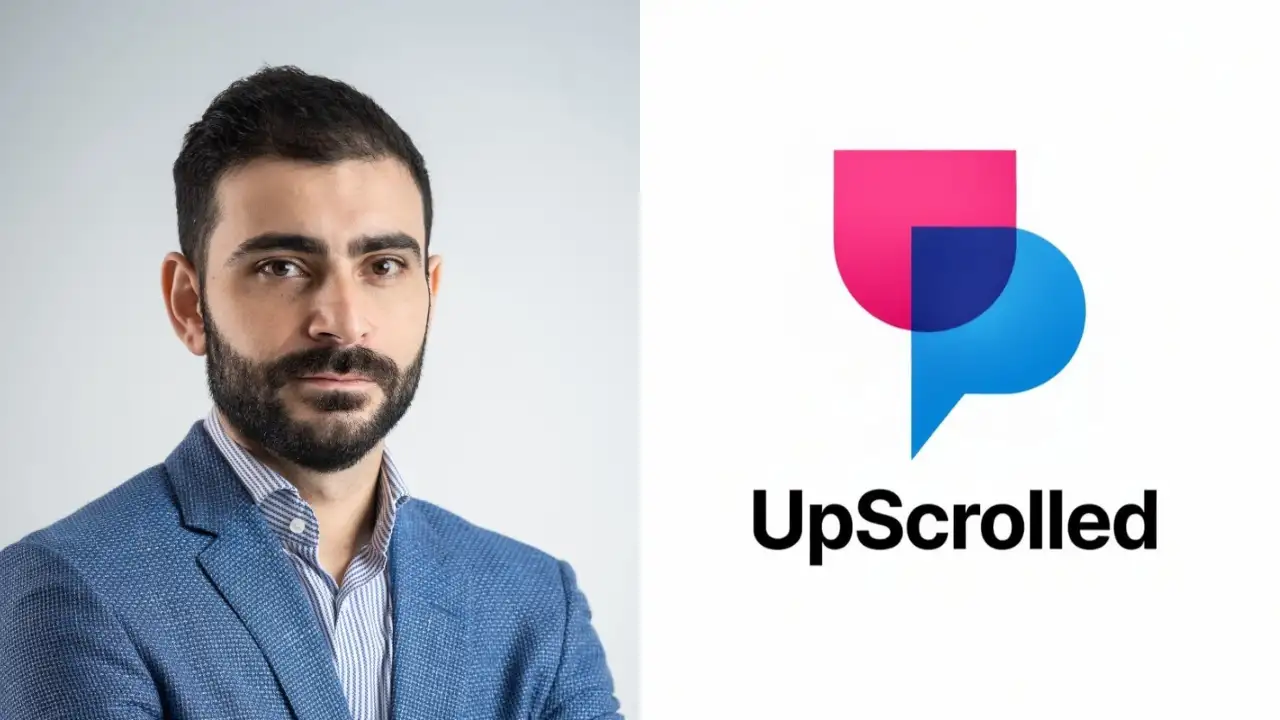
Issam Hijazi has emerged as a notable figure in global technology discourse at a moment of unusual volatility in the social media landscape. As TikTok’s operations in the United States underwent a dramatic ownership restructuring accompanied by service disruptions, large numbers of users began exploring alternative platforms that promised stability, transparency, and editorial independence.
Among the beneficiaries of this shift was UpScrolled, a relatively new social application that rapidly climbed app store rankings and struggled to manage a sudden surge in downloads. At the center of this unexpected growth is Hijazi, a technologist whose multinational background and professional experience have shaped a platform explicitly designed as a response to perceived failures in dominant social networks.
Hijazi’s rise into the spotlight is less the result of personal branding than of timing and positioning. While he had been building UpScrolled quietly, the broader environment of regulatory scrutiny, geopolitical tension, and user distrust toward large technology firms created conditions in which alternative platforms could gain traction almost overnight.
His background as a Palestinian-Jordanian-Australian technologist, combined with a career spent inside some of the world’s largest enterprise technology companies, has given him both credibility and a distinct perspective on how digital platforms shape public discourse. As debates around censorship, algorithmic bias, and corporate control intensify, Hijazi’s work is increasingly viewed as part of a wider effort to rethink the foundations of social media.
Background and Career of Issam Hijazi
Issam Hijazi’s professional trajectory reflects a globalized career shaped by both geographic mobility and exposure to large-scale technology systems. Identifying as Palestinian-Jordanian-Australian, Hijazi has lived and worked across multiple regions, including Jordan, the United Arab Emirates, Singapore, and Australia. This multinational experience has informed his understanding of how digital platforms operate across political, cultural, and regulatory contexts, an understanding that later became central to the philosophy behind UpScrolled.
Before founding his own company, Hijazi held roles at major technology firms such as IBM and Oracle. These positions placed him within highly structured corporate environments where large, complex systems are developed and maintained at scale. Exposure to enterprise software, cloud infrastructure, and data-driven decision-making provided him with technical expertise as well as insight into how corporate priorities can influence product design and governance.
According to publicly available professional profiles, these experiences contributed to his growing interest in the ethical and social implications of technology, particularly in relation to information flow and visibility online. Hijazi eventually became the head of Recursive Methods Pty Ltd, an Australia-based company that would later develop and operate UpScrolled.
Read : Who Is Erik Martindale, Florida Nurse Facing Backlash for Refusing Anesthesia to MAGA Supporters?
The decision to base the company in Australia positioned it somewhat outside the regulatory and political pressures faced by U.S.-centric social media firms, while still allowing access to global app marketplaces. His background, straddling regions often affected by geopolitical conflict and information control, appears to have sharpened his focus on issues such as censorship, narrative suppression, and the uneven amplification of content.
Read : Discover Paradise on Earth: Unveiling the Most Heavenly Destinations
By the time UpScrolled was founded in 2025, Hijazi had articulated a clear critique of existing platforms. He argued that meaningful stories were increasingly buried while sensational or misleading content was amplified through opaque recommendation systems. This assessment was not framed solely as a political concern but as a structural problem inherent in engagement-driven algorithms. His career thus evolved from participating in large corporate systems to attempting to design an alternative that addressed what he saw as systemic flaws in the prevailing social media model.
The Creation of UpScrolled and Its Core Philosophy
UpScrolled was conceived as a direct response to what Issam Hijazi described as the erosion of trust between users and major social platforms. Launched in 2025, the app positioned itself as politically impartial and explicitly rejected several practices that have become common in the industry, including shadowbanning, pay-to-play content promotion, and undisclosed algorithmic manipulation. From its inception, the platform emphasized transparency as a defining principle rather than a marketing slogan.
The design of UpScrolled reflects an attempt to balance familiarity with reform. Its interface blends elements commonly associated with established platforms such as Instagram and X, allowing users to post photos, videos, and text while also engaging through private messages. This hybrid structure was intended to reduce friction for new users migrating from other platforms, while the underlying feed logic sought to differentiate the app in more substantive ways.

Users are offered a chronological following feed alongside a discover feed that ranks content based on engagement, moderated by light time decay and an element of randomness. Hijazi and his team have stated that the goal of this system is to prevent any single metric, such as virality or outrage-driven engagement, from dominating visibility. Unlike algorithmic feeds that heavily prioritize watch time or interaction velocity, UpScrolled’s approach is presented as an attempt to surface a wider range of voices without artificially boosting or suppressing content.
The platform has also outlined clear moderation boundaries, restricting only content that violates community guidelines or involves illegal activity, hate speech, bullying, or harassment. Publicly, UpScrolled has positioned itself in opposition to what it characterizes as biased moderation practices by larger competitors. Statements from the company have criticized platforms such as TikTok, Meta, and X for allegedly censoring voices or applying inconsistent standards.
While these claims remain part of an ongoing debate within the technology sector, they resonate with users who feel alienated by sudden content removals, unexplained reach declines, or shifting platform policies. Under Hijazi’s leadership, UpScrolled has attempted to frame itself as a corrective to these trends rather than merely another competitor in a crowded market.
UpScrolled’s Surge Amid TikTok’s U.S. Turmoil
The rapid rise of UpScrolled into broader public awareness was closely tied to developments surrounding TikTok’s operations in the United States. In response to a 2024 federal law requiring separation from its Chinese parent company, ByteDance, TikTok’s U.S. operations were spun off into a new entity. The revised ownership structure granted a combined 50 percent stake to Oracle, Silver Lake, and Emirati investment firm MGX, while ByteDance retained a 19.9 percent interest. Although framed as a compliance measure, the transition intensified scrutiny and speculation about the platform’s future direction.
Shortly after the restructuring, U.S.-based TikTok users reported widespread service disruptions beginning on January 25. Issues included login failures, lagging performance, repetitive content, and delays in posting. Downdetector recorded tens of thousands of outage reports at the peak of the disruption. TikTok attributed the problems to a power outage at a U.S. data center, but the timing, coinciding with the ownership change, amplified existing concerns about stability and governance.

Against this backdrop, UpScrolled experienced an abrupt influx of new users. Data from Appfigures indicated that the app was downloaded approximately 41,000 times over a three-day period, representing nearly a 29-fold increase over its prior daily average. The company acknowledged difficulties in scaling its infrastructure, posting on Bluesky that the volume of new users had exceeded server capacity and that efforts were underway to restore full functionality.
The transparency of this communication contrasted with the more opaque responses users associated with larger platforms, further reinforcing UpScrolled’s appeal. Prominent voices contributed to the migration. Journalists, musicians, and public figures publicly expressed concerns about censorship and content suppression following TikTok’s transition.
Allegations that critical content related to U.S. political leadership and immigration policies was being suppressed circulated widely, although such claims remain contested. Regardless of their veracity, they fueled a perception that control over digital discourse was becoming increasingly concentrated. In this environment, Issam Hijazi’s UpScrolled benefited from being positioned as both an alternative and a statement against centralized platform power.
The surge did not merely elevate the app’s visibility but also placed Hijazi himself under greater scrutiny. As users sought information about the platform’s origins and leadership, his background and stated philosophy became part of a broader conversation about who builds social media and whose values shape online spaces.
While UpScrolled remains a relatively small player compared to established giants, its rapid rise during a period of instability underscores how moments of disruption can reshape the competitive landscape. For Issam Hijazi, the convergence of his long-standing critique of social media systems with a sudden shift in user behavior has transformed a niche project into a focal point of debate about the future of digital communication.