
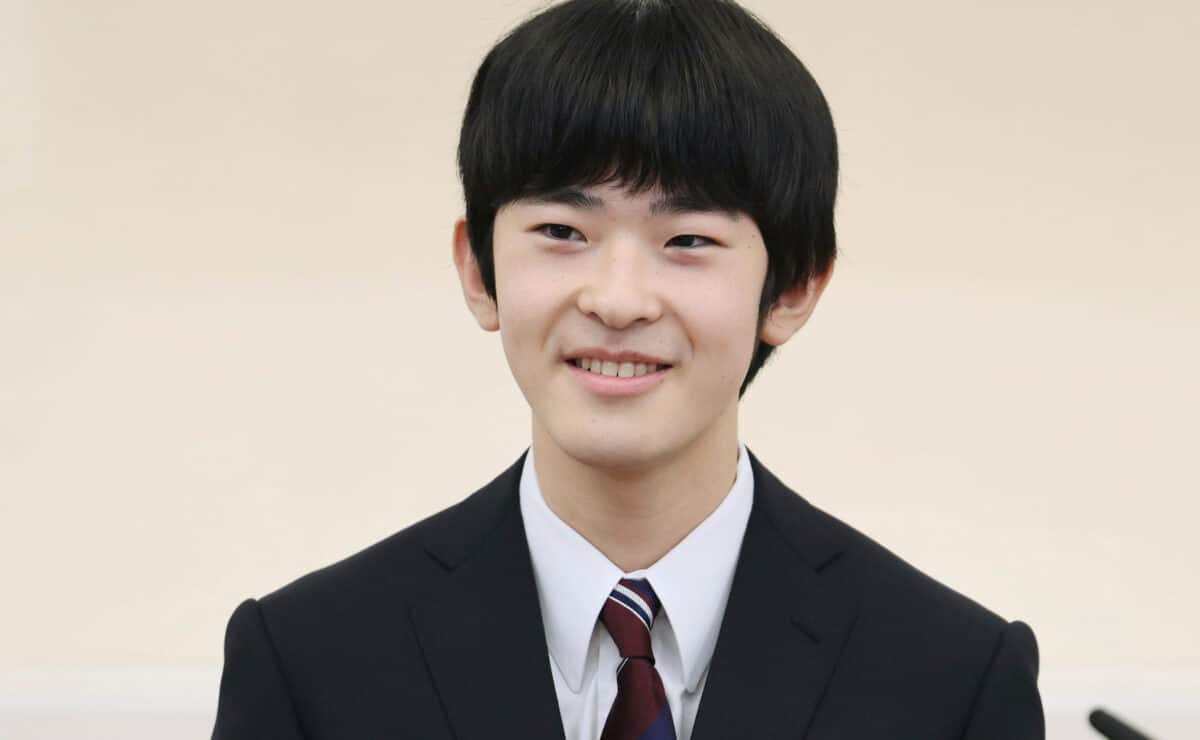
On September 6, 2025, Japan marked a significant milestone in its imperial history as Prince Hisahito, the only son of Crown Prince Akishino and Crown Princess Kiko, celebrated his coming-of-age ceremony, formally recognizing him as an adult at the age of 19.
This event is noteworthy not only because Hisahito is the first male royal to reach adulthood in nearly four decades—since his father, Crown Prince Akishino, in 1985—but also because it underscores the precarious state of Japan’s ancient monarchy, which faces a looming succession crisis due to its male-only succession policy. As the nephew of Emperor Naruhito and second in line to the Chrysanthemum Throne, Hisahito carries the weight of a 1,500-year-old institution on his young shoulders.
A Milestone Marked by Tradition
Prince Hisahito’s coming-of-age ceremony, held a year after he turned 18 due to his focus on university entrance exams, was a meticulously orchestrated event steeped in centuries-old Japanese tradition. The rituals began at his family’s residence at the Akasaka Estate in Tokyo, where Hisahito, dressed in a formal tuxedo, received a ceremonial crown delivered by a messenger from Emperor Naruhito.
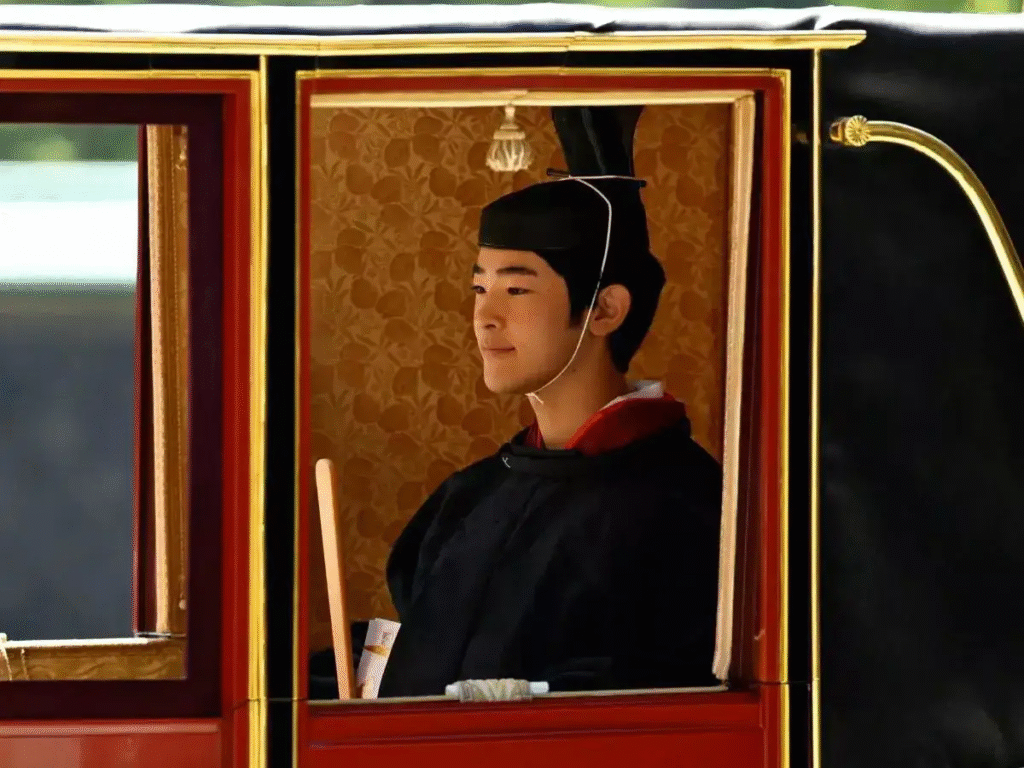
The main ritual took place at the Imperial Palace, attended by other royal family members and top government officials. Hisahito wore a traditional beige robe symbolizing his pre-adulthood status, which was later replaced with a black adult “kanmuri” headpiece, signifying his transition to adulthood. He bowed deeply to express gratitude to the Emperor for the crown and to his parents for hosting the ceremony, pledging to fulfill his responsibilities as a royal member.
The ceremony continued with Hisahito, now in adult attire with a black top, riding in a horse-drawn carriage to pray at three sacred shrines within the palace compound. Later, he donned his tuxedo again to visit Emperor Naruhito and Empress Masako in the prestigious Matsu-no-Ma (Pine Room) at the Imperial Palace. He also received the Grand Cordon of the Supreme Order of the Chrysanthemum, a postwar tradition for male royals.
Hisahito’s schedule included visits to pay respects at significant sites, such as the Ise Grand Shrine, Japan’s most revered Shinto shrine, the mausoleum of the mythical first emperor Jimmu in Nara, and the tomb of his great-grandfather, Emperor Hirohito, in the Tokyo suburbs. In the evening, Crown Prince Akishino and Crown Princess Kiko hosted a private celebration for their son at a Tokyo hotel, attended by relatives. These elaborate rituals not only marked Hisahito’s personal milestone but also highlighted the enduring cultural and symbolic importance of Japan’s imperial traditions.
Read : Prince Hisahito Becomes Japan’s First Royal Male to Turn 18 in 40 Years Amid Population Crisis
Hisahito’s coming-of-age is particularly significant because it marks the first time a male royal has reached adulthood since 1985. Born on September 6, 2006, he is the youngest of the 16-member all-adult imperial family, which currently includes only three other men: Emperor Naruhito, Crown Prince Akishino, and Prince Hitachi, who is 89 years old.
(yesterday) coming of age ceremony of His Imperial Highness Prince Hisahito (the only heir to the Throne after his father, brother to the Emperor)
— Gen (@Gen777777) September 7, 2025
crown with tail from Heian (Kyoto capital) period.
794 to 1185 (time of William the Conqueror) pic.twitter.com/b6kcL6GX6H
Hisahito’s birth was a pivotal moment for the monarchy, as it ended years of debate about amending the Imperial House Law to allow female succession, a discussion that gained traction after the birth of Princess Aiko, Emperor Naruhito’s daughter, in 2001. Hisahito’s arrival in 2006 ensured the continuation of the male-only succession for at least one more generation, but it also placed immense pressure on him as the sole male heir of his generation.
The Succession Crisis and Calls for Reform
The Japanese monarchy, often cited as the world’s oldest hereditary monarchy, faces an existential crisis due to its dwindling numbers and strict male-only succession policy, enshrined in the 1947 Imperial House Law. This law, rooted in conservative pre-war values, permits only male succession and requires female royals who marry commoners to relinquish their royal status. With only 16 members in the imperial family and just three male heirs—Naruhito, Akishino, and Hisahito, followed by the elderly Prince Hitachi—the monarchy’s future is uncertain. The absence of additional male heirs after Hisahito raises the possibility that he could be the last emperor unless reforms are enacted or he produces male heirs of his own.
The issue of succession has sparked significant debate in Japan. Historically, Japan allowed female emperors, with eight reigning empresses, the most recent being Go-Sakuramachi from 1762 to 1770. However, none of these empresses produced heirs during their reigns, and the 19th-century decision to abolish female succession has limited the pool of potential heirs. Princess Aiko, the only child of Emperor Naruhito and Empress Masako, is a direct descendant and widely popular among the public as a potential future empress, but the current law bars her from ascending the throne.
Proposals to amend the Imperial House Law to allow female succession gained momentum in the early 2000s but were shelved after Hisahito’s birth. In 2022, a government-commissioned panel suggested allowing female royals to retain their status after marriage and adopting male descendants from now-defunct royal lines to bolster the male lineage. However, these proposals have stalled due to conservative resistance and debates over whether spouses and children of princesses should retain royal status.
The conservative Yomiuri newspaper, in May 2025, called for urgent revisions to the Imperial House Law to permit female succession and grant royal status to princesses’ husbands and children, emphasizing the need to secure the monarchy’s future. Former Imperial Household Agency chief Shingo Haketa has framed the issue as not merely about male or female succession but about the survival of the monarchy itself.
The shrinking imperial family mirrors Japan’s broader demographic challenges, with a rapidly aging and declining population. Without reform, the burden of the monarchy’s continuity rests heavily on Hisahito, a pressure that has been acknowledged by observers as both a personal and institutional challenge.
Hisahito’s Path Forward: Balancing Duty and Personal Interests
At 19, Prince Hisahito is navigating the delicate balance between his royal obligations and his personal aspirations. A freshman at the University of Tsukuba, where he studies biology at the School of Life and Environmental Sciences, Hisahito has a keen interest in insects, particularly dragonflies. He has co-authored an academic paper on a survey of dragonflies at his Akasaka estate and expressed a desire to focus on insect conservation in urban environments.
His passion for the natural world is a family trait, as his grandfather, Emperor Emeritus Akihito, is a noted marine biologist. Hisahito’s academic pursuits reflect a desire to contribute meaningfully to society beyond his royal role, a sentiment he echoed during his debut press conference on March 3, 2025, where he spoke of balancing his studies with official duties.
Hisahito’s education has been notably non-traditional for a royal. Unlike most imperial family members who attended the prestigious Gakushuin schools, Hisahito enrolled at Ochanomizu University Kindergarten and later its elementary and junior high schools. In 2022, he joined the University of Tsukuba’s Senior High School, where he participated in extracurricular activities like the badminton club and school events such as sports days and cultural festivals.
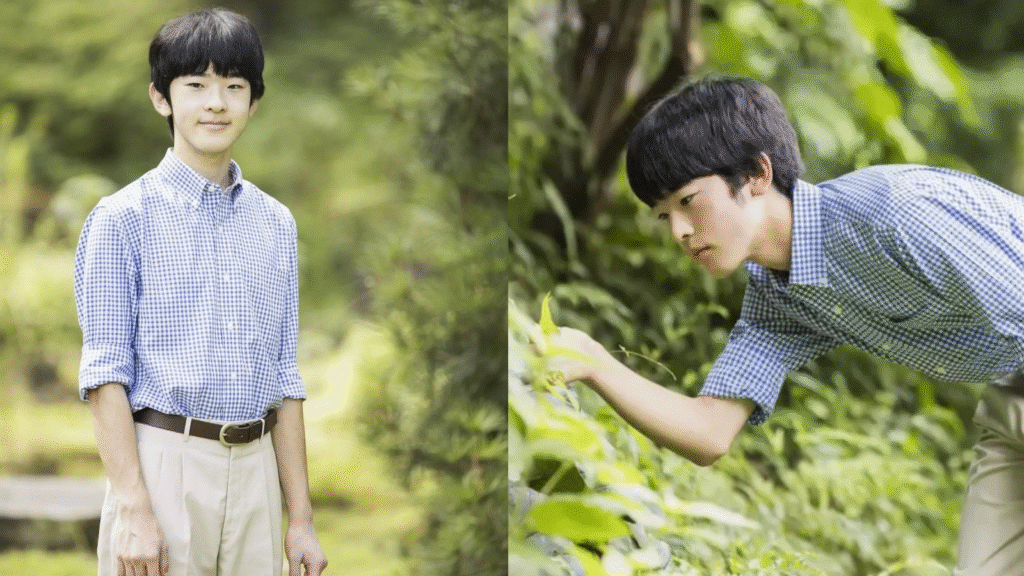
His parents, Crown Prince Akishino and Crown Princess Kiko, have aimed to provide him with a relatively normal upbringing despite his unique position. His first overseas trip in 2019 to Bhutan, where he accompanied his parents on an official visit, marked an early step into public life, and his engagement in such duties is expected to increase now that he is an adult.
In his press conference, Hisahito articulated a thoughtful perspective on his role, stating that the emperor should be a symbolic figure who “always thinks of the people and stays close to them.” He expressed gratitude to his parents and sisters, Princess Kako and former Princess Mako, who lost her royal status upon marrying a commoner in 2021. Hisahito also addressed personal matters lightly, noting that he had not yet considered marriage, focusing instead on his studies and royal duties. His coming-of-age has tripled his annual allowance from approximately ¥3 million to ¥9 million, reflecting his increased responsibilities as an adult royal.
Despite his youth, Hisahito has faced challenges, including a 2019 assassination attempt at his junior high school and a 2022 plagiarism controversy over an award-winning essay about his trip to the Ogasawara Islands. He and the Imperial Household Agency acknowledged the essay’s inadequate citations, and he submitted revisions without losing the award. These incidents highlight the scrutiny he faces as a public figure and the expectations placed upon him as the monarchy’s future.
As Japan grapples with the question of how to preserve its monarchy, Prince Hisahito’s coming-of-age serves as both a celebration and a reminder of the challenges ahead. His journey into adulthood, marked by tradition and tempered by modern realities, positions him as a pivotal figure in determining whether the Chrysanthemum Throne will endure or fade into history. For now, Hisahito remains focused on his studies and duties, embodying the hope of a nation that values its ancient heritage while confronting the need for change.