

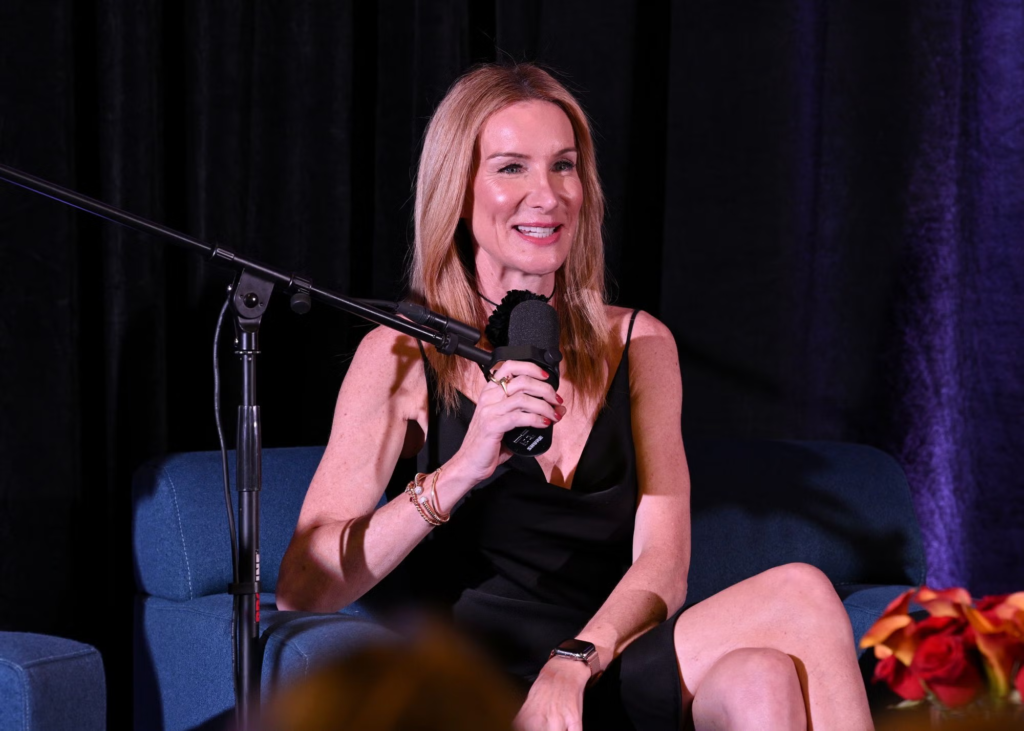
Jennifer Welch, co-host of the I’ve Had It podcast and a longtime television personality, became the focal point of a heated online controversy after sharply criticizing Erika Kirk, widow of the late Turning Point USA CEO Charlie Kirk. Welch’s remarks, delivered during a recent episode of her podcast, prompted a surge of polarized reactions across social media platforms and reignited wider discussions about gender politics, public influence, and the increasingly confrontational tone of political commentary. Her comments also introduced renewed attention to Welch herself, leading many to ask who she is, how her career developed, and why her words provoked such an explosive public response.
Welch’s Background in Television and Podcasting
Jennifer Welch first captured national attention as one of the stars of the Bravo reality series Sweet Home Oklahoma, a program that followed her and her friends navigating family life, work, and personal relationships. The show’s blend of humor, candid conversations, and emotional openness helped to establish Welch as a recognizable media figure, setting the groundwork for her future ventures. Alongside her close friend and co-host Angie Sullivan, Welch transitioned into the podcasting sphere in 2022 with the launch of I’ve Had It, a program positioned firmly within progressive social commentary and known for its forthright and often confrontational tone.
The podcast’s premise centers on the hosts’ discussions of cultural, political, and personal irritations, which are delivered with a mix of exasperation, pointed critique, and comedic flair. This formula rapidly attracted a substantial audience and notable media attention. Left-wing commentator Hasan Piker even described it as one of the most radical progressive podcasts in North America, underscoring its reputation for directness and ideological clarity. Welch and Sullivan have built a loyal listener base that expects them to tackle contentious issues without restraint, a style that set the stage for the explosive episode in which Welch addressed Erika Kirk.
As her media presence grew, Welch became known for challenging what she sees as hypocrisy, manipulation, or harmful rhetoric in the public sphere. Her approach resonates with audiences seeking uncompromising commentary but can also polarize listeners when directed at prominent political figures. This duality has become a defining feature of her public persona, shaping both her popularity and the criticism she receives.
The Controversy Surrounding Erika Kirk and the Accusations of Hypocrisy
The controversy began after Erika Kirk made comments at a New York Times event suggesting that women who voted for newly elected New York City mayor Zohran Mamdani were doing so because they viewed government support as a substitute for personal relationships. Kirk framed her remarks as a warning against what she described as a growing tendency among young women to rely on the state rather than forming marriages or families.
Her argument, which emphasized traditional family structures and self-reliance, led to swift critique from progressive commentators who viewed her framing as both dismissive and out of touch with socio-economic realities faced by many women. Welch’s response was particularly forceful. On her podcast, she accused Kirk of weaponizing her gender to demean other women and labeled her an opportunistic grifter.
She emphasized what she perceived as the contradiction between Kirk’s advocacy for traditional domestic roles and her active pursuit of a public career that includes speaking engagements, leadership roles, and televised appearances. Welch argued that Kirk’s advice for women to prioritize marriage and motherhood over public ambitions stood in stark contrast to the life Kirk herself leads, a point she used to support her accusations of hypocrisy.
Jennifer Welch on Erika Kirk: “She is a grifter. Just look at the costume changes. It’s wild. This woman should be kicked to the curb. She is an absolute grifter just like Donald Trump and just like her unrepentent racist homophobic husband was” pic.twitter.com/GdIOHub9za
— Marco Foster (@MarcoFoster_) December 7, 2025
Her remarks did not stop at criticisms of Erika Kirk’s political messaging. Welch went further, stating that Kirk’s late husband, Turning Point USA founder Charlie Kirk, had been racist and homophobic. These comments intensified the backlash, as Charlie Kirk, who was killed earlier in the year, remains a deeply polarizing figure within American political discourse. Welch’s characterizations struck many listeners as intentionally provocative, while supporters viewed them as bold truths articulated without fear of reprisal.
During the same episode, Angie Sullivan added that a woman’s identity should extend beyond being someone’s wife or mother, a statement that underscored the broader ideological divide underlying the confrontation. The podcast hosts subsequently interviewed Zohran Mamdani, the politician at the center of the original criticism, further cementing the episode as a flashpoint in their ongoing exploration of political and cultural divides.
The online response to Welch’s comments was swift and highly divided. Critics called Welch’s tone unnecessarily vicious and described her as jealous or bitter, reflective of broader tensions surrounding feminism, traditionalism, and the rhetoric used by public figures on both sides of the political spectrum. Supporters, meanwhile, applauded her for confronting what they viewed as damaging narratives about womanhood, social progress, and the role of government.
The intensity of the responses illustrated how charged discussions around gender expectations and political identity have become, especially when tied to well-known figures in conservative and progressive circles. A day after Welch’s criticism, Erika Kirk appeared on Sean Hannity’s show to promote her late husband’s book, Stop, in the Name of God: Why Honoring the Sabbath Will Transform Your Life.
Her appearance added another layer to the story, demonstrating her ongoing prominence within conservative media and reinforcing the public’s interest in her response to the podcast episode. She spoke about the spiritual commitments that shaped her husband’s life and highlighted the book’s message about rest and devotion. Hannity praised Charlie Kirk as a biblical scholar and emphasized the value of the book’s teachings, presenting a markedly different narrative than the one portrayed on Welch’s show.
Why the Episode Resonated and What It Reveals About Modern Media Conflict
The clash between Jennifer Welch and Erika Kirk offers a revealing case study of how media dynamics, political identity, and personal storytelling intersect in the current cultural landscape. Welch’s willingness to use provocative language reflects a broader trend in political media, where commentators increasingly rely on sharp critiques and dramatic statements to capture attention and articulate ideological positions. This approach can mobilize supporters who appreciate unfiltered honesty, but it also risks alienating those who view such rhetoric as unnecessarily inflammatory.
Read : Employee Fired Over ‘Racist’s Fav Drink’ Message on Ohio Woman’s Starbucks Cup Honoring Charlie Kirk
The controversy also highlights differing perspectives on gender roles within contemporary American society. Erika Kirk’s remarks reflect a traditionalist view emphasizing marriage, family, and structured gender responsibilities, philosophies embraced by many within conservative circles. Welch, conversely, represents a progressive viewpoint that challenges prescriptive gender roles and emphasizes autonomy and self-actualization. The public backlash and support for both sides demonstrate that debates over women’s roles continue to be deeply polarizing and emotionally charged.
Additionally, the reaction illustrates how accusations of hypocrisy resonate strongly in public discourse. Welch’s central critique—that Kirk advises a lifestyle she does not herself follow—taps into a long-standing frustration with perceived double standards among public figures, particularly those involved in moral or political advocacy. Whether audiences view Welch’s interpretation as fair or as an unfair personal attack depends largely on their political alignment and beliefs about the responsibilities of public figures.
The episode also underscores the increasing importance of podcasts as cultural battlegrounds. Once seen largely as entertainment or education platforms, podcasts have evolved into influential spaces where ideas are debated, identities are challenged, and public controversies are born. Welch and Sullivan’s podcast has positioned itself as a voice for progressive critique, and the strong reactions to their comments reveal how intertwined personal opinions and political identities have become.
As Welch’s comments continue to circulate online, discussions surrounding them reflect broader questions about the responsibilities of commentators, the limits of public criticism, and the potential consequences of increasingly confrontational rhetoric. The incident also demonstrates how personal narratives, political identity, and media framing can rapidly converge into a national conversation, especially when the individuals involved already occupy prominent roles within polarized communities.
Jennifer Welch’s rise in the public eye has been shaped by her direct style, bold claims, and willingness to challenge well-known figures. Whether praised for her candor or criticized for her harshness, she has become emblematic of a media environment where forceful commentary is both expected and scrutinized. Her confrontation with Erika Kirk will likely remain a defining moment in the trajectory of her podcasting career, illustrating the powerful and sometimes unpredictable impact of outspoken political dialogue in the modern digital landscape.
Blaze-4 is legit, been playing there for a while now. Good selection of games and fast payouts. Check it out! blaze-4