

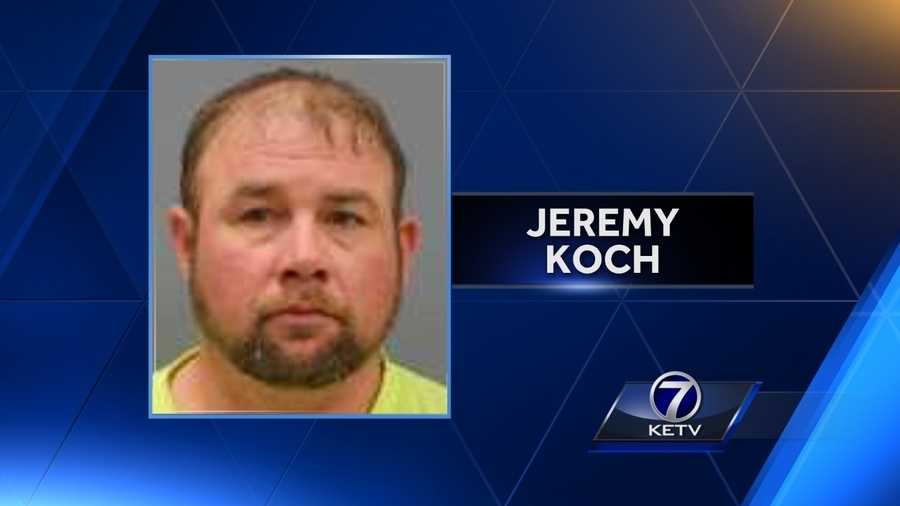
The serene community surrounding Johnson Lake in central Nebraska was shaken to its core on Saturday when news broke that 42-year-old Jeremy Koch had taken the lives of his wife and two sons before ending his own.
The incident, described by law enforcement as a multiple homicide followed by suicide, came just days after a GoFundMe page was launched to support Jeremy’s mental health treatment. What seemed to be a desperate plea for help turned into a tragic chain of events that left an entire community grieving and a family completely wiped out.
According to the Nebraska State Patrol, deputies from the Dawson County Sheriff’s Office were dispatched to a residence in Plum Creek Canyon #1 on the morning of May 10, 2025. Upon arrival, they discovered the bodies of Jeremy Koch, his wife Bailey Koch, 41, and their two sons, Hudson, 18, and Asher, 16.
All four had died from fatal stab wounds. A knife was recovered at the scene. The Patrol confirmed that all were residents of the home and that autopsies have been ordered. The investigation remains ongoing, though authorities have indicated that the evidence points to a murder-suicide, with Jeremy Koch as the perpetrator.
This horrifying case has not only devastated the Dawson County area but has also sparked a wider discussion about the seriousness of untreated or unsuccessfully treated mental illness.
With more attention being drawn to the signs that preceded the tragedy, especially those detailed by Bailey in her heartfelt GoFundMe post, many are now asking how such a catastrophe could have been prevented, and what more needs to be done to support families in similar situations.
A Family on the Brink: The Kochs’ Struggles Behind Closed Doors
Bailey Koch, a special education teacher by profession, opened up about the family’s situation just days before the killings through a GoFundMe campaign. In her post, she laid bare the long, painful history of her husband’s battle with depression.
Jeremy Koch, who had operated the family’s landscaping and greenhouse business for nearly two decades, had struggled with severe depression since 2009. His mental health challenges were not new or sudden, and Bailey did not shy away from detailing the extent of his suffering.
The couple’s ordeal dated back to a near-fatal suicide attempt in 2012, when Jeremy intentionally crashed his car into a semi-truck. The accident left him with multiple critical injuries, including a fractured pancreas, a punctured lung, and serious damage to his colon, not to mention brain trauma. Miraculously, he survived.
But as Bailey painfully expressed, the mental torment did not end with survival — in fact, it only seemed to deepen. The man she loved continued to fight a daily battle to simply exist. Things took a turn for the worse in August 2024, when Jeremy became largely unable to work due to his declining mental state.
Read : Zambian Elephant Kills American Tourist During Safari Drive : Watch Video
As the breadwinner of their small business, his absence led to severe financial strain. Bailey wrote that she had drained both her own and Jeremy’s retirement savings just to cover bills. She even began the painful process of looking into selling the family business, believing it to be too great a stressor for Jeremy to handle.

In March 2025, a terrifying incident underscored how dire the situation had become. Bailey recounted how Jeremy had stood over her one morning with a knife, ready to end his life. She was able to talk him down and convince him to seek professional help.
He began receiving treatment at Richard Young Hospital in Kearney, where doctors recommended Electroconvulsive Therapy (ECT) after he was deemed unsuitable for Ketamine infusions. But despite their efforts, his condition did not improve. The treatment was discontinued on April 28, just days before the tragedy.
Bailey described Jeremy as a “shell of himself” by then, barely able to eat, drink, or take medication. His condition deteriorated further, culminating in a diagnosis of “Mental Health Crisis – Failure to Thrive.”
With no beds available at Richard Young, he was transferred to Cozad Hospital, where staff tried to stabilize him with hydration and nutrition. But even this intervention seemed too little, too late. As Bailey wrote, he was slowly completing suicide by neglecting his most basic needs.
The Heartbreaking Future That Will Never Come
What makes this tragedy even more heartbreaking is the vivid picture Bailey painted of the family’s life — a life filled with ambition, love, and plans for the future. Hudson, the Kochs’ eldest son, was just a week away from graduating high school.
He had been accepted into a prestigious bonsai apprenticeship in California, which he was scheduled to begin shortly after graduation. Asher, the younger son, was a freshman and an active member of his school’s varsity golf team. Both boys had promising futures ahead of them.
Bailey’s GoFundMe post reflected not just desperation, but hope. Despite all the hardship, she continued to believe that with the right support, Jeremy could recover and their family could find some sense of normalcy again.
She wrote about his previous periods of functionality and how he was a “very busy and loving adult” when well. The fact that she reached out publicly showed the level of fear she had that something catastrophic could happen — fear that, devastatingly, came true.
This wasn’t a family hiding behind closed doors. Bailey had taken active steps to seek help. She had rallied support through her community, explained their dire circumstances, and pleaded for assistance. Her openness about Jeremy’s condition and the toll it was taking on their family was a courageous act — one that, in another timeline, might have resulted in the intervention they so desperately needed.
But in this timeline, the help didn’t come in time.
Failings in the Mental Health System and the Aftermath
The case of Jeremy Koch raises critical questions about the effectiveness of the mental health care system in the U.S., particularly in rural states like Nebraska. Despite having a documented history of severe depression and multiple suicide attempts, Jeremy still lacked access to consistent and effective treatment.
Even after being admitted to a hospital, staff had to make do with inadequate resources, including the absence of beds at a dedicated psychiatric facility. There is also the issue of medication resistance. As Bailey explained, Jeremy was both med-resistant and med-sensitive, complicating his treatment.
When traditional medications didn’t work, alternatives like Ketamine therapy were denied, leaving ECT as a last resort — a treatment that was ultimately discontinued due to its ineffectiveness in Jeremy’s case. This paints a stark picture of how the system is often ill-equipped to deal with complex, treatment-resistant mental illness.
Meanwhile, the burden fell on Bailey to manage not only Jeremy’s care but also the family’s finances, emotional needs, and daily life. It is a burden that no spouse or parent should have to shoulder alone. The GoFundMe campaign, while well-intentioned, underscores a troubling reality: in America, families often have to crowdfund to receive essential mental health care.
In the aftermath of this tragedy, many are mourning not just the loss of four lives, but the warning signs that went unheard, or were simply too late to act upon. The Koch family was known in their community — they were business owners, educators, students, athletes. They were real people with real dreams and devastating challenges.
As the investigation continues, and as autopsies are conducted, one can only hope that this horrific event will spark a deeper examination of how we, as a society, respond to mental illness — particularly when it affects entire families. It also emphasizes the importance of early intervention, comprehensive support networks, and increased funding and access to mental health care.
Jeremy Koch’s story is not just about violence or mental illness. It’s about love, desperation, and the tragic consequences of an overburdened system failing a family who cried out for help.