
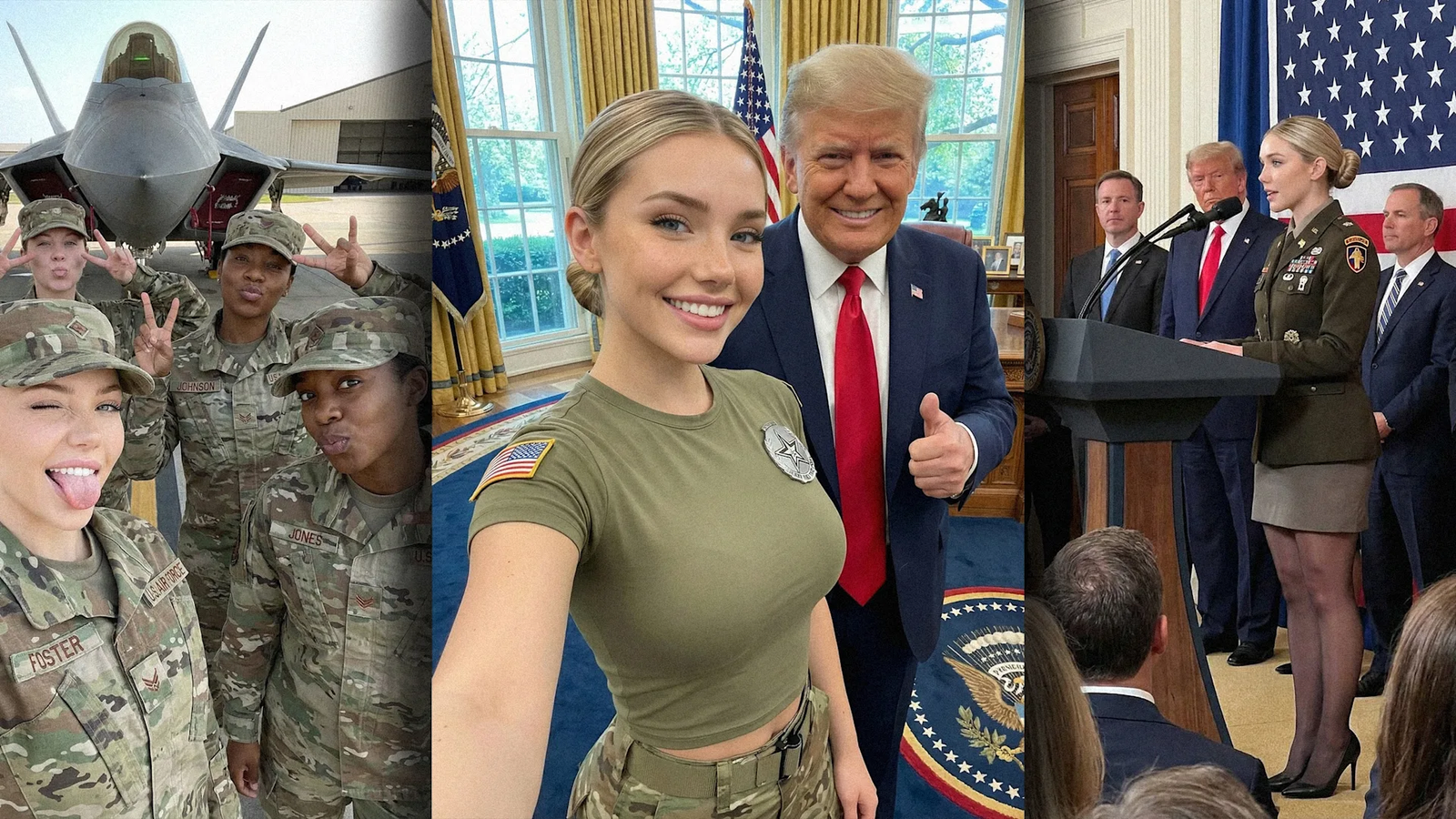
The rapid rise of artificial intelligence has transformed the digital landscape in ways that were once difficult to imagine, blurring the boundaries between reality and fabrication. One of the most striking examples of this shift is the viral phenomenon of Jessica Foster, a supposed US Army soldier who captivated social media audiences with her polished appearance, patriotic messaging, and seemingly extraordinary access to high-level military and political environments.
With over a million followers at the peak of her popularity, Jessica Foster was widely perceived as a real individual who embodied both glamour and national pride. Her posts featured her delivering speeches, posing alongside global leaders, and appearing on naval warships, creating a narrative that resonated strongly with a broad audience. However, what initially appeared to be an inspiring digital persona soon unraveled into a cautionary tale about the power and risks of AI-generated identities.
Investigations revealed that Jessica Foster did not exist in reality. Instead, she was a carefully crafted artificial creation, designed using advanced AI tools capable of producing hyper-realistic images and narratives. The discovery shocked followers and raised important questions about authenticity, trust, and manipulation in the age of digital influence. Her story is not just about one fake account, but about a growing trend that could reshape how people perceive information online.
The Rise of a Viral Digital Soldier
Jessica Foster’s online presence was meticulously constructed to appeal to a wide audience. Her social media posts combined elements of patriotism, authority, and visual appeal, creating a persona that felt both aspirational and credible. She appeared in military uniforms, often in dramatic and visually striking settings such as warships, airbases, and official-looking events. These images suggested that she was not just an ordinary soldier, but someone deeply embedded within significant national and global affairs.
The content was carefully curated to maintain consistency and engagement. Her captions often carried patriotic undertones, expressing pride in service and dedication to national values. This messaging resonated particularly well with audiences who admired military service or aligned with similar political sentiments. The combination of strong visual storytelling and emotionally charged messaging played a key role in her rapid growth.
What made her account especially compelling was the illusion of access and authority. She appeared to interact with influential figures and participate in events that would typically be restricted to high-ranking officials. For many followers, this reinforced the belief that she was a real and important figure within the military structure. The authenticity of her images, enhanced by advanced AI tools, made it difficult for the average viewer to question their legitimacy.
Her popularity grew rapidly as users shared her content across platforms, further amplifying her reach. The account’s viral success was not accidental but the result of a deliberate strategy that leveraged visual appeal, emotional engagement, and algorithm-driven visibility. In a short span of time, Jessica Foster became a recognizable and influential online personality, admired by many who believed in her story.
The Discovery: Unmasking an AI-Generated Identity
Despite her convincing presence, subtle inconsistencies eventually began to attract attention. Observers noticed irregularities in her images, including unusual lighting, mismatched details in her uniform, and backgrounds that did not align with real-world environments. These discrepancies, while not immediately obvious to casual viewers, raised suspicions among experts and analysts.
Read : 9-Year-Old JackLynn Blackwell Dies Attempting Viral ‘Blackout Challenge’
Further investigation revealed that there were no official records of a US Army soldier named Jessica Foster. This absence of verification was a critical turning point, prompting deeper analysis into the authenticity of her content. Specialists in digital forensics and AI imaging identified patterns consistent with artificially generated visuals. These included unnatural textures, inconsistencies in facial features across images, and elements that suggested algorithmic creation rather than photographic capture.
Virtual patriot: how the AI model of OnlyFans Jessica Foster deceived millions of MAGA supporters jerking off to an AI character.
— Beefeater (@Beefeater_Fella) March 20, 2026
According to Euronews, the glamorous character Jessica Foster quickly gained popularity on social media. She posed in military uniform, posted photos… pic.twitter.com/3PvGAi8H1o
The confirmation that Jessica Foster was entirely fictional came as a shock to her followers. Many had interacted with her posts, shared her content, and even defended her authenticity in online discussions. The realization that they had been engaging with a non-existent persona highlighted the persuasive power of AI-generated content.
The removal of her original account did not completely resolve the issue. Copies of her images and identity began to appear on other accounts, continuing to circulate across social media platforms. This demonstrated how easily such digital creations can be replicated and sustained, even after being exposed. It also underscored the challenges faced by platforms in identifying and removing coordinated or AI-driven content.
The case of Jessica Foster illustrates how advanced technology can be used to construct highly believable identities that bypass traditional methods of verification. It also reveals the limitations of current detection systems, which often struggle to keep pace with the sophistication of AI-generated media. For many observers, this incident marked a turning point in understanding the potential scale and impact of synthetic identities.
Why the Jessica Foster Case Matters in the Age of AI
The implications of the Jessica Foster case extend far beyond a single viral account. It represents a broader shift in how information and influence can be manufactured in the digital age. As AI tools become more accessible and powerful, the creation of realistic personas is no longer limited to specialized experts. This democratization of technology increases the likelihood of similar incidents occurring across different contexts and regions.
Read : Who Is Palm Beach Pete, the Jeffrey Epstein Lookalike Who Went Viral in Florida?
One of the most significant concerns is the potential for such identities to influence public opinion. By combining emotionally resonant messaging with visually convincing content, AI-generated personas can shape narratives and sway audiences without their awareness. In Jessica Foster’s case, her portrayal as a patriotic soldier allowed her content to carry a sense of authority and credibility that might not have been questioned by followers.

There are also financial and strategic dimensions to consider. Reports suggested that the account may have been linked to monetized platforms, indicating that the creator could have benefited financially from its popularity. This raises questions about the motivations behind such creations, whether they are driven by profit, political agendas, or social experimentation.
The case also highlights the growing challenge of verification in digital spaces. Traditional markers of authenticity, such as visual realism and follower count, are no longer reliable indicators of legitimacy. Users must now navigate an environment where appearances can be easily fabricated, and where trust must be earned through more rigorous forms of validation.
Technology analysts emphasize the need for stronger safeguards, including improved detection tools and clearer verification systems. At the same time, there is a growing recognition that public awareness is equally important. Users must develop a critical approach to online content, questioning its origins and authenticity rather than accepting it at face value.
The story of Jessica Foster serves as a powerful example of how quickly and effectively artificial identities can gain influence. It also demonstrates the potential risks associated with unchecked technological advancement. As AI continues to evolve, the line between real and artificial will become increasingly blurred, making it essential for both platforms and users to adapt.
The incident ultimately underscores a fundamental reality of the digital age: popularity does not guarantee authenticity. The ability to create convincing illusions has reached a point where even large audiences can be misled. In this environment, vigilance and critical thinking are no longer optional but necessary tools for navigating an increasingly complex online world.