

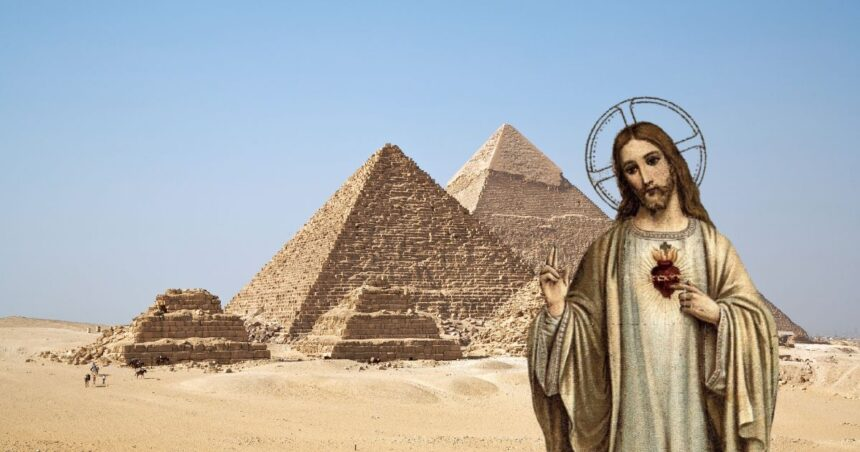
In a world where archaeology, theology, and quantum physics rarely intersect, British anthropologist Dr. Paul Warner has managed to stitch them together in a theory that is as bold as it is controversial. According to Dr. Paul Warner, the Jesus Buried Beneath Great Pyramid of Giza—one of humanity’s most iconic structures.
This striking claim was revealed after his meeting with Egypt’s Minister for Tourism and Antiquities, Ahmed Issa, on October 20, 2022. The Egyptian authorities reportedly agreed to receive Warner’s research data in exchange for their cooperation. If his theory holds any truth, it could represent one of the most transformative discoveries in human history.
A Hidden Chamber Beneath the Ancient Stone
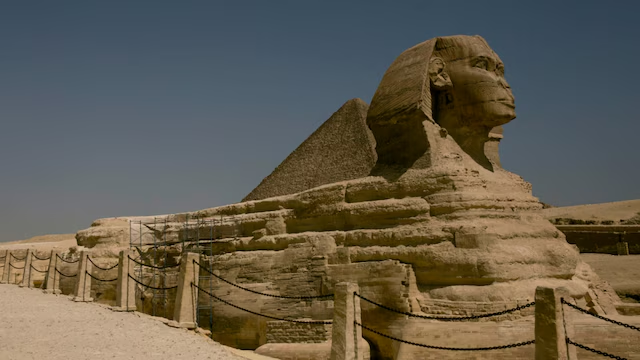
Dr. Warner’s theory centers on the belief that an undiscovered double chamber lies behind a large stone block in the southern corridor of the Great Pyramid of Giza. While the notion may seem far-fetched to many traditional archaeologists, Warner asserts that both Jesus’ tomb and the Ark of the Covenant are concealed within this mysterious chamber.
The basis of his hypothesis is a combination of religious text analysis, modern archaeological practices, and even principles derived from quantum physics.
Rather than limiting his exploration to biblical scripture alone, Warner expanded his research to include the Torah, the Quran, and Mesopotamian clay tablets—some of the earliest known written records. He claims that these ancient texts collectively suggest a single, central location that has historically remained untouched and hidden in plain sight.
According to Paul Warner, there are artificial structures beyond the southern passage of the pyramid, distinguishable only through advanced imaging and interpretation of architectural anomalies.
Read : Unveiling the Ancient Secrets: How the Pyramids of Giza Were Constructed
These formations, he argues, are not the result of natural processes but the product of human design—suggesting the existence of a chamber built to safeguard items of great spiritual and historical importance.
Furthermore, he emphasizes that the location of the chamber aligns with spiritual geometry discussed across various faiths, making it symbolically appropriate as the final resting place of sacred relics. Paul Warner believes the stone block acts as a seal, one placed there intentionally by ancient civilizations to protect the chamber from looters, invaders, or natural disasters.
Clash with Conventional Archaeology and Scientific Bodies
Dr. Paul Warner’s assertions haven’t gone unnoticed by the broader archaeological community. However, they have largely been met with skepticism. The controversy surrounding his claims reached new heights when he openly criticized the Scan Pyramids Mission—an internationally renowned consortium of scientists using muon radiation technology to map the interior of the pyramids.
The Scan Pyramids Mission has been involved in several groundbreaking discoveries, including identifying unknown voids and corridors within the Great Pyramid using cosmic-ray muon detectors. Yet according to Warner, they have failed to explore or even acknowledge the specific southern passageway where he believes the chamber lies.
Warner accuses the group of failing to uphold agreements to assist in breaching the stone barrier. He argues that institutional resistance to paradigm-shifting ideas, combined with political sensitivity regarding religious relics, has slowed the pursuit of knowledge.
In Warner’s view, archaeology must evolve beyond conservative boundaries and embrace interdisciplinary approaches if it hopes to uncover deeper truths buried in the sands of time.
His stance, however, has sparked heated debates among experts. Many mainstream archaeologists question the validity of combining spiritual prophecies and quantum theory with field excavation. Others warn that such theories could inadvertently fan religious tensions, especially given the sanctity of the items Warner claims to have located.
Despite opposition, Paul Warner remains steadfast. He insists that refusing to explore this theory limits humanity’s understanding of its own origin, and by extension, our potential for peaceful coexistence.
Quantum Entanglement and the Divine: A Radical Perspective
Perhaps the most unorthodox aspect of Dr. Paul Warner’s theory is his reliance on quantum theory—specifically, quantum entanglement and non-local consciousness—to explain religious experiences and prophetic visions. In his analysis, the notion of divine revelation and communication with higher beings can be interpreted through the lens of quantum mechanics.
He draws a connection between religious prophecy and the principles behind supercomputing and entangled particles. Just as two entangled particles can remain connected across vast distances, Paul Warner suggests that human consciousness may be similarly linked to higher dimensions or realities. Prophets, mystics, and visionaries throughout history may have accessed these alternate planes through altered states of consciousness.
While this blending of science and spirituality may raise eyebrows in academic circles, Warner sees it as a natural extension of human curiosity. He argues that understanding the metaphysical components of existence is essential to decoding our collective past. Moreover, he believes this synthesis could help bridge gaps between religious ideologies and promote a more unified interpretation of sacred history.
In support of his theory, Warner points to recurring themes and symbols that appear in both ancient texts and modern quantum models. He argues that these parallels are not coincidental but indicative of an underlying order that spans both the physical and spiritual realms.
For instance, he likens the structure of the Great Pyramid to a quantum circuit—meticulously designed to align with cosmic frequencies and energy patterns. According to his research, these architectural features were not merely symbolic but functional—meant to safeguard the spiritual and physical essence of its contents.
From Warner’s point of view, ancient civilizations possessed a kind of proto-quantum knowledge that allowed them to harness energies and design structures beyond the capabilities of modern engineering.
If proven true, this theory could not only rewrite history books but also transform our understanding of consciousness, divinity, and humanity’s role in the cosmos.
A Theory That Demands Exploration
Dr. Paul Warner’s theory may appear radical, but it serves as a reminder of how much we still don’t know about our ancient past. The possibility that Jesus’ tomb and the Ark of the Covenant lie hidden beneath one of the world’s oldest and most enigmatic monuments is both thrilling and controversial.
While critics warn against conflating science with religious mysticism, Warner argues that only such bold thinking can reveal the deeper truths that ancient structures might still guard.
Despite the skepticism, Egypt’s willingness to consider Paul Warner’s findings marks a potentially historic shift in the search for lost relics. Whether or not these sacred items will ever be unearthed, Warner’s theory already challenges the archaeological world to reconsider its assumptions and embrace a more integrated, open-minded approach to discovery.
In a world teetering between ancient divisions and modern uncertainty, Paul Warner’s belief that such a discovery could inspire peace in the Middle East offers a hopeful, if idealistic, vision. Whether that vision becomes reality depends not only on what lies beneath the Great Pyramid, but on our collective willingness to dig deeper—both literally and philosophically.