
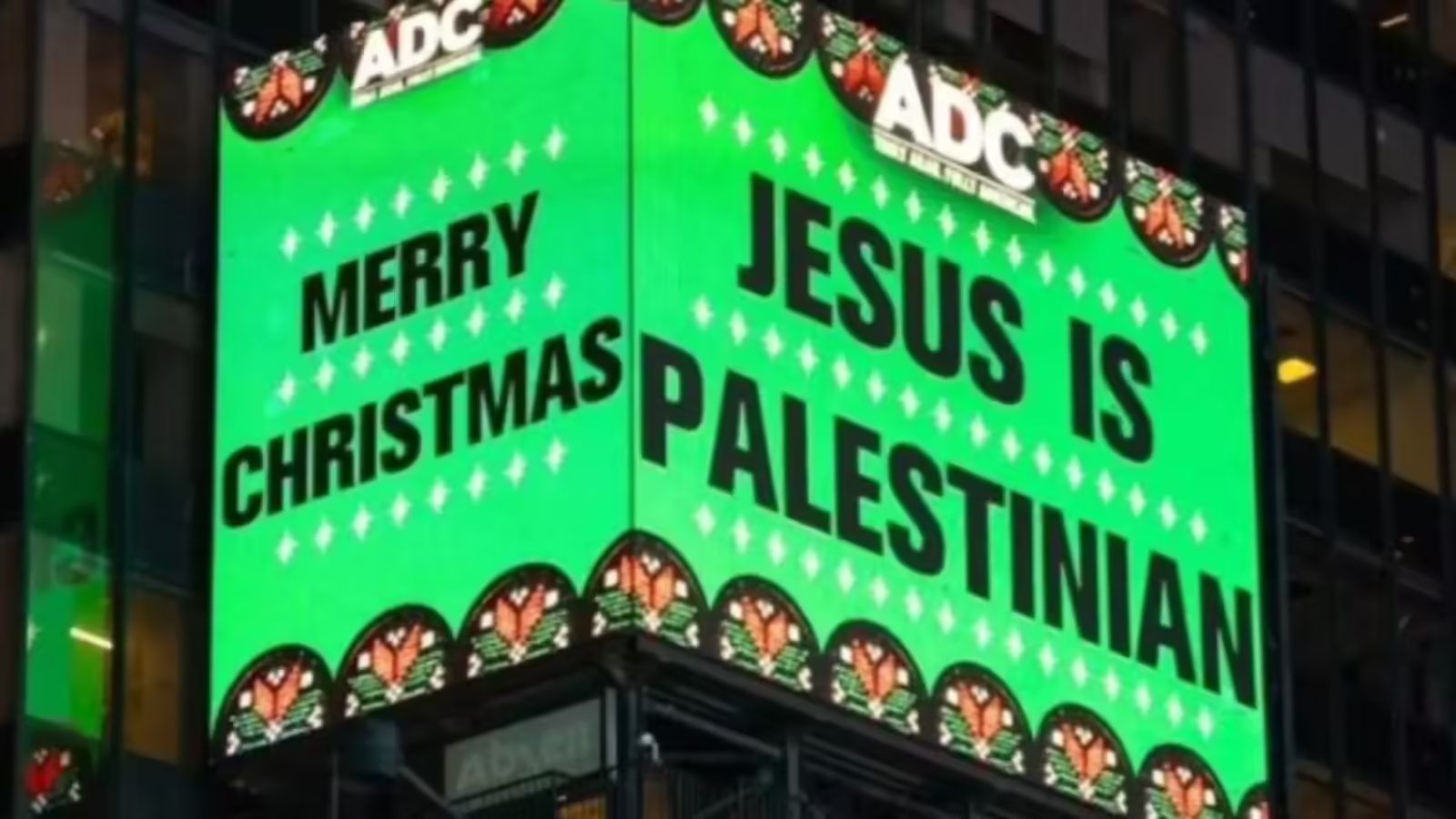
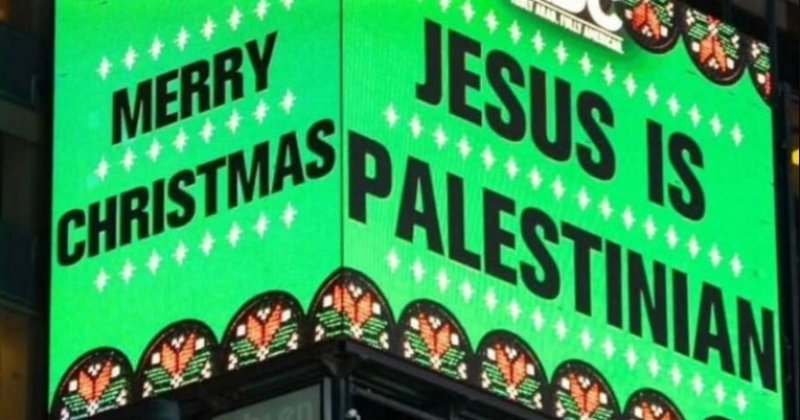
The appearance of a digital billboard declaring “JESUS IS PALESTINIAN” alongside a “MERRY CHRISTMAS” greeting in New York City’s Times Square during the Christmas season drew widespread attention and immediate debate. Located in one of the most heavily visited public spaces in the world, the display reached thousands of tourists and commuters during a period already charged with religious meaning and global political tension.
The message, sponsored by the American-Arab Anti-Discrimination Committee (ADC), sparked conversations that extended far beyond the physical space of Midtown Manhattan, quickly spreading across social media and news platforms. While some viewers interpreted the billboard as provocative or divisive, others viewed it as an invitation to reflect on history, identity, and the intersection of faith and contemporary politics.
Times Square has long functioned as a symbolic stage for public messaging, commercial advertising, and political expression. During the Christmas season, this space becomes even more culturally significant, as religious symbolism, tourism, and national attention converge. Against this backdrop, the billboard’s wording carried amplified meaning. The phrase did not merely reference a historical or theological claim; it intersected with modern geopolitical realities and deeply held beliefs. The reactions it provoked reveal as much about present-day social divisions and sensitivities as they do about the message itself.
Who Sponsored the Billboard and What Was the Intended Purpose
The “Jesus Is Palestinian” billboard was sponsored by the American-Arab Anti-Discrimination Committee, a civil rights organization that advocates for the rights and representation of Arab Americans. According to ADC National Executive Director Adeb Ayoub, the organization has maintained advertising space in Times Square since the beginning of the year, rotating messages on a weekly basis. The Christmas season, he explained, was chosen strategically due to the exceptionally high volume of foot traffic, offering maximum visibility for the organization’s messaging.
Ayoub stated that the purpose of the billboard was not to provoke hostility or dismiss other religious interpretations, but rather to initiate conversation and highlight shared values across religious and cultural communities. He emphasized that Christianity originated in what is historically known as Palestine, a region that today carries profound political and humanitarian significance. From the ADC’s perspective, referencing Jesus in this context serves as a reminder of common historical roots among Christians, Muslims, and Jews, particularly those from the Middle East.
The organization framed the message as inclusive rather than exclusionary. Ayoub noted that interpretations of Jesus’ identity vary widely and that individuals are entitled to their own beliefs. By placing the message in a highly visible public space, the ADC sought to elevate Arab and Muslim voices, which it argues are often marginalized in American public discourse. The billboard, in this sense, functioned as both an expression of identity and a challenge to dominant narratives that separate religion from the historical and cultural contexts in which it emerged.
Read : Time Square: The Heartbeat of New York City
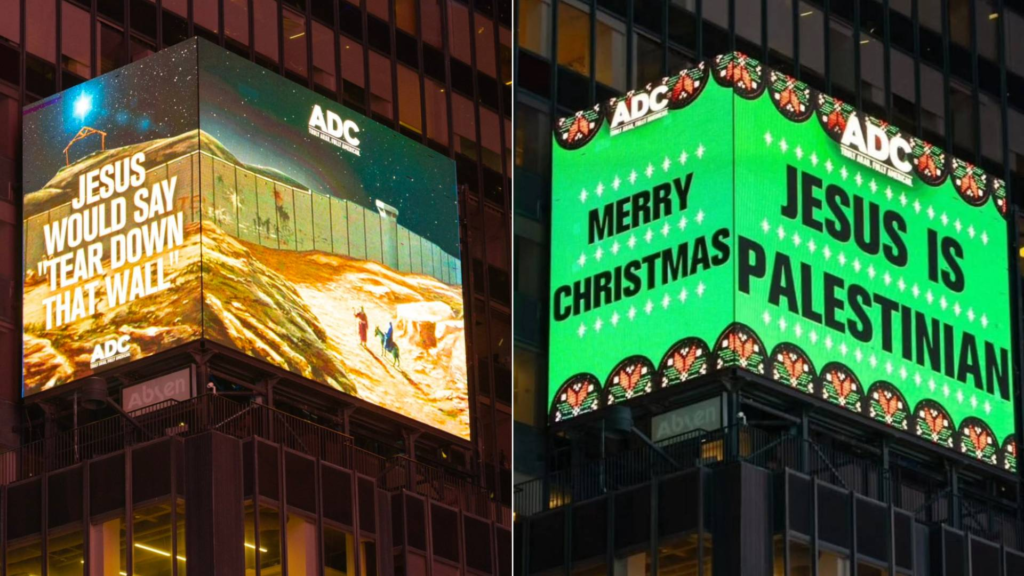
The subsequent replacement of the billboard with a quotation attributed to former U.S. President Ronald Reagan, stating “Jesus would say: ‘tear down this wall,’” further underscored the ADC’s approach. The reference drew parallels between the Berlin Wall and contemporary barriers, including the Israeli security wall, reinforcing the organization’s broader focus on human rights and freedom of movement. The rotating nature of the messages suggests a sustained effort to use Times Square as a platform for advocacy rather than a one-time provocation.
Public Reaction in Times Square and Across Social Media
Reactions to the billboard were swift and varied, reflecting the diverse audience that Times Square attracts. Many tourists stopped to read and discuss the message, with some expressing discomfort at encountering a politically charged statement during a religious holiday. Interviews conducted by local media outlets revealed that several visitors felt the message was divisive or inappropriate for the Christmas season. Some argued that Jesus transcends national or ethnic labels and belongs to all believers, regardless of geography. Others suggested that the timing was particularly sensitive given ongoing global conflicts and heightened emotions surrounding the Middle East.
British tourists interviewed on-site described the message as potentially offensive, while others said it risked introducing political debate into a space associated with celebration and unity. For these viewers, the juxtaposition of “MERRY CHRISTMAS” with a statement tied to contemporary political identity felt jarring. The concern was less about historical accuracy and more about the emotional resonance of the message during a period traditionally focused on peace and goodwill.
At the same time, there were voices of support among both tourists and online commentators. Some visitors from Europe described the billboard as a legitimate expression of perspective, noting that history and faith are often inseparable from place. A French tourist commented that Jesus belongs to everyone and suggested that the message reflected empathy for people currently experiencing hardship in Palestine. These responses framed the billboard as an act of solidarity rather than division.
On social media platforms such as X, reactions mirrored the diversity of opinions expressed on the ground. Photos and videos of the billboard circulated widely, prompting commentary ranging from praise to confusion and criticism. Some users described the message as beautiful and thought-provoking, while others questioned why such a statement appeared in an American public space. The speed with which the image spread online amplified its impact, transforming a localized display into a global talking point.
The intensity of the reaction highlights the power of public messaging in symbolic spaces. Times Square is not a neutral backdrop; it carries cultural weight and global visibility. Messages displayed there are often interpreted as representative of broader societal values or conflicts. In this case, the billboard became a focal point for debates about religion, national identity, free expression, and the role of advocacy in public spaces.
Historical Context, Identity Debates, and Broader Implications
At the core of the controversy lies a complex interplay between history, theology, and modern political identity. Historically, Jesus of Nazareth was born and lived in a region that was part of Roman Judea, an area that corresponds geographically to parts of present-day Israel and Palestine. The use of the term “Palestinian” in this context is rooted in geography rather than modern nationality, but contemporary audiences often interpret it through the lens of current political realities.
Read : Thomas J. Price’s Black Woman Statue in Times Square Sparks Controversy
Supporters of the billboard argue that acknowledging the geographic origins of Christianity can foster greater understanding of the Middle East’s cultural and religious heritage. From this perspective, the message challenges Western-centric portrayals of religious history and encourages recognition of Christianity’s roots outside Europe. It also serves as a reminder that the land associated with biblical narratives is inhabited today by communities facing ongoing conflict and hardship.
Critics, however, contend that applying modern political labels to ancient figures risks oversimplification and misinterpretation. For many Christians, Jesus’ identity is primarily spiritual rather than national or ethnic. Introducing contemporary political terminology into religious discourse can feel reductive, especially when displayed during a sacred holiday. This tension underscores broader debates about how history is interpreted and used in present-day advocacy.
The billboard incident also raises questions about freedom of expression and the responsibilities that accompany high-visibility platforms. Public displays in spaces like Times Square are legally protected forms of speech, yet they carry an implicit influence due to their scale and audience. Organizations that utilize such platforms must navigate the balance between raising awareness and respecting the sensitivities of diverse viewers.
Ultimately, the “Jesus Is Palestinian” billboard illustrates how a short phrase can encapsulate layers of meaning and provoke wide-ranging discussion. The fact that it generated debate across religious, cultural, and political lines suggests that it succeeded in its stated goal of sparking conversation. Whether viewed as divisive or enlightening, the message compelled observers to confront uncomfortable questions about history, identity, and empathy.
The rapid replacement of the billboard does not diminish its impact. For a brief period, it occupied one of the most visible stages in the world, prompting reflection during a season associated with faith and reflection. The reactions it inspired demonstrate that public discourse around religion and politics remains deeply charged, particularly when global conflicts intersect with deeply personal beliefs. In this sense, the Times Square billboard stands as a case study in how symbolic messaging can resonate far beyond its physical presence, shaping conversations that continue long after the screen goes dark.
Leaobetslot seems like a solid choice if you’re into slots. Had a bit of fun spinning the reels. See what you think: leaobetslot