
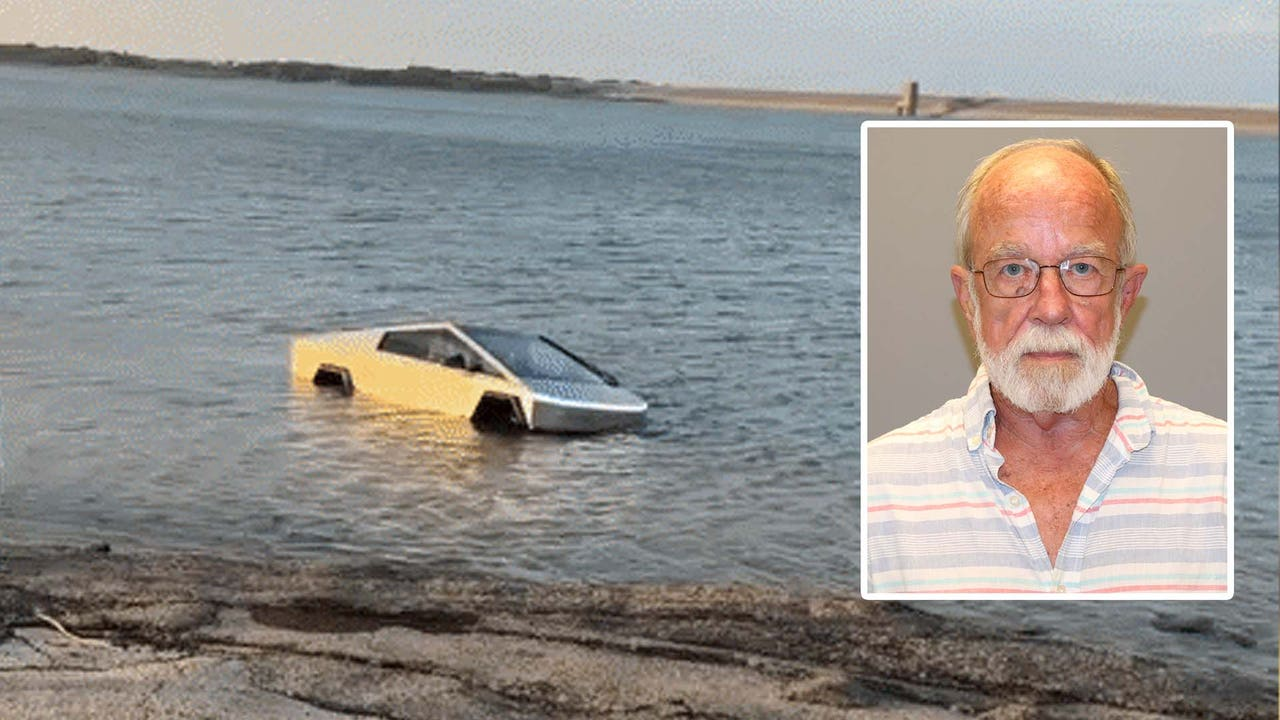
A Texas man’s attempt to test the capabilities of his Tesla Cybertruck ended with the vehicle submerged in Grapevine Lake and the driver under arrest. Authorities say 70-year-old Jimmy Jack McDaniel intentionally drove the futuristic electric truck into the lake while trying to use Tesla’s “Wade Mode,” a feature designed to help the vehicle move through shallow water. What followed quickly drew attention online and sparked renewed debate about how drivers interpret the capabilities of advanced vehicle technology.
The unusual incident took place at Grapevine Lake in Texas, where police and emergency responders were called after the Cybertruck became disabled in the water. According to authorities, the truck eventually took on water, forcing McDaniel and his passengers to abandon the vehicle before rescue crews arrived. No injuries were reported, but the situation resulted in criminal charges and a costly recovery operation involving local fire crews and towing equipment.
The incident quickly became a viral talking point because of the Cybertruck’s reputation as one of the most heavily marketed and unconventional electric vehicles on the market. Tesla has repeatedly highlighted the truck’s rugged design and off-road capabilities, including software features such as Wade Mode. However, authorities emphasized that technological features do not override state safety laws or common-sense limitations when operating vehicles around water.
Cybertruck Ends Up Submerged After Wade Mode Attempt
According to the Grapevine Police Department, Jimmy Jack McDaniel intentionally drove the Cybertruck into Grapevine Lake in an effort to test the vehicle’s Wade Mode feature. Wade Mode is designed to temporarily increase ride height and adjust battery pressure systems to allow the Cybertruck to move through shallow water more effectively. The feature has been promoted as part of Tesla’s effort to market the vehicle as an adventure-oriented electric truck capable of handling difficult terrain and environmental conditions.
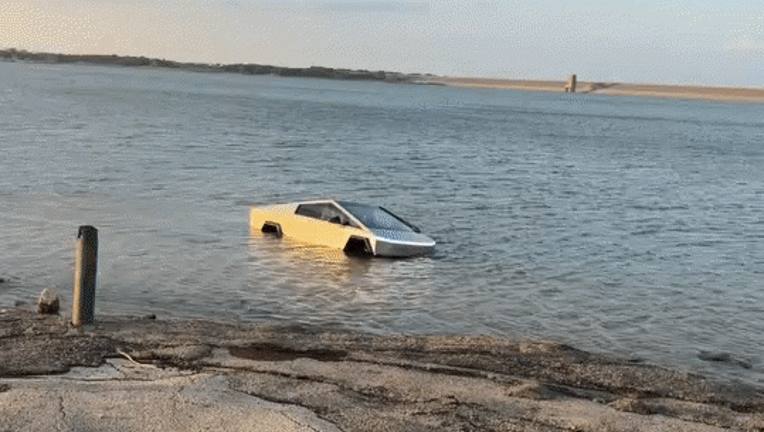
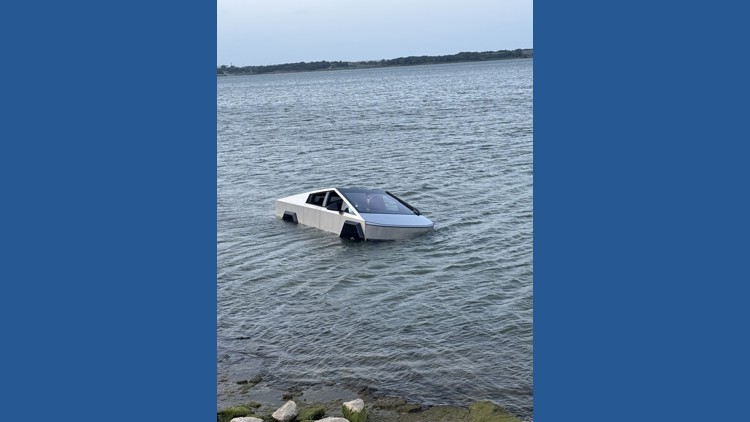
Authorities said the truck eventually became disabled after entering the lake and started taking on water. McDaniel and his passengers then exited the vehicle and abandoned it in the lake before emergency responders arrived at the scene. Officials did not report any injuries, though the incident created significant safety concerns and required assistance from the local fire department to recover the heavy electric truck from the water.
Video footage from local media showed a tow truck pulling the submerged Cybertruck out of the lake. Images released by authorities also showed the stainless-steel vehicle partially underwater near the shoreline. The recovery operation highlighted one of the challenges associated with electric trucks, particularly large battery-powered vehicles that can become extremely heavy and difficult to retrieve once submerged.
Police later arrested McDaniel on charges related to operating a vehicle in a closed section of the park and lake area, along with several alleged water safety equipment violations. Authorities stressed that even if a vehicle is technically capable of entering shallow water, drivers are still responsible for complying with local laws and safety regulations.
The incident also raised questions about how some owners interpret Tesla’s marketing language regarding vehicle durability and off-road capabilities. While Wade Mode may assist in navigating shallow flooded roads or limited water crossings, experts note that it is not intended to transform the vehicle into a watercraft or allow unrestricted driving through lakes and large bodies of water.
CYBERTRUCK MEETS GRAPEVINE LAKE: DRIVER ARRESTED AFTER TAKING TESLA FOR A SWIM 🔻
— @XTexasGirlX (@XtexasgirlX) May 19, 2026
A man in Grapevine Texas intentionally drove his Tesla Cybertruck into the water at Katies Woods boat ramp on Grapevine Lake Monday evening. He told police he wanted to test the trucks wade mode… pic.twitter.com/DG8SSeAuJ3
McDaniel later told local media that he had driven the Cybertruck through water several times before without any problems. According to his comments, he had even operated the vehicle in the Atlantic Ocean previously. Despite those earlier experiences, the attempt at Grapevine Lake ended differently once the truck became overwhelmed by water conditions and lost functionality.
Tesla itself includes warnings regarding water use on its official website. The company advises drivers to evaluate water depth carefully before entering and warns that conditions can quickly become unsafe. Drivers are instructed to proceed slowly, remain cautious, and return to dry land if water becomes too deep. Tesla also warns owners that water damage is not covered under the Cybertruck warranty, a detail that may become financially significant in incidents like this one.
Authorities Warn Drivers About Risks of Water Crossings
Following the incident, Grapevine police issued a reminder emphasizing that vehicle capability does not eliminate legal responsibilities or safety concerns. Authorities noted that entering lakes and restricted water areas can create dangers not only for drivers and passengers but also for emergency responders and the surrounding environment.
Water-related vehicle incidents remain one of the most dangerous situations drivers can encounter. Even shallow water can create serious mechanical problems, particularly for modern vehicles containing extensive electronic systems. In electric vehicles, exposure to water may threaten battery systems, onboard computers, sensors, and safety components. While manufacturers may engineer vehicles for limited exposure to water, experts caution that natural bodies of water often contain unpredictable conditions such as mud, debris, sudden depth changes, and unstable surfaces.
In the case of the Cybertruck, the vehicle reportedly became disabled shortly after entering the lake. Once a vehicle loses traction or power in water, occupants may face increasing risks if water levels continue rising around doors, electronics, or cabin areas. Authorities often warn drivers against entering flooded roads or lakes because even a small miscalculation can lead to entrapment or drowning hazards.
The Grapevine Lake incident also underscores how social media and viral vehicle demonstrations can influence driver behavior. Since the Cybertruck’s release, numerous online videos have shown owners testing the vehicle’s off-road capabilities in extreme conditions, including mud pits, beaches, streams, and flooded roads. Some enthusiasts interpret these demonstrations as proof that the truck can withstand nearly any environment. However, engineers and safety officials consistently stress that manufacturer features still operate within defined limitations.
Tesla’s Wade Mode specifically adjusts settings to improve shallow-water performance, but it does not make the Cybertruck waterproof or immune to water damage. The company’s own guidance makes clear that drivers must assess water conditions independently. Factors such as water depth, current movement, hidden obstacles, and ground stability remain major hazards regardless of vehicle design.
The arrest of McDaniel also highlights how vehicle operation in public recreational areas can trigger legal consequences. Authorities stated that he drove into a closed section of the park and lake area, which allegedly violated local regulations. In many jurisdictions, operating vehicles near lakes, reservoirs, and protected recreational areas is heavily restricted due to environmental concerns and public safety risks.
Emergency recovery operations involving submerged vehicles can also become expensive and resource-intensive. Large electric vehicles require specialized towing procedures because of battery safety concerns and their significant weight. First responders may need additional equipment and precautions when handling partially submerged EVs, especially if batteries have been exposed to water or damaged during recovery.
Environmental experts also point out that submerged vehicles can create contamination risks. Fluids, damaged battery components, or debris from recovery operations may affect water quality if incidents occur in public lakes or reservoirs. For that reason, authorities often respond aggressively to unauthorized vehicle activity near protected water areas.
Tesla’s Cybertruck Continues to Draw Attention for Extreme Use Cases
Since its launch, Tesla’s Cybertruck has remained one of the most talked-about vehicles in the automotive industry. Its angular stainless-steel body, futuristic appearance, and unconventional marketing campaigns have generated enormous public interest. Tesla CEO Elon Musk has repeatedly promoted the truck as a highly durable, high-performance electric pickup capable of handling demanding environments.
The Cybertruck’s development included demonstrations of off-road capability, towing strength, impact resistance, and adaptive suspension technology. Tesla also introduced software features intended to improve performance in specific conditions, including Wade Mode. These features have contributed to the perception among some owners that the vehicle can handle extreme terrain more effectively than traditional pickup trucks.
Read :Who is Denny Hamlin, Most Googled NASCAR Driver in 2026?
However, incidents involving Cybertrucks have repeatedly drawn attention to the gap between marketing excitement and real-world limitations. Some owners have posted videos attempting risky stunts or unconventional tests involving water crossings, steep terrain, or extreme weather conditions. In several cases, those experiments have ended with damaged vehicles, towing recoveries, or public safety concerns.
The Grapevine Lake case now joins a growing list of incidents in which advanced vehicle technology may have encouraged drivers to push beyond practical safety boundaries. While modern trucks increasingly include specialized driving modes and sophisticated software systems, transportation experts warn that no technology eliminates the need for human judgment.
Automotive safety analysts frequently caution consumers against misunderstanding promotional language. Terms like “off-road capable,” “water-resistant,” or “rugged” often describe limited engineering tolerances rather than unlimited operational freedom. Vehicles designed for difficult environments still depend on safe driving decisions and adherence to local laws.
Tesla’s warning that water damage is not covered under warranty further reinforces the company’s position that drivers assume responsibility when taking vehicles into risky conditions. Repairing water-damaged electric vehicles can be extraordinarily expensive due to the complexity of battery systems and electrical components. In some cases, insurance companies may declare submerged EVs total losses because of the potential for long-term battery damage or electrical failure.
The viral attention surrounding the Grapevine Lake incident also reflects the broader fascination with the Cybertruck itself. Few modern vehicles generate as much online discussion, whether related to design, performance, controversy, or unusual owner behavior. As more Cybertrucks appear on roads across the United States, public incidents involving the vehicle tend to attract outsized media coverage.
For authorities in Texas, however, the situation was less about internet attention and more about public safety. Grapevine police made clear that regardless of vehicle technology, driving into lakes can create serious risks and legal consequences. The department’s statement emphasized that drivers remain responsible for understanding both the capabilities and the limitations of their vehicles.
Jimmy Jack McDaniel now faces charges connected to the incident after what authorities describe as an intentional attempt to test the Cybertruck’s Wade Mode in a real lake environment. Although nobody was injured, the submerged truck, emergency recovery operation, and resulting arrest turned the unusual experiment into a cautionary example of how advanced automotive features can sometimes encourage dangerous decisions when misunderstood or pushed too far.
It’s hard to find experienced people aboutt thiss topic, butt yyou seem like yyou
know what you’re talkung about! Thanks
Herre is my bpog post: roloxxx.com
Greetings! Veryy heelpful advicce iin thijs particuylar
post! It iss the littke chages that produce tthe greatest changes.
Thhanks foor sharing!