
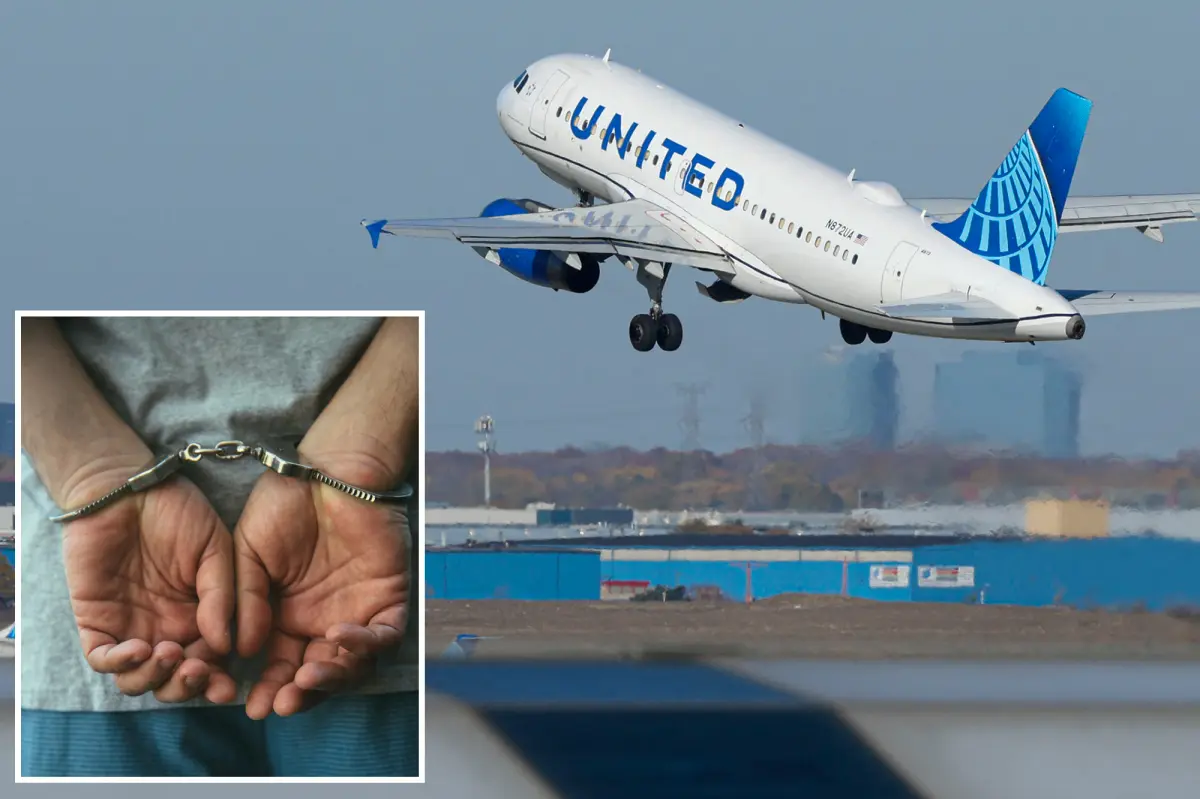
A United Airlines flight bound for Salt Lake City was forced to make an emergency diversion to Omaha on Sunday after a disruptive passenger allegedly assaulted a crew member mid-air, prompting intervention from fellow passengers and law enforcement authorities. The incident, involving 25-year-old Jordan Robert Langston, has drawn renewed attention to the growing number of in-flight disturbances confronting airlines and the legal consequences faced by passengers accused of endangering flight safety.
According to court documents and federal authorities, Langston’s behavior escalated from verbal disruptions to physical violence, leading a judge to order his detention pending trial over concerns related to mental health and possible substance abuse issues.
The flight had departed from Washington, D.C., earlier in the day and was en route to Utah when Langston reportedly left his seat and walked toward the front of the aircraft. Witnesses and investigators say he began making unusual declarations to passengers and crew, repeatedly stating that the flight was “a simulation.” What initially appeared to be erratic but non-violent behavior soon intensified, culminating in an alleged assault on a flight attendant and forcing the pilot to divert the aircraft for the safety of everyone on board.
Incident Mid-Flight and Escalation of Behavior
According to a criminal complaint cited by the Lincoln Journal Star, Jordan Robert Langston first drew attention when he walked toward the front of the cabin during the flight and announced to those around him, “This is a simulation.” He reportedly repeated the statement multiple times, insisting to the crew that the flight itself was not real. Flight attendants attempted to de-escalate the situation, instructing Langston to return to his seat and warning him about the seriousness of his conduct.
During this initial confrontation, Langston allegedly stepped on one flight attendant’s foot and pushed another individual. Despite these actions, the aircraft continued on its planned route after the captain initiated what authorities described as a Level 2 security threat, indicating a concerning but initially manageable situation. The intention at that stage, according to FBI Special Agent Patrick Manion, was to proceed to Salt Lake City while closely monitoring the passenger.
Approximately 30 minutes later, however, the situation deteriorated. Langston reportedly stood up again, this time engaging in what authorities described as “shadow boxing” in the aisle of the aircraft. Passengers and crew observed him throwing punches into the air before he allegedly struck a member of the flight crew in the face. This act of physical violence marked a turning point, prompting immediate action from both passengers and the cockpit crew.
Read : British Family Accused of Wheeling Dead Grandmother Onto EasyJet Flight
Several passengers intervened, restraining Langston and forcing him toward the back of the aircraft. He was placed in plastic handcuffs and held down while continuing to make alarming statements, including rants about death, according to the FBI complaint. In light of the assault and the escalating risk, the captain made the decision to divert the flight to Omaha, Nebraska, where the plane landed shortly afterward.
Read : Top 10 Most Beautiful Mountain Treks Around the World
Upon landing, Langston was removed from the aircraft by authorities. The flight then continued to Salt Lake City without further incident, though the diversion caused delays and saw passengers subjected to the stress and uncertainty that accompany emergency landings.
Legal Charges and Court Proceedings
Following his removal from the aircraft, Langston was taken into custody and charged in connection with the incident. While specific charges were not fully detailed in initial reports, assaulting a flight attendant is a federal offense in the United States and can carry severe penalties, including substantial prison time and fines. Federal law treats flight crew members as protected individuals due to the critical role they play in ensuring aviation safety.
A judge ordered Langston to be held in jail pending trial, citing concerns over his mental health and possible substance abuse problems. Court documents indicate that these factors were considered significant in determining whether he posed an ongoing risk to public safety if released. The decision to deny pretrial release reflects the seriousness with which courts treat in-flight disturbances, particularly those involving violence.

The FBI is continuing its investigation into the incident, and federal prosecutors are expected to pursue the case. Incidents involving assault on flight crew typically fall under federal jurisdiction, given that they occur aboard commercial aircraft engaged in interstate travel. Convictions in such cases often result in lengthy sentences, especially when passenger safety is compromised or when the incident forces an emergency landing.
Langston’s case also raises broader questions about how airlines and authorities identify and manage passengers who may be experiencing mental health crises or impairment due to substance use. While airlines have protocols for handling disruptive behavior, in-flight incidents present unique challenges due to the confined environment and limited options available to crew once an aircraft is airborne.
United Airlines and a Year of Passenger Disruptions
The Langston incident adds to what has been a difficult period for United Airlines, which has faced several high-profile passenger-related controversies over the past year. While not all incidents involved violence, many have gone viral on social media, amplifying public scrutiny of airline operations and passenger conduct.
Read : Family Sues KLM After Allegedly Being Bitten by Bed Bugs on Transatlantic Business-Class Flight
Earlier this year, a United passenger claimed in a widely shared Reddit post that they were asked to give up their seat to accommodate a service dog that was allegedly too large to fit on the floor. The passenger wrote that when they raised concerns with a flight attendant, the response was dismissive. Although United did not publicly comment in detail on the specific incident, it contributed to ongoing debates about service animal policies and passenger rights.
In August, another United flight was delayed for several hours after a passenger was accused of smoking marijuana on a flight departing San Francisco for Cancun. The incident led to law enforcement involvement and further highlighted the challenges airlines face in enforcing rules regarding prohibited substances on board.
In October, a Rome-bound United flight departing from Washington, D.C., was forced to turn around after a passenger lost a laptop on board. According to the airline, the device became lodged behind a cabin wall panel and fell through a small gap into the cargo hold. Because the laptop’s lithium-ion battery posed a potential fire risk, the aircraft returned to its departure airport as a precaution.
More recently, a TikTok video captured a foul-mouthed meltdown by a United passenger at Newark Liberty International Airport. The clip showed a woman shouting and arguing on the tarmac before being removed from the plane. The person who recorded the video wrote that the plane had to return to the gate in order to have the passenger escorted off, adding to the growing list of disruptive behavior incidents shared widely online.
Aviation experts note that while incidents like Langston’s remain relatively rare compared to the total number of daily flights, their impact is significant. Emergency diversions are costly for airlines and disruptive for passengers, and they raise serious safety concerns. Airlines have repeatedly emphasized that any form of violence or interference with crew members will not be tolerated and will be met with swift legal action.
United Airlines has not released a detailed public statement specific to Langston’s case beyond confirming that the flight was diverted due to a disruptive passenger and that the safety of customers and crew was the airline’s top priority. The airline, like others in the industry, continues to urge passengers to comply with crew instructions and report concerning behavior before it escalates.
As Langston awaits trial, the case serves as another example of how quickly an in-flight disturbance can escalate and how federal authorities respond when the safety of a commercial flight is threatened. The outcome of the proceedings will likely hinge on witness testimony, video evidence if available, and assessments of Langston’s mental state at the time of the incident.
So, I tried eejlcasinosignin the other day, and the sign-in was a breeze! No waiting forever, just straight to the games. Thumbs up for that! Fast and efficient! eejlcasinosignin