
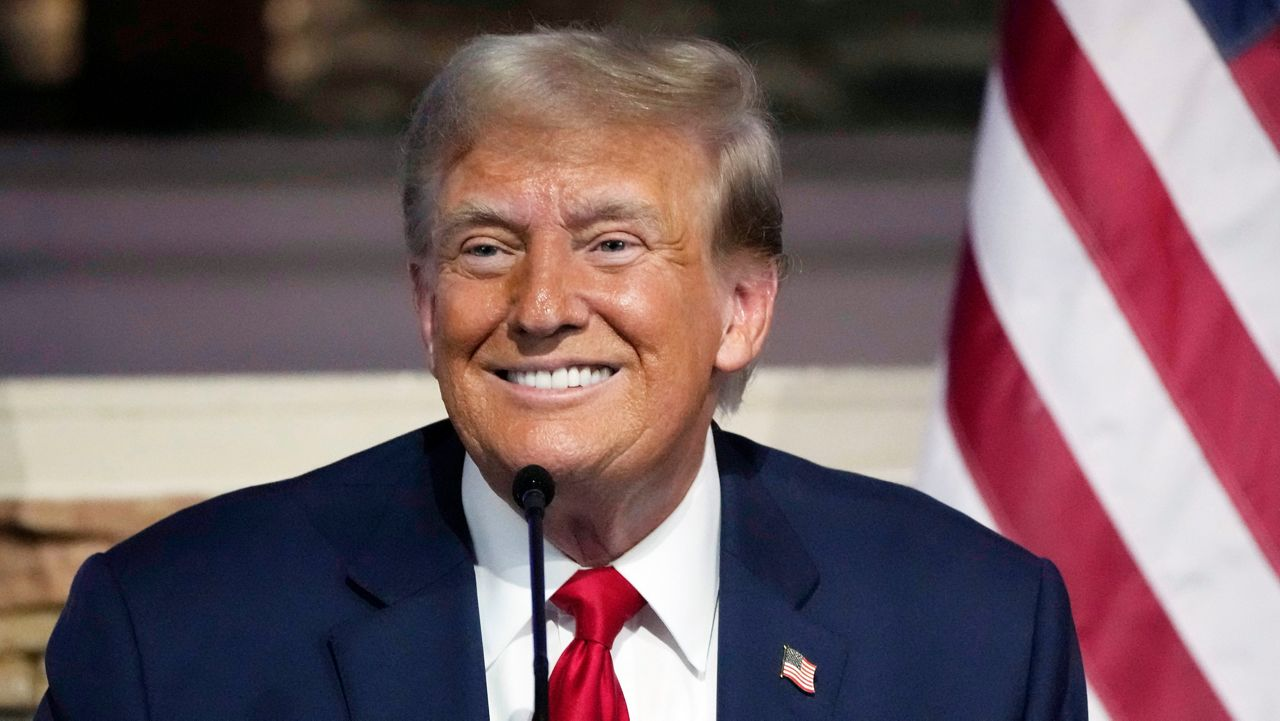
As Donald Trump awaits his official return to the White House, legal challenges continue to trail his political comeback. This week, a New York judge decided to delay a ruling in Trump’s hush money case, a historic legal proceeding for a U.S. president-elect who has already been convicted but is seeking to overturn that decision.
This delay puts on hold a potential ruling related to presidential immunity, a factor that could reshape the trial’s outcome and Trump’s post-election path.
What is the Hush Money Case Against Trump?
The “hush money” case refers to a complex legal web that began with alleged payments to silence claims of an affair. In 2016, Trump’s former lawyer, Michael Cohen, paid $130,000 to Stormy Daniels, an adult film star, to prevent her from discussing an alleged affair with Donald Trump. The payment, often referred to as “hush money,” was part of a larger scheme to keep unfavorable information hidden from the public ahead of the 2016 election.
The legal issue centers on whether Trump, who reimbursed Cohen for the payment, falsified business records to cover up the transaction as legal expenses.
Read : Return of Donald Trump as the POTUS is Bad News for Pakistan
This became the foundation for 34 felony charges of falsifying business records against Trump, marking a landmark moment in U.S. history as he became the first former president to be criminally convicted. Trump maintains his innocence, asserting that the charges are politically motivated, and has called Daniels’ claims untrue.
Presidential Immunity and Its Impact on the Case
Trump’s legal team, spearheaded by attorney Todd Blanche, has seized on a recent Supreme Court ruling about presidential immunity to argue for dismissing his conviction. The ruling stipulates that presidents are immune from prosecution for official acts carried out during their tenure.
Read : Trump Challenges Biden to Golf Match with $1 Million Charity Bet
Donald Trump’s team argues that this immunity should extend to evidence introduced at his trial, particularly communications involving White House aides Hope Hicks and Madeleine Westerhout. They contend that these communications, if protected by immunity, should not have been shown to jurors.
The Supreme Court’s recent decision has opened up new questions about what counts as “official acts” in a presidential role, as Trump’s legal team claims that certain evidence displayed in the trial unfairly prejudiced the jury.
Justice Juan Merchan, overseeing the case, is set to determine next week whether this immunity invalidates any evidence used in Trump’s trial, thereby calling into question the legitimacy of the verdict.
Prosecutors, however, maintain that the Supreme Court’s ruling on presidential immunity does not apply to the materials presented at trial.
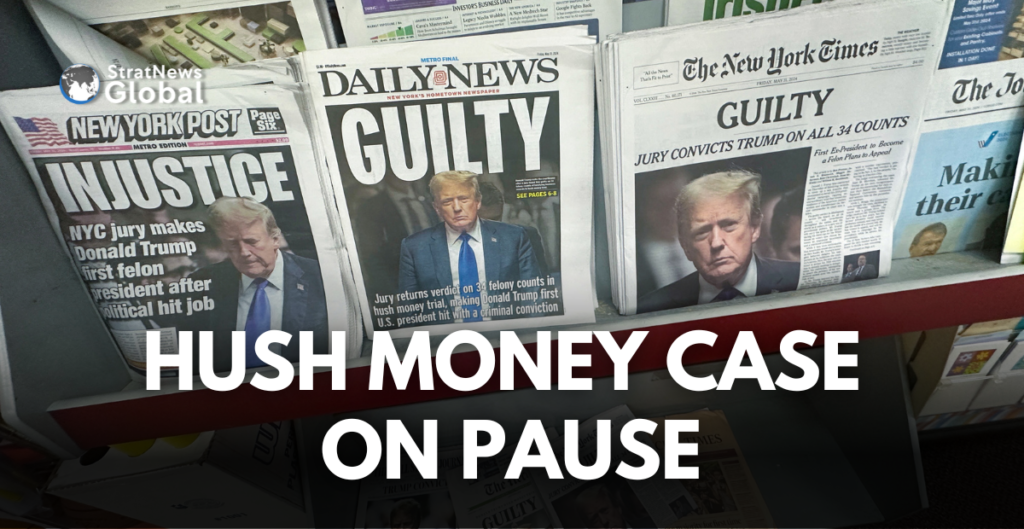
They argue that the evidence relating to Trump’s interactions with his aides represented only a minor part of the “mountains” of proof that led to Trump’s conviction. The Manhattan District Attorney’s office holds that the trial process was legitimate and that the jury’s verdict should remain intact, given the broader scope of evidence.
Trial Delays and Their Broader Implications
The deferment of this ruling holds several potential ramifications. If the court accepts Trump’s immunity claim and decides to overturn his conviction, it could significantly alter the future of the Manhattan District Attorney’s case against him.
Additionally, such a ruling would set an unprecedented standard for presidential immunity in criminal cases, especially regarding acts performed by former presidents running for office again.
Furthermore, the current pause could impact Trump’s upcoming sentencing, initially scheduled for late November. With Trump’s legal team requesting a stay on the sentencing date due to the recent election results, they argue that a conviction could hamper his ability to serve as president if it is allowed to stand.
The Manhattan District Attorney’s office is balancing these concerns with the need to uphold the jury’s verdict, describing the circumstances as “unprecedented.”
The latest pause adds a layer of complexity to an already highly scrutinized case. Trump, who resumed his campaign activities immediately after his conviction, has vowed to continue his legal fight, aiming to overturn the guilty verdict.
As the judge’s decision looms, the nation’s attention remains fixated on whether the former president’s status will afford him a legal shield not previously granted to any other public official.
A History of Legal Battles
Donald Trump’s relationship with the Manhattan District Attorney’s office dates back to 2018, when investigators began looking into his finances. This investigation eventually narrowed its focus to the “hush money” payments and culminated in Trump’s indictment in March 2023 by a New York grand jury.
Trump’s seven-week trial in the spring of 2024, which resulted in his conviction on 34 counts, made him the first U.S. president or president-elect to be convicted of a crime.
The trial itself was marked by intense media coverage, with Trump’s legal team challenging every step, from the admissibility of evidence to the fairness of the proceedings.

Following the Supreme Court’s July 2024 decision on presidential immunity, Trump’s defense team filed an appeal, claiming the verdict should be voided on grounds of inadmissible evidence. Now, Justice Merchan’s upcoming ruling will determine the impact of presidential immunity on the trial’s outcome.
While Trump continues to deny any wrongdoing in relation to the hush money deal, his legal team has focused on shifting the conversation toward what they argue is an overreach in using evidence involving his former aides.
Trump’s attorneys argue that the verdict fails to account for presidential privileges, contending that Trump’s case falls under the protections for former presidents facing prosecution for their actions while in office.
What Lies Ahead?
With Justice Merchan’s ruling anticipated next week, the legal and political implications of the case remain far-reaching. If Donald Trump’s immunity argument succeeds, it could set a precedent affecting future presidents, reshaping how presidential immunity applies in both criminal and civil cases. However, if the court upholds Trump’s conviction, it would signal a significant limit to the privileges of presidential office.
As the nation waits, Donald Trump’s legal team is preparing for any outcome, ready to appeal to higher courts if necessary. The case highlights the complexities of prosecuting former presidents and underscores the ongoing national debate over the limits of presidential power and accountability.
With both the legal and political implications still unfolding, Donald Trump’s hush money case remains a critical chapter in American history. The outcome of this case will have lasting effects not only on Trump’s future but also on the broader interpretation of presidential immunity and the accountability of elected officials.