

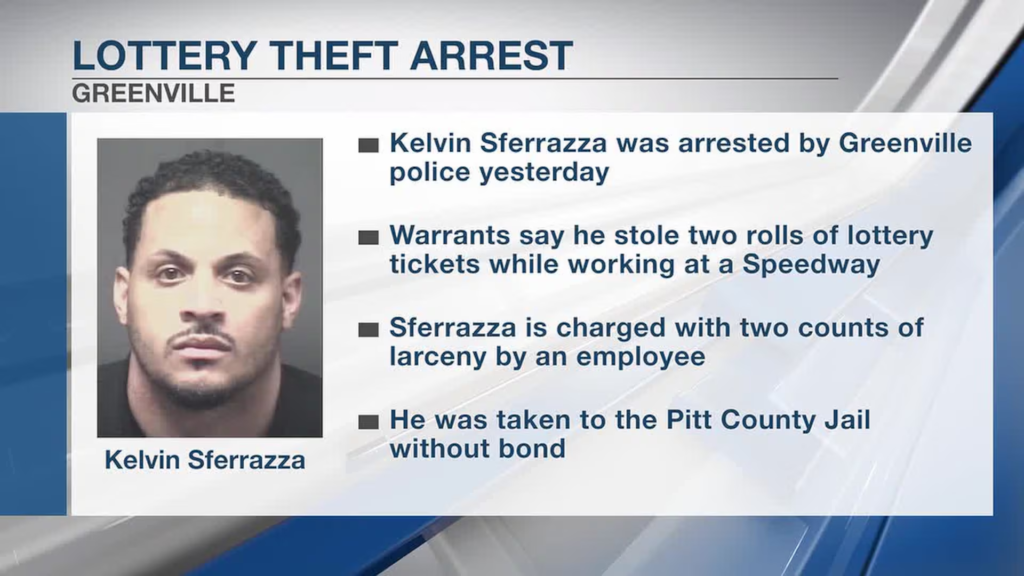
A petrol station employee in Greenville has been arrested after authorities accused him of stealing rolls of lottery tickets from the store where he worked. The case has drawn attention locally due to the unusual nature of the alleged theft and because it occurred during a period when several other lottery-related fraud cases have surfaced in the region. Police say the suspect, a 37-year-old man identified as Kelvin Sferrazza, now faces criminal charges after investigators concluded that the tickets were taken directly from his workplace.
The alleged incident has raised questions about internal theft in retail environments, particularly in convenience stores and petrol stations where lottery tickets are commonly sold and handled by employees throughout the day. Authorities say the incident happened earlier in the week at a Speedway fueling station located on Stantonsburg Road.
According to arrest warrants, Kelvin Sferrazza allegedly took two rolls of lottery tickets that were each valued at $50 while he was on duty. Even though the total amount involved in the alleged theft appears relatively small, cases involving employee theft are often treated seriously because they involve a breach of trust between a worker and their employer. Officials say the investigation began after the tickets were reported missing, prompting a closer review of inventory and store activity.
Alleged Theft at Greenville Speedway Station
Investigators say the alleged theft took place on Tuesday while Kelvin Sferrazza was working at the Speedway petrol station. Lottery tickets are usually stored in secure display units or behind the counter and are sold in sequential rolls that contain multiple scratchcards or instant-win tickets. These rolls are tracked as part of store inventory, making it possible for businesses to identify discrepancies when items go missing. According to authorities, two rolls priced at $50 each were removed from the store’s supply without authorization during Sferrazza’s shift.
The discovery of the missing tickets led to an internal review, which eventually prompted law enforcement involvement. While officials have not publicly described the exact method used to determine who was responsible, employee theft cases are often uncovered through a combination of inventory records, surveillance footage, and internal reporting by staff members or managers. After examining the available evidence, investigators obtained warrants charging Kelvin Sferrazza with two counts of larceny by an employee, a criminal charge applied when a worker is accused of stealing property from the company they work for.
Authorities arrested Kelvin Sferrazza on Thursday following the investigation. After being taken into custody, he was transported to the Pitt County Jail. Jail records indicate that he was held without bond at the time of his booking. Officials say the decision to hold him without bond is connected to other legal matters involving the suspect. According to records, Sferrazza currently has pending charges in Pitt County as well as Beaufort County, though further details about those cases were not immediately released.
Read : New Studies Reveal How Space Travel Impacts the Health of Space Tourists
Retail businesses frequently implement security measures to prevent internal theft, particularly in stores that handle cash transactions and high-demand items such as lottery tickets. These measures often include video surveillance, electronic inventory tracking systems, and regular audits designed to identify discrepancies quickly. Even with these safeguards in place, however, employee theft remains a challenge for many retailers. Convenience stores and petrol stations are particularly vulnerable because staff members often work independently during shifts and handle both cash and merchandise.
Other Lottery Fraud Cases Surface in South Carolina
The arrest of Sferrazza comes amid a series of other lottery-related investigations in South Carolina. Only two weeks before the Greenville incident, state authorities announced the arrest of two men accused of attempting to commit lottery fraud involving counterfeit or stolen tickets. These cases were investigated by the South Carolina Law Enforcement Division, which oversees major fraud and criminal investigations involving the state lottery system.
According to officials, 34-year-old Zachary Blackwell was charged with intent to defraud and possession of counterfeit game tickets after allegedly attempting to pass a stolen South Carolina Education Lottery scratchcard at a self-scan terminal. Self-scan verification machines allow players to check whether their tickets are winners by scanning a barcode on the ticket. Authorities say the system flagged the suspicious ticket during the verification process, prompting further investigation.
Read : 18-Year-Old Taleah Rosssmith Arrested for Biting WinCo Worker While Attempting to Steal Alcohol
In a separate incident, 56-year-old Lamont Clarke was also charged with intent to defraud and possession of counterfeit game tickets. Investigators allege that Clarke attempted to pass multiple South Carolina Education Lottery scratchcards at a grocery store. Store employees reportedly became suspicious during the transaction and alerted authorities, who later determined that the tickets involved were counterfeit.
Officials say these cases demonstrate the variety of ways lottery systems can be targeted by individuals attempting to commit fraud. Stolen tickets, counterfeit scratchcards, and attempts to redeem altered or invalid tickets are among the schemes investigators encounter. While lottery agencies use advanced tracking systems to monitor ticket distribution and redemption, fraud attempts occasionally occur, prompting law enforcement investigations.
Retailers who sell lottery tickets are required to follow strict procedures when handling them. Tickets must be activated through a dedicated lottery terminal before they can be sold, ensuring that each ticket is linked to a specific retailer and transaction. This activation process helps prevent stolen tickets from being redeemed and allows officials to trace suspicious activity when necessary. Employees who handle lottery tickets are also trained to recognize signs of tampering or fraud.
Despite these precautions, authorities say occasional incidents still arise, particularly in busy retail environments where large numbers of tickets are sold daily. Investigators encourage store owners and employees to report any unusual activity involving lottery tickets so that potential fraud can be addressed quickly. The recent cases in South Carolina have highlighted the importance of maintaining strong oversight and security measures across the lottery retail network.
Lottery Wins Continue Amid Fraud Concerns
While recent incidents have focused on theft and fraud, legitimate lottery wins continue to generate excitement among players across the country. In Greenville County itself, one player recently claimed a prize worth $50,000 after purchasing a winning ticket from a local retailer. Lottery officials say wins like this illustrate the widespread appeal of scratchcards and other instant-win games, which are sold at thousands of retail locations across the United States.
The popularity of lottery games often increases when major jackpots reach exceptionally high levels. Earlier this month, a player in Illinois won a massive Mega Millions jackpot worth $533 million, marking the first jackpot win of 2026 for the multi-state lottery game. The jackpot had grown steadily over several weeks after a long stretch without a winner.
Read : CityCat Worker Jodie Daunis Fired After Taking 114 Sick Days in 12 Months
Mega Millions jackpots increase each time a drawing occurs without a winning ticket that matches all required numbers. In this case, the prize rolled over for 28 consecutive drawings before finally being claimed. The previous jackpot win occurred on December 2 in New Jersey, making the Illinois prize the first major jackpot awarded in the new year.

Like other large lottery prizes, the Mega Millions jackpot comes with two payout options. The winner can choose to receive the full prize amount through annual payments distributed over several decades, or they can opt for a one-time lump sum payment that is smaller but available immediately. Officials say the estimated cash value of the Illinois jackpot is approximately $244.2 million.
Major lottery wins often draw widespread attention and can significantly increase ticket sales nationwide. Petrol stations, convenience stores, and supermarkets frequently see long lines of customers hoping to try their luck when jackpots climb into the hundreds of millions of dollars. Retailers benefit from increased sales during these periods, as many customers purchase additional tickets while visiting stores.
Lottery officials emphasize that strict rules and verification processes are designed to protect both players and retailers. Every ticket sold is recorded through a centralized system, and prize claims are carefully reviewed before payments are issued. These measures help ensure the fairness and integrity of lottery games, which generate billions of dollars in revenue annually and often contribute funding to public programs such as education.
Cases like the arrest of Kelvin Sferrazza highlight the contrast between the excitement of legitimate lottery participation and the legal consequences faced by those accused of abusing the system. Even relatively small incidents involving lottery tickets can result in serious criminal charges when they involve theft or attempts to defraud retailers or the lottery system. Authorities say investigations into such incidents will continue as part of ongoing efforts to maintain trust in the lottery industry and protect businesses that participate in the sale of lottery products.