

A 44-year-old North Carolina woman is facing multiple criminal charges following an alleged assault involving a pregnant school resource officer at an elementary school in Beaufort County. Authorities say the incident unfolded during a confrontation at John Small Elementary School, where Khadeeja Muhammad had reportedly gone to see her child despite being instructed by social services not to make contact.
The case has drawn attention because of the alleged nature of the assault, the setting within a school environment, and the involvement of a pregnant law enforcement officer assigned to protect students and staff. While officials have stated that neither the officer nor her unborn child was injured, the incident has raised broader questions about school safety, parental access restrictions, and the legal consequences of violating court or agency directives.
According to court documents, Khadeeja Muhammad was arrested Thursday by the Beaufort County Sheriff’s Office after warrants were issued outlining a series of alleged offenses. The accusations include resisting a public officer, assault on a government official or employee, assault on a pregnant woman, second-degree trespass, and disorderly conduct at a school.
Muhammad was subsequently booked into the Beaufort County Detention Center, where she remained following her arrest. Law enforcement officials have emphasized that the charges stem from a single encounter that escalated after repeated instructions to leave the school premises were allegedly ignored.
Events Leading Up to the Alleged Assault at John Small Elementary School
Court records indicate that Muhammad went to John Small Elementary School in an attempt to see her child. At the time, the Division of Social Services had reportedly instructed her not to have contact with the child, a directive that formed a key part of the situation. The specific reasons behind the social services restriction were not detailed in the warrants, but such orders are typically issued in cases involving custody disputes, child welfare concerns, or ongoing investigations. Regardless of the underlying circumstances, authorities allege that Muhammad arrived at the school despite knowing she was not permitted to make contact.
Once on campus, school officials became aware of her presence, prompting the involvement of the school resource officer. According to the warrants, the officer instructed Muhammad multiple times to leave the premises. School resource officers are sworn law enforcement personnel assigned to schools to maintain safety, manage disturbances, and serve as a liaison between law enforcement and educational institutions. In this role, they have the authority to issue lawful orders, including directing individuals to leave school property if they are not authorized to be there.
Authorities allege that Muhammad refused to comply with these repeated requests. The refusal to leave allegedly escalated the situation, transforming what might have been a routine trespass matter into a physical confrontation. According to the court documents, during this confrontation Muhammad allegedly kicked the pregnant school resource officer in the stomach. The alleged act formed the basis for the most serious charges filed against her, particularly assault on a pregnant woman and assault on a government official or employee.
Read : Exploring the Vibrant Tapestry of Phnom Penh: Cambodia’s Dynamic Capital
Law enforcement officials later confirmed that despite the alleged kick, the school resource officer and her unborn child were not injured. This information was emphasized by the sheriff’s office, likely to address immediate concerns about the health and safety of both the officer and the baby. Even in the absence of physical injury, however, the alleged action remains a felony-level offense under North Carolina law due to the protected status of the victim and the circumstances of the incident.
Criminal Charges Filed and Applicable North Carolina Law
Following the incident, Khadeeja Muhammad was charged with multiple offenses reflecting both her alleged conduct and the location where it occurred. Among the charges is resisting a public officer, which in North Carolina can apply when an individual willfully resists, delays, or obstructs a law enforcement officer in the performance of their duties. Prosecutors often rely on this charge when a person refuses to comply with lawful commands or interferes with an officer’s attempt to maintain order.
Another significant charge is assault on a government official or employee. This offense applies when an individual assaults a public servant, including law enforcement officers, while they are performing official duties. Convictions for this charge can carry enhanced penalties compared to simple assault, reflecting the state’s interest in protecting public employees who are required to place themselves in potentially volatile situations as part of their jobs.
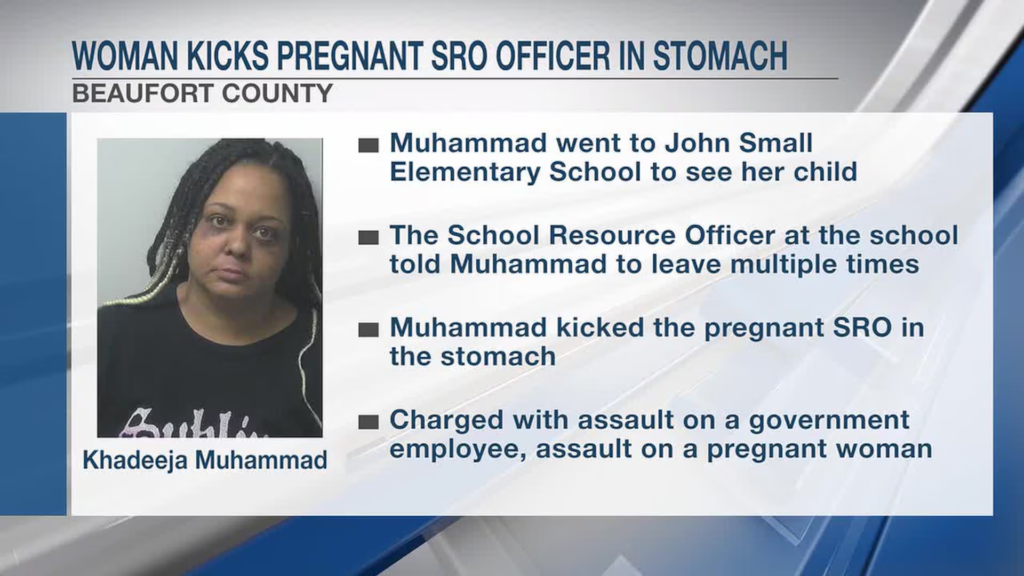
Muhammad also faces a charge of assault on a pregnant woman, a specific offense recognized under North Carolina law. Assaults against pregnant individuals are treated with particular seriousness because of the potential risk to both the woman and the unborn child. Even if no injury occurs, the act itself can be sufficient to sustain the charge if prosecutors can prove that the defendant knew or reasonably should have known that the victim was pregnant.
Additional charges include second-degree trespass and disorderly conduct at a school. Second-degree trespass typically involves remaining on property after being told to leave by someone with authority to make that request. Disorderly conduct at a school encompasses a range of behaviors that disrupt the educational environment or threaten the safety and order of school operations. Together, these charges underscore the importance placed by the state on maintaining secure and orderly school campuses.
Legal experts note that when multiple charges arise from a single incident, courts will often consider the totality of the circumstances when determining bail, potential plea agreements, or sentencing outcomes. The presence of aggravating factors, such as the alleged assault on a pregnant officer and the setting within an elementary school, could weigh heavily in prosecutorial decisions.
Community Impact and Broader Concerns About School Safety
Incidents involving alleged violence on school grounds tend to resonate strongly within local communities, particularly when they involve parents and law enforcement officers assigned to protect children. John Small Elementary School serves young students, and any disruption involving physical confrontation can be unsettling for families, educators, and administrators alike. While authorities have not indicated that students were directly involved or injured, the mere occurrence of such an incident highlights the challenges schools face in balancing parental access, child welfare directives, and campus security.
School resource officers play a central role in these situations, often acting as the first line of response when conflicts arise. Their duties require them to de-escalate tensions, enforce school policies, and ensure compliance with legal restrictions such as no-contact orders. When an encounter escalates to alleged physical violence, it raises questions about how schools can further support officers and staff in managing emotionally charged situations involving parents or guardians.

The case also underscores the complexities surrounding child welfare interventions. Orders from the Division of Social Services restricting parental contact are typically issued after careful consideration, yet enforcing those orders can be difficult in practice. Schools are often placed in the position of enforcing directives that originate outside the educational system, relying on law enforcement to intervene when necessary. This dynamic can lead to confrontations, particularly when parents dispute or emotionally react to restrictions involving their children.
Local officials have not released additional statements regarding any changes to security procedures at the school following the incident. However, cases like this often prompt internal reviews to assess whether existing protocols are sufficient or if additional measures are needed to prevent similar situations in the future. Community members frequently look to such reviews for reassurance that schools remain safe environments for children and staff.
As Khadeeja Muhammad’s case proceeds through the legal system, it will likely continue to draw attention due to the nature of the allegations and the multiple charges involved. Court appearances and potential hearings will determine how the case moves forward, including whether any charges are amended or resolved through plea negotiations.
For now, the incident serves as a reminder of the legal boundaries surrounding school property, the serious consequences of violating no-contact orders, and the heightened protections afforded to public officials and pregnant individuals under North Carolina law.
What i do not understood is actually how you are not really much more well-liked than you might be now. You are very intelligent. You realize therefore significantly relating to this subject, produced me personally consider it from a lot of varied angles. Its like men and women aren’t fascinated unless it’s one thing to accomplish with Lady gaga! Your own stuffs nice. Always maintain it up!
I have been absent for some time, but now I remember why I used to love this web site. Thanks, I will try and check back more often. How frequently you update your web site?
Very good blog! Do you have any recommendations for aspiring writers? I’m planning to start my own website soon but I’m a little lost on everything. Would you propose starting with a free platform like WordPress or go for a paid option? There are so many choices out there that I’m completely overwhelmed .. Any ideas? Thank you!