
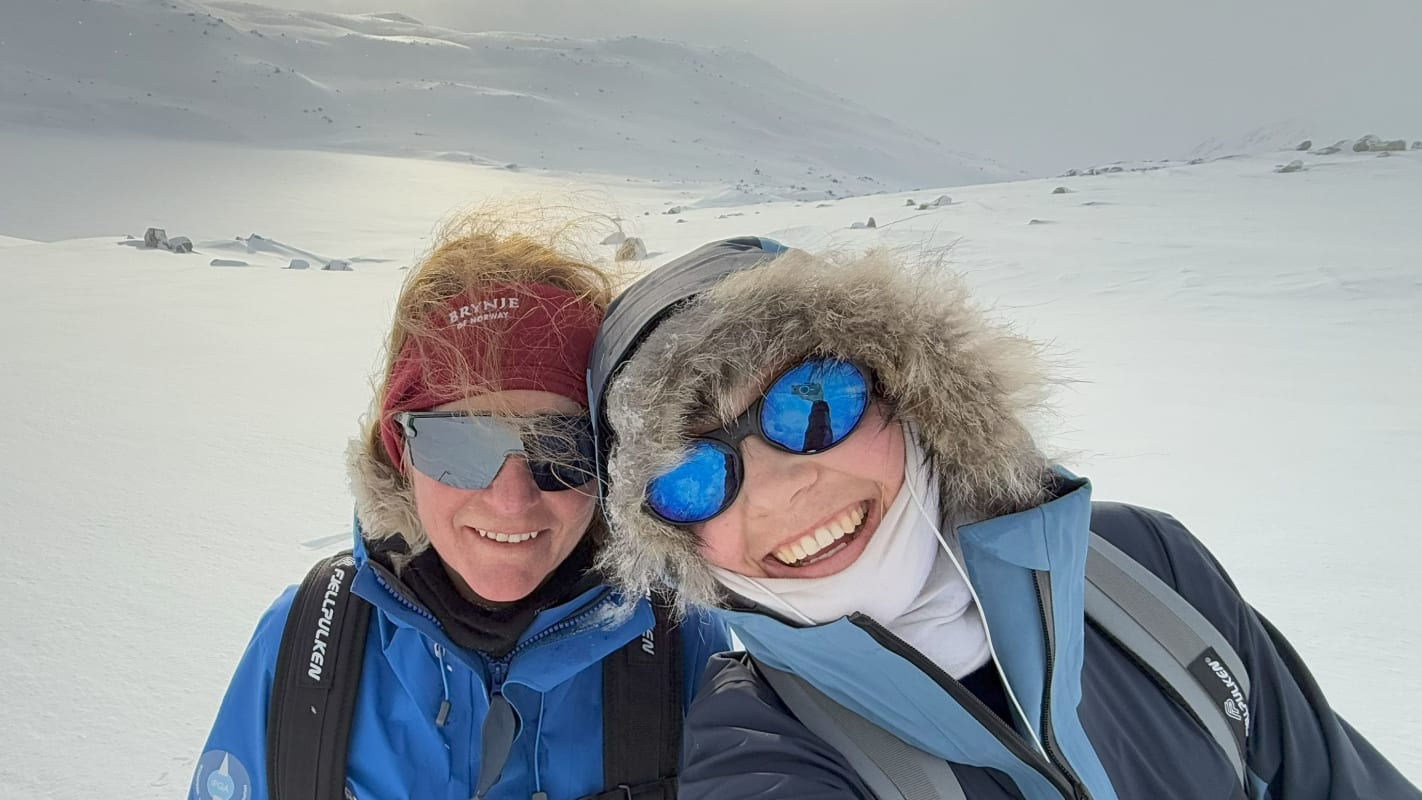
An ambitious Antarctic expedition by Norwegian adventurers Kathinka Gyllenhammar and her daughter Emma came to an abrupt and dramatic halt just 40 kilometers from its planned finish point, underscoring both the extreme risks of polar travel and the resilience required to survive in one of the most hostile environments on Earth.
The mother-daughter team had spent more than two months crossing Antarctica using a demanding combination of skiing and kite-skiing, only for a sudden accident to leave Kathinka Gyllenhammar seriously injured and in urgent need of evacuation. The incident unfolded in near-whiteout conditions, highlighting how even experienced polar travelers remain vulnerable to the continent’s unforgiving terrain and unpredictable forces.
The expedition had attracted attention not only because of its scale and technical difficulty, but also because it represented a rare intergenerational journey in Antarctica, blending endurance, logistics, and trust between parent and child. By the time of the accident, the pair had already completed the vast majority of their route, making the setback particularly poignant. What followed was a rapid emergency response involving Antarctic aviation crews and medical teams, ultimately resulting in their evacuation to Chile for treatment.
A Dual-Discipline Antarctic Expedition
Kathinka and Emma Gyllenhammar set out from Union Glacier in November with a carefully planned expedition that combined two of the most physically demanding modes of Antarctic travel: traditional ski-hauling and kite-skiing. For the first leg of their journey, the pair skied unsupported for 1,265 kilometers over 55 days, hauling heavy sleds laden with food, fuel, and survival equipment. This phase culminated in their arrival at the South Pole on January 9, a milestone that marked both a physical and psychological achievement after nearly two months on the ice.
Ski travel in Antarctica is slow and relentlessly taxing. Temperatures remain well below freezing, surfaces vary constantly, and progress is measured in small daily gains. Despite these challenges, the Gyllenhammars maintained steady forward momentum, relying on disciplined routines and meticulous planning. Their successful arrival at the Pole demonstrated not only physical conditioning but also logistical competence, as even minor errors in rationing or navigation can have serious consequences in such remote conditions.
From the South Pole, the expedition transitioned into its second phase: kite-skiing the return leg. Kite-skiing, which uses a large traction kite to harness wind power, can dramatically increase daily distances when conditions are favorable. However, it also introduces new risks, particularly when winds are weak or inconsistent. In such circumstances, the kite may fail to provide steady pull, forcing travelers to expend additional energy while still managing the complexities of kite control.
Read : Female Skier Mauled by Snow Leopard After Approaching It to Take a Photo
The return journey quickly proved more difficult than anticipated. Wind speeds frequently hovered between 1 and 3 meters per second, far below ideal levels for efficient kite-skiing. Poor visibility further compounded the challenge, making navigation and terrain assessment more difficult. In updates sent from the ice, the pair described painfully slow progress and the physical toll of attempting to generate speed without sufficient wind. What should have been a relatively swift return leg became a prolonged struggle against unfavorable conditions.
Read : In the shadow of Himalaya: Exploring India’s Top Ten Most Beautiful Villages
Despite these setbacks, the Gyllenhammars pressed on. By day 65 of their expedition, they were within striking distance of their pickup point. After a full day of kiting, they found themselves skiing down a long slope, believing the end of their journey was just hours away. It was at this moment, when fatigue was high and the terrain deceptively familiar, that the expedition took a sudden and dangerous turn.
The Accident Near the Finish Line
The accident occurred while Kathinka Gyllenhammar and Emma were descending a slope in poor visibility, a common but hazardous scenario in Antarctica. Sastrugi—sharp, wind-carved ridges of hardened snow—covered the surface. These formations can vary dramatically in size and shape, sometimes rising high enough to act as obstacles capable of stopping a sled abruptly. When traveling at speed under kite power, sastrugi present a particular danger, as the forces involved can change instantly and violently.
As they moved downhill, Emma briefly turned to adjust her equipment. When she looked back, her mother was no longer behind her. Visibility was limited, and for several moments Emma could not determine what had happened. She began climbing back up the slope, scanning the white expanse for any sign of Kathinka. It was only after spotting a flash of reflected light that she realized her mother was signaling with her compass.
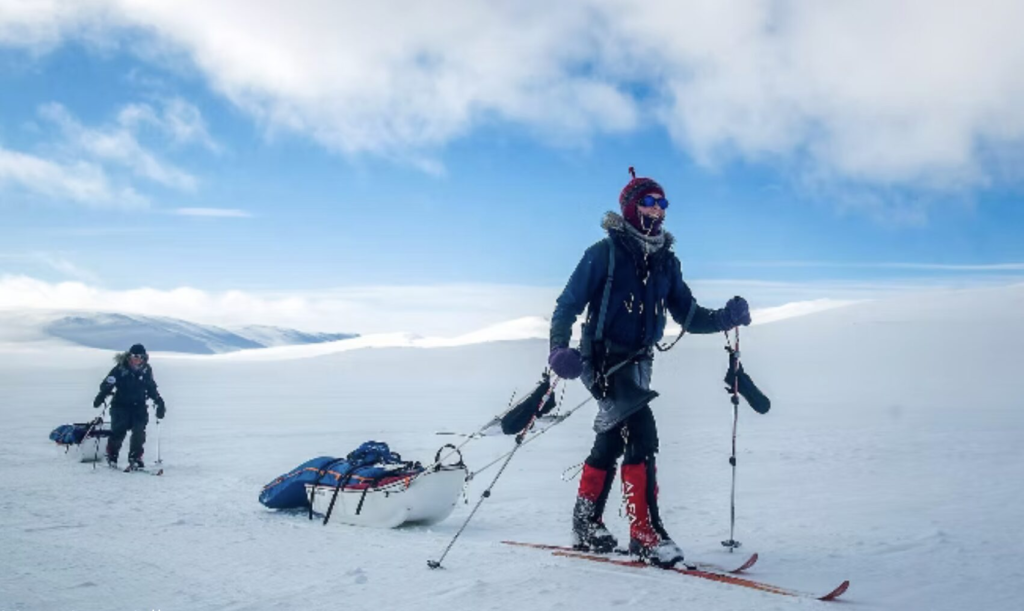
Emma reached Kathinka to find her lying in the snow, her legs twisted beneath her body and her movement severely restricted. The initial fear was that Kathinka Gyllenhammar might be paralyzed, a terrifying possibility given their isolation and exposure to the elements. The cause of the injury soon became clear. Kathinka’s sled had jammed between sastrugi, stopping abruptly, while the kite continued to pull her forward. The opposing forces effectively wrenched her body, resulting in multiple fractures.
Emma acted quickly and methodically. She erected their tent to shield her mother from the wind and cold, a critical step in preventing hypothermia. She then activated their SOS device, alerting rescue services to their location and condition. In Antarctica, even a well-coordinated rescue can take hours, as aircraft availability, weather conditions, and distance all play crucial roles.
Read : Skier Eric Battjes Dies After Crashing Into Tree at Copper Mountain Resort
After several tense hours, a plane managed to land near their position. Medical personnel assessed Kathinka’s condition on site before evacuating both women to Union Glacier. From there, they were transported onward to Chile, where Kathinka was admitted to hospital for further evaluation and treatment. Doctors confirmed that she had sustained three fractures to her pelvis and one fractured rib. While serious, the injuries were not life-threatening, and they did not involve spinal damage, a relief after the initial fears in the field.
Emma later described the mechanics of the accident in an interview with the Norwegian Broadcasting Corporation, explaining that her mother had effectively been pulled in two directions at once. The description illustrates the inherent risk of kite-skiing in uneven terrain, particularly when fatigue and low visibility reduce reaction times.
Evacuation, Recovery, and Wider Implications
The successful evacuation of Kathinka and Emma Gyllenhammar highlights the crucial role of emergency infrastructure in Antarctica, even for expeditions that aim to be as self-sufficient as possible. While polar travel often emphasizes independence and minimal external support, modern expeditions rely on established logistics hubs such as Union Glacier and on international cooperation to manage emergencies. Without rapid access to aircraft and medical expertise, the outcome of such accidents could be far more severe.

Kathinka’s injuries will require a prolonged recovery period, particularly given the complexity of pelvic fractures. While she avoided paralysis or internal organ damage, the rehabilitation process is expected to be lengthy and demanding. For athletes and adventurers accustomed to extreme physical challenges, recovery can be as mentally taxing as it is physical, requiring patience and a careful balance between rest and gradual rehabilitation.
Beyond the immediate human story, the incident serves as a reminder of the inherent dangers of polar exploration, even for experienced and well-prepared teams. Antarctica’s environment amplifies the consequences of minor errors and unexpected events. Terrain features such as sastrugi are ever-present, shaped continuously by wind and weather, and can change rapidly. Combined with fatigue, limited visibility, and the mechanical forces involved in kite-skiing, they represent a constant hazard.
The expedition also underscores the evolving nature of Antarctic travel. Modern techniques like kite-skiing allow explorers to cover vast distances more efficiently, but they introduce new variables that must be carefully managed. As more adventurers attempt ambitious polar routes using hybrid methods, incidents like this one will likely inform future safety protocols, training, and equipment design.
For Emma Gyllenhammar, the experience was both traumatic and formative. Acting decisively under extreme stress, she played a central role in ensuring her mother’s survival. Their journey, though unfinished in its original form, stands as a testament to preparation, resilience, and the importance of rapid decision-making in extreme environments. While the final 40 kilometers remained uncrossed, the expedition’s broader lessons may prove just as significant as the distance they traveled across the Antarctic ice.