
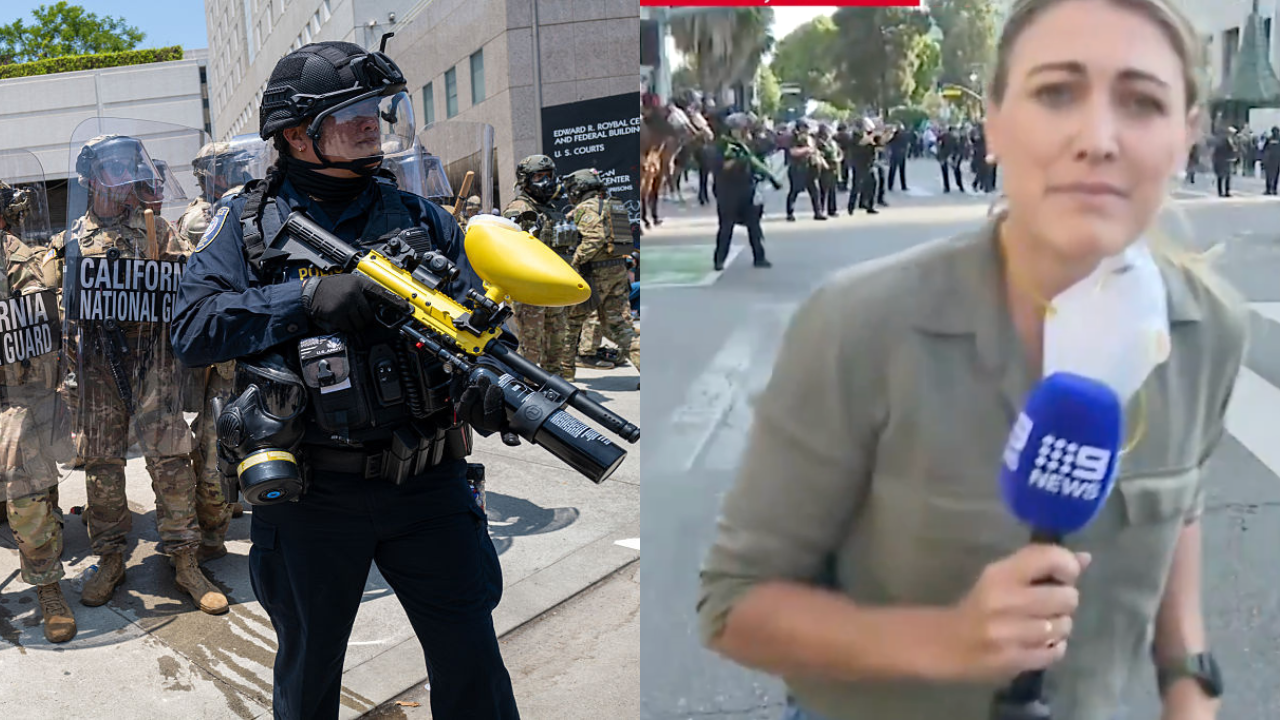
In a dramatic and unsettling moment for press freedom and civil discourse, Australian journalist Lauren Tomasi was struck by a rubber bullet while covering protests in Los Angeles against U.S. immigration raids. The incident occurred on June 9, 2025, and was captured live on camera, sparking international outrage and raising serious concerns over the treatment of journalists during civil unrest. The protests, which centered around immigration crackdowns led by the Trump administration, turned chaotic as law enforcement, including the LAPD and National Guard, moved in with aggressive crowd-control tactics.
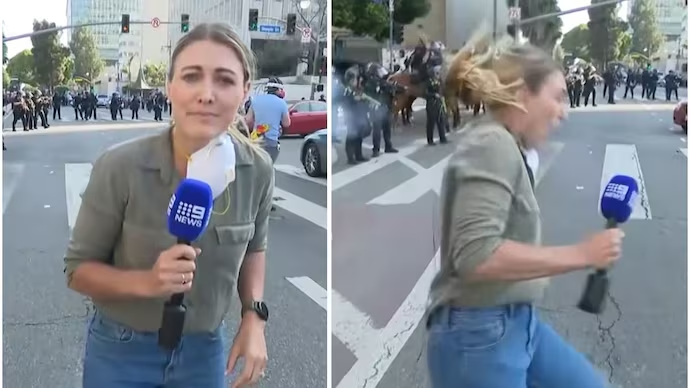
Tomasi, a U.S. correspondent for Australia’s Nine News, was reporting from the heart of downtown Los Angeles when she was caught in the crossfire. Just moments before she was hit, she described the deteriorating situation on air, noting that police were using rubber bullets and horses to disperse the crowd.
Seconds later, video footage captured a police officer aiming directly at her and her cameraman, firing a rubber bullet that struck Tomasi in the leg. The footage, widely circulated on social media and news platforms, shows Tomasi crying out in pain, clutching her calf, while a bystander shouts, “You just fucking shot the reporter!”
The incident has sent shockwaves through both Australia and the United States, triggering calls for accountability and deeper reflection on how law enforcement engages with media personnel in volatile situations.
Clash at the Protests: Civil Unrest and Immigration Tensions
The protest took place near the Metropolitan Detention Centre on East Temple Street, where immigration raids had earlier led to several arrests. Demonstrators gathered to voice their opposition to U.S. Immigration and Customs Enforcement (ICE) and the broader immigration policies of the Trump administration, which many see as harsh and dehumanizing. These protests have become increasingly common, particularly in cities with large immigrant populations like Los Angeles.
Sunday’s demonstration, however, escalated quickly. The LAPD declared the gathering an “unlawful assembly” and began dispersing the crowd with aggressive tactics. Officers on horseback pushed through the throng of protesters while others deployed rubber bullets and flash-bang grenades.
The aim was to force protesters away from the detention center and surrounding federal buildings, but the result was a chaotic scene with multiple reports of injuries, including to journalists and bystanders.
Lauren Tomasi and her camera operator had been reporting from the site for hours before the police crackdown intensified. Tomasi, in her report just seconds before being shot, described the escalation: “After hours of standing off, this situation has now rapidly deteriorated.
Read : Los Angeles Streets Turn Into Battlegrounds as Anti-ICE Protests Turn Violent: Watch
The LAPD moving in on horseback, firing rubber bullets at protesters, moving them on through the heart of LA.” Her live reporting abruptly turned into a news event of its own as she was struck, providing a chilling reminder of the risks journalists face in such environments.
Welcome to Trump's America.
— Sumit (@SumitHansd) June 9, 2025
Australian TV reporter Lauren Tomasi was shot by LAPD with rubber bullets while covering the protests in L.A.
"ENOUGH IS ENOUGH"
He is destroying America! pic.twitter.com/viHJq7XHri
British photographer Nick Stern was also injured during similar protests over the weekend. He reported being hit by a non-lethal round used by deputies, highlighting that Tomasi’s case is not isolated. Both incidents underscore the increasingly dangerous atmosphere for media professionals covering civil unrest in the United States.
Australia’s Response and International Outcry
Australia’s Department of Foreign Affairs and Trade swiftly responded to the incident, releasing a statement that emphasized the need for journalists to operate safely and freely. “All journalists should be able to do their work safely,” the statement read. “Australia supports media freedom and the protection of journalists.”
The Australian Greens senator Sarah Hanson-Young was among the first political figures to react strongly, calling the shooting “shocking” and “completely unacceptable.” She urged Prime Minister Anthony Albanese to demand an urgent explanation from the United States government. “The first thing he must tell the president is to stop shooting at our journalists,” Hanson-Young said. “Freedom of the press is a fundamental pillar of a strong, functioning democracy.”
Her sentiments were echoed by other Australian politicians, including the Greens’ Nick McKim and the Nationals’ Matt Canavan. McKim insisted that the Australian government should register its displeasure “at the highest possible level” and not wait for a formal meeting between leaders. Canavan, while cautious not to jump to conclusions, acknowledged the footage made it appear that there may have been targeted action against journalists and called for a detailed investigation into the events.
There are indications that Prime Minister Albanese might raise the issue with President Trump at the upcoming G7 summit in Canada. However, as of now, no formal meeting between the two leaders has been confirmed. Regardless of whether such a meeting occurs, pressure is mounting on the Australian government to act decisively in defense of its citizens and the global principles of media freedom.
The Fragile Line Between Public Order and Press Freedom
The shooting of Lauren Tomasi is not just a case of mistaken identity or unfortunate collateral damage—it speaks to a growing global concern over how state actors are treating journalists in the field. Particularly in democratic nations, where the role of the press is constitutionally protected, these incidents raise uncomfortable questions. Was the targeting intentional? Are law enforcement officers being adequately trained to recognize and protect members of the media? Are governments doing enough to ensure accountability when these boundaries are crossed?
The LAPD issued a statement noting that media personnel were advised to “keep a safe distance from active operations,” but this has not quelled the criticism. Many argue that such advisories are insufficient if officers in the field are not held accountable for violating established norms of press protection. The sight of a uniformed officer deliberately aiming and shooting at a reporter adds a layer of intentionality that is deeply disturbing.
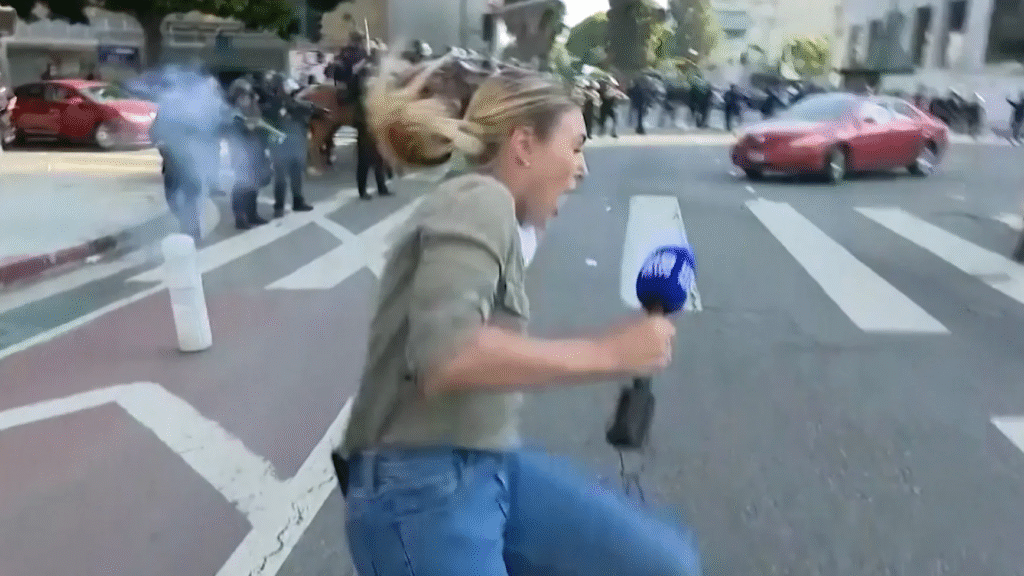
Media organizations and human rights watchdogs have consistently warned about the rising number of attacks on journalists during protests, especially in the United States. The fact that this incident was broadcast live, with clear visual evidence, makes it harder for authorities to brush aside. It demands a thorough investigation, one that goes beyond routine internal reviews and includes public accountability measures.
Nine News has reiterated its commitment to continuing coverage of such critical events, despite the risks. “Lauren and her camera operator are safe and will continue their essential work covering these events,” the network said in a statement. “This incident serves as a stark reminder of the inherent dangers journalists can face while reporting from the frontlines of protests, underscoring the importance of their role in providing vital information.”
Freedom of the press cannot function meaningfully if reporters must fear for their safety while doing their job. In democracies, where accountability and transparency are supposed to form the bedrock of governance, journalists are not combatants—they are observers and informers. Treating them as anything else risks dismantling the very structures of democracy from within.
As protests continue across Los Angeles and other American cities, the hope is that authorities will take a more measured approach in handling civil unrest. The incident involving Lauren Tomasi should serve as a pivotal moment for policy change—not only in how crowd control is conducted but also in reaffirming the rights of the press. Anything less is a step backward.