

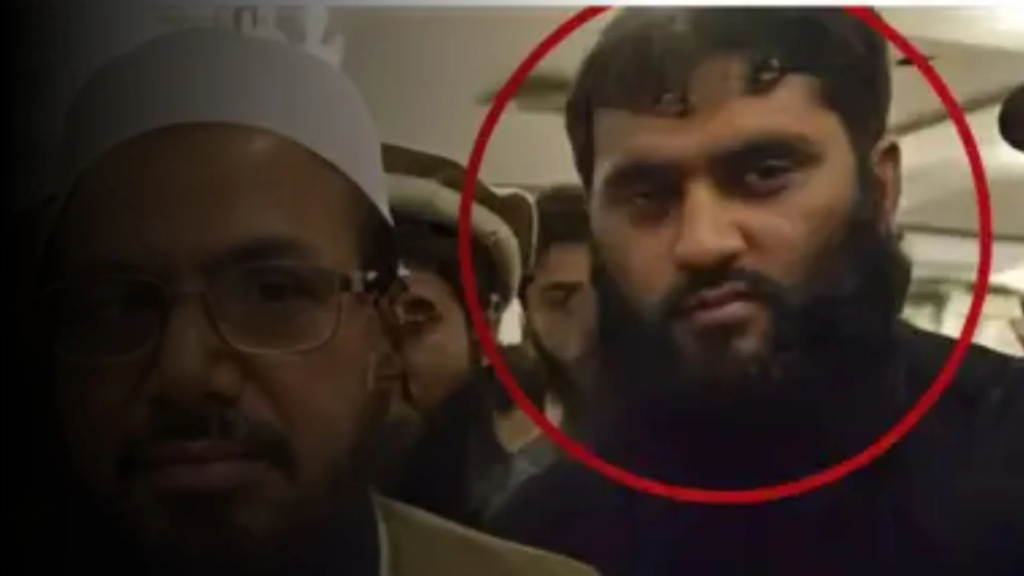
Abu Qatal alias Qatal Sindhi, one of the top commanders of the Pakistan-based terror outfit Lashkar-e-Taiba (LeT), was shot dead by unidentified gunmen in Jhelum district of Pakistan’s Punjab province on Saturday night.
The 43-year-old terrorist, a close aide of Hafiz Saeed, was responsible for orchestrating multiple attacks on civilians and security forces in the Jammu region, including the January 2023 Rajouri attack and the June 2024 Reasi bus attack.
His killing has sent shockwaves through Pakistan’s terror networks and is seen as a major development in the ongoing counterterrorism efforts.
The Rise of Abu Qatal in Lashkar-e-Taiba
Abu Qatal was an important figure within Lashkar-e-Taiba, having been active since 2002-03. He was closely associated with Hafiz Saeed, the mastermind of the 26/11 Mumbai attacks, and played a significant role in orchestrating violent operations in Jammu and Kashmir.
Intelligence reports suggest that Qatal was deeply involved in guerrilla-style terror attacks, where highly trained foreign terrorists would infiltrate India, execute their missions, and then hide in the forests of the Pir Panjal range before regrouping.
For over two decades, Qatal operated within the LeT hierarchy, overseeing recruitment, arms training, and strategic planning of attacks against security forces and civilians in Jammu and Kashmir. His name prominently appeared in various investigations, and he was actively pursued by the National Investigation Agency (NIA).
Reports indicate that Qatal had initially infiltrated Jammu and Kashmir in 2002-03 and was responsible for multiple terror activities in the Poonch-Rajouri belt. He eventually returned to Pakistan in 2005, where he continued to guide LeT’s operations from across the border.
Read : 40-Year-Old Woman Shot Dead in Her Flat at Llys Illtyd
Despite remaining in Pakistan for the past several years, Qatal continued to direct LeT’s activities remotely. His role became particularly prominent in the recent attacks on civilians in the Jammu region.
Read : Four ISIS Terrorists Arrested at Ahmedabad Airport: A Major Breakthrough for Gujarat Police
According to intelligence sources, Qatal was instrumental in planning and executing two major attacks in Jammu and Kashmir—the Rajouri attack in January 2023 and the Reasi bus attack in June 2024.
Abu Qatal’s Role in Major Terror Attacks in Jammu and Kashmir
One of the deadliest attacks linked to Abu Qatal was the January 1, 2023, twin attacks on civilians in Dhangri village, Rajouri. LeT terrorists targeted villagers, killing seven people, including two children, before planting an improvised explosive device (IED) that exploded the next day, injuring over a dozen individuals.
The attack was designed to instill fear among the local population, particularly among the minority Hindu community. Investigations into the attack revealed that Qatal had orchestrated the operation from Pakistan, with the help of his associates in Jammu and Kashmir.
Another attack attributed to Qatal was the June 9, 2024, bus attack in Reasi. The bus, carrying Hindu pilgrims from Shiv Khori temple to the Mata Vaishno Devi shrine in Katra, came under fire from LeT terrorists.

The firing caused the driver to lose control, sending the vehicle into a deep gorge near the Poni area, resulting in the deaths of nine people, including the driver and conductor. Over 40 passengers sustained injuries. According to intelligence sources, Qatal was directly responsible for planning and coordinating this attack with his operatives in Jammu and Kashmir.
The National Investigation Agency (NIA) had filed a charge sheet against Qatal in February 2024 for his role in these attacks. The charge sheet named two other LeT commanders—Saifullah alias Sajit Jutt and Mohammad Qasim—who were working alongside Qatal to facilitate terror activities in Jammu and Kashmir.
These three senior LeT figures were found to be responsible for recruiting and dispatching terrorists from Pakistan into India to execute attacks on security personnel and civilians.
The Mystery Behind Abu Qatal’s Assassination
The circumstances surrounding Abu Qatal’s death remain unclear, but intelligence reports suggest that he was ambushed by unknown assailants around 7 pm on Saturday while traveling with his security guards in Jhelum, Pakistan.
The attack was swift, leaving Qatal dead on the spot. Pakistani authorities have not officially commented on the incident, and no group has claimed responsibility for the assassination.
The sudden killing of such a high-profile terrorist has raised speculation about possible motives. Some experts believe it could be an internal rivalry within terror groups or a targeted operation by foreign intelligence agencies.
Given Qatal’s deep involvement in LeT’s activities and his close ties with Hafiz Saeed, it is possible that Pakistani agencies, under pressure from international forces, decided to eliminate him to distance themselves from his activities.
Another theory suggests that Qatal’s assassination could be linked to a factional dispute within LeT or Pakistan’s broader terror network. In the past, similar eliminations have occurred when Pakistani intelligence agencies sought to remove individuals who had become liabilities.
Given the growing pressure from India and global counterterrorism bodies, Pakistan may have orchestrated Qatal’s killing to project itself as taking action against terror elements operating from its soil.
Regardless of the motive, Qatal’s death marks a significant moment in the fight against terrorism. His killing will likely disrupt LeT’s operations in Jammu and Kashmir, at least temporarily. However, it remains to be seen whether his elimination will lead to any meaningful long-term change in Pakistan’s support for terror groups.
The National Investigation Agency, which had been tracking Qatal for years, is expected to analyze the impact of his death on LeT’s functioning. Given that Qatal was deeply involved in operational planning and recruitment, his absence could create a leadership vacuum in the organization’s command structure.
However, experts warn that LeT has a history of quickly replacing its slain commanders, and the group is unlikely to be significantly weakened unless comprehensive action is taken against its entire network.
For India, Qatal’s killing is a major success, albeit an indirect one. His death eliminates one of the key masterminds behind terror attacks in Jammu and Kashmir. Security forces and intelligence agencies will continue their vigilance against other LeT commanders, particularly those still active in facilitating cross-border terrorism.
As investigations into Qatal’s assassination continue, the coming weeks may provide more clarity on who was behind the attack and what implications it holds for Pakistan’s terror landscape. In the meantime, the elimination of one of LeT’s most wanted terrorists marks a crucial step in counterterrorism efforts in South Asia.