
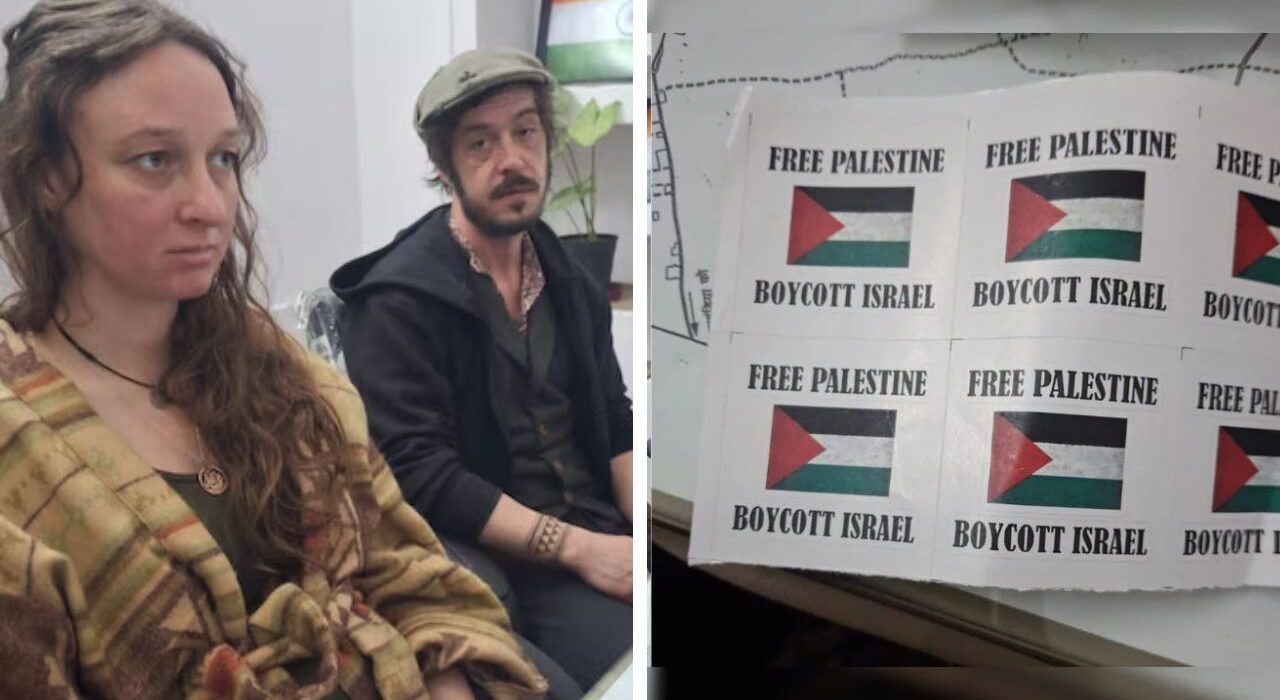
Indian authorities have ordered a British couple to leave the country after determining that they violated the conditions of their tourist visas by engaging in political activity. Lewis Gabriel D and his girlfriend, Anushi Emma Christine, were accused of pasting stickers reading “Free Palestine” and “Boycott Israel” at multiple public locations in Pushkar, a well-known temple town in Rajasthan that attracts large numbers of international visitors. The action, which took place in January, was treated as a serious breach of immigration rules, prompting intervention by intelligence agencies and the eventual revocation of the couple’s visas.
The case has drawn attention not only because it involves foreign nationals and deportation, but also because it intersects with sensitive geopolitical issues, including India’s relationship with Israel, the ongoing war in Gaza, and the limits placed on political expression by visitors on tourist visas. Officials have emphasised that the matter is not about the content of the message itself, but about the violation of visa conditions that explicitly prohibit political, protest, or ideological activities by foreign tourists while in India.
The incident unfolded in Pushkar, a town with deep religious significance and a global reputation as a backpacker destination. Over the years, Pushkar has also become particularly popular among Israeli tourists, many of whom visit India after completing mandatory military service. This demographic context, combined with heightened global tensions surrounding the Israel–Palestine conflict, contributed to the swift and firm response from local and central authorities once the sticker campaign was discovered.
Investigation and Visa Violations in Pushkar
According to police and intelligence officials, information about the sticker-pasting activity was received on January 21. The Intelligence Department, including units of the Criminal Investigation Department and the Intelligence Bureau, assessed the reports and deemed the matter serious enough to warrant immediate attention. CCTV footage and local intelligence inputs were reviewed, leading to the identification of Lewis Gabriel D and Anushi Emma Christine as the individuals responsible for placing the stickers around the town.
The couple, who were staying in Pushkar on tourist visas, were subsequently questioned by a police team led by Additional Superintendent of Police Rajesh Meena. During interrogation, authorities concluded that the two had engaged in political advocacy while on tourist visas, which is prohibited under Indian immigration rules. Tourist visas are intended strictly for leisure, sightseeing, and casual visits, and explicitly bar holders from participating in protests, political campaigns, or ideological activism of any kind.
Officials stated that the stickers were placed at multiple public locations, including areas frequented by both local residents and international visitors. After the investigation, the stickers were removed with the assistance of district police. The authorities then initiated action under the Immigration and Foreigners Act of 2025, revoking the couple’s visas and issuing a “Leave India Notice” that mandated their immediate departure from the country.
Read : 7-Year-Old Boy Accidentally Shoots Himself in Hand with Gun Brought to Freetown Elementary School
Rajesh Meena told Indian media outlets that India maintains strict oversight of foreign nationals and their activities, particularly in sensitive or high-profile tourist destinations. He warned that any violation of visa conditions could lead not only to deportation but also to blacklisting, which would prevent the individuals from re-entering India in the future. In similar cases, foreign nationals may also face detention while deportation proceedings are underway.
Read : Earth’s Blue Oceans Turning Green Due to Climate Change: NASA Satellite Data
The police stressed that the enforcement action was procedural rather than ideological. From the authorities’ perspective, the central issue was the misuse of a tourist visa to carry out political expression in public spaces. This stance reflects a long-standing policy position in India, where freedom of expression for citizens exists within a constitutional framework, but foreign visitors are expected to strictly adhere to the terms of their visas and refrain from political engagement.
Geopolitical Sensitivities and India’s Position
The case unfolded against the backdrop of intensified global debate over the Israel–Palestine conflict, particularly following Israel’s military campaign in Gaza that began in October 2023. That war, triggered by a Hamas attack in southern Israel that killed around 1,200 people and led to the taking of 251 hostages, has resulted in massive destruction and loss of life in Gaza. Palestinian health authorities estimate that at least 71,800 Palestinians have been killed, with tens of thousands more injured and displaced, and much of the territory reduced to rubble.
Calls to “Free Palestine” and protests condemning Israeli actions have taken place across the world, including in India. Indian citizens have organised demonstrations in cities such as Chennai and Delhi, highlighting civilian casualties and calling for international intervention. These protests, when conducted by Indian nationals and in accordance with local laws, fall within the ambit of domestic political expression. However, authorities draw a clear distinction when similar activities are undertaken by foreign nationals on tourist visas.
India’s official position on the Israel–Palestine conflict has historically supported a two-state solution, advocating for the establishment of an independent Palestinian state alongside Israel. In international forums, India has often reiterated this stance, even as its bilateral relationship with Israel has deepened significantly over the past decade. Under Prime Minister Narendra Modi’s government, India and Israel have expanded cooperation in defence, security, technology, trade, and innovation.
Israel is now among India’s largest suppliers of military equipment, and strategic ties between the two countries are closer than ever. Israel’s ambassador to India, Reuven Azar, has indicated that Prime Minister Modi is expected to visit Israel, a trip that would further underline the strength of the partnership. This evolving relationship has led India to be more cautious in its public criticism of Israel, particularly in official statements regarding the war in Gaza.
Despite this, Indian officials have maintained that immigration enforcement actions, such as the one taken against the British couple in Pushkar, should not be interpreted as a shift in foreign policy or as suppression of a particular viewpoint. Instead, they argue, such actions are consistent with existing visa regulations that apply equally regardless of the political cause involved. Foreign nationals advocating any political position, whether related to domestic Indian issues or international conflicts, are subject to the same restrictions when visiting on tourist visas.
Implications for Foreign Visitors and Public Expression
The deportation order issued to Lewis Gabriel D and Anushi Emma Christine serves as a reminder of the limits placed on foreign visitors in India, particularly with regard to political activity. Indian visa regulations are explicit in prohibiting tourists from engaging in protests, campaigns, or public advocacy, whether online or offline. These rules are rooted in the principle that political participation and public activism are privileges reserved for citizens and certain categories of long-term residents, not short-term visitors.
For many foreign travellers, especially younger backpackers and activists, the boundaries of permissible activity may not always be clear. Public expression in the form of stickers, posters, or social media posts can be perceived as minor or symbolic acts in some countries, but in India, such actions can carry legal consequences when undertaken by foreign nationals. Authorities have increasingly relied on surveillance, intelligence inputs, and local reporting to monitor compliance with visa conditions, particularly in areas with high concentrations of international visitors.
Pushkar’s unique demographic profile played a role in how quickly the sticker campaign was detected. With nearly 2,000 Israeli tourists reportedly in the town at the time, and with several establishments linked to Jewish organisations such as Chabad, local authorities were particularly sensitive to any activity that could inflame tensions or disrupt communal harmony. Officials have emphasised that maintaining public order and avoiding international diplomatic complications are key considerations in such cases.
The broader humanitarian situation in Gaza continues to attract global attention. Even after a US-brokered ceasefire came into effect last October, reports indicate that Israeli military operations have continued, resulting in hundreds of additional deaths. Access to medical treatment remains severely limited, with only a small number of critically ill Palestinian patients permitted to leave Gaza through the Rafah Crossing. According to the World Health Organisation and Unicef, tens of thousands of wounded individuals, including thousands of children, are still awaiting urgent medical care.
These developments ensure that the Israel–Palestine conflict remains a deeply emotive and polarising issue worldwide. In India, public debate and protest among citizens are likely to continue, shaped by domestic politics, foreign policy considerations, and humanitarian concerns. For foreign nationals, however, the case of the British couple underscores the importance of understanding and respecting the legal framework governing their stay.
Ultimately, the order for Lewis Gabriel D and Anushi Emma Christine to leave India reflects a consistent application of immigration law rather than an isolated or exceptional measure. Indian authorities have made it clear that any form of political, protest, or ideological activity by tourists will attract strict action, including deportation and potential blacklisting.
As international travel resumes at scale and global conflicts increasingly influence public discourse, such cases are likely to remain a point of contention, highlighting the complex balance between free expression, national sovereignty, and the responsibilities that come with crossing borders as a visitor.
Really strong article and an amazingly useful site overall —
thank you for both. I’ll definitely keep coming back for more.
کراتین ماسل اسپرت، یکی از محصولات برجسته و باکیفیت
در دنیای مکملهای ورزشی است.
Very good article! We will be linking to this particularly great article on our site.
Keep up the great writing.
My blog post; винлаб промокод на день рождения
I have been exploring for a bit for any high quality articles or blog posts on this kind of area . Exploring in Yahoo I eventually stumbled upon this site. Studying this info So i’m satisfied to express that I’ve an incredibly good uncanny feeling I discovered exactly what I needed. I most definitely will make certain to do not fail to remember this web site and give it a look on a relentless basis.