
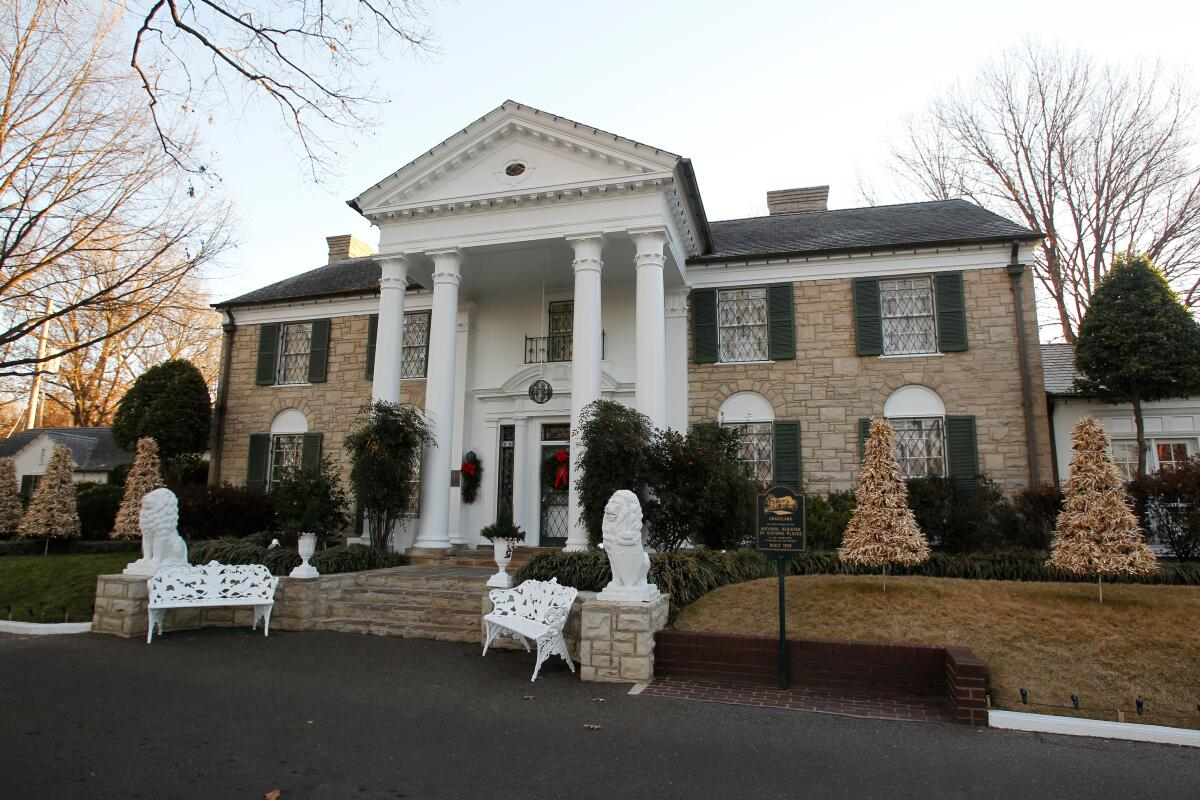
In a stunning conclusion to one of the most audacious fraud attempts in recent memory, Lisa Jeanine Findley, a 54-year-old Missouri woman with a history of financial scams, has been sentenced to over four years in federal prison for her role in a brazen plot to defraud the Presley family and auction off Graceland, the iconic Memphis estate of Elvis Presley. U.S. District Judge John T. Fowlkes Jr. handed down the sentence of four years and nine months, followed by three years of supervised release, during a hearing in federal court in Memphis on September 23, 2025.
This case, which first surfaced in 2024, not only targeted one of America’s most cherished cultural landmarks but also highlighted the vulnerabilities of high-profile estates to sophisticated identity theft and forgery schemes. Findley’s plot unraveled after she posed as representatives of a fictitious investment firm, fabricating documents to claim that the late Lisa Marie Presley had defaulted on a multimillion-dollar loan secured by Graceland itself.
The scheme, which involved forged signatures, fake court filings, and a published foreclosure notice in a local newspaper, was halted only by swift legal action from the Presley heirs. As fans worldwide breathed a sigh of relief that Graceland remained secure, the sentencing serves as a stark reminder of the lengths to which scammers will go to exploit legacies of fame.
The Audacious Plot: Forgery and Deception Targeting a Cultural Icon
The origins of Lisa Jeanine Findley’s scheme trace back to July 2023, mere months after the death of Lisa Marie Presley, Elvis’s only daughter, on January 12, 2023. At the time, Riley Keough, Lisa Marie’s eldest daughter and an actress known for roles in films like Mad Max: Fury Road, had assumed full control of the Promenade Trust, which owns and operates Graceland as a museum and tourist attraction. Findley, operating from her home in Kimberling City, Missouri—a small community nestled in the Ozarks—began her impersonations by emailing Keough’s lawyers under the alias “Kurt Naussany,” purportedly an executive at Naussany Investments and Private Lending LLC, a company that existed only on paper.
According to federal prosecutors, Findley alleged that in 2018, Lisa Marie Presley had borrowed $3.8 million from this phantom lender, using Graceland—the 13.8-acre estate purchased by Elvis in 1957 for $102,500—as collateral. When the supposed loan went unpaid following Lisa Marie’s passing, Findley demanded a $2.85 million settlement from the Presley family to avoid foreclosure. To lend credibility to her claims, she fabricated a slew of documents: loan agreements bearing forged signatures of Lisa Marie Presley and a Florida notary public, a bogus creditor’s claim filed with the Superior Court of California in Los Angeles, and a deceptive deed of trust submitted to the Shelby County Register’s Office in Memphis.
The plot escalated in April 2024 when Findley, still masquerading as Naussany representatives including aliases like Gregory Naussany and Carolyn Williams, published a fraudulent foreclosure notice in The Commercial Appeal, Memphis’s prominent daily newspaper. The notice announced an auction of Graceland set for May 23, 2024, at the north front lawn of the property, inviting bids from the public as if the estate were up for grabs. This public declaration sent shockwaves through Elvis fandom, with social media ablaze and local officials scrambling to verify the claims. Findley, who also went by names like Lisa Holden, Lisa Howell, and Lisa Jeanine Sullins, had built a digital facade complete with email accounts and websites that vanished shortly after scrutiny began.
Investigators later uncovered that Findley’s criminal history was peppered with smaller-scale frauds, including identity theft and financial grifts that painted a picture of a serial deceiver honing her craft over years. In a desperate pivot after the scheme collapsed, she attempted to pin the blame on a Nigerian identity thief, a tactic that only deepened the irony given the international flavor of many elder fraud cases. The audacity of targeting Graceland—a site where Elvis, his parents, Lisa Marie, and her son Benjamin Keough are buried—underscored the cold calculation behind the forgery. As one prosecutor noted during the proceedings, this was not just theft; it was an assault on a sacred family legacy.
Read : 30-Year-Old Man Makes 100,000 Australian Dollars by Selling Items Picked from Trash
The plot’s mechanics relied on the chaos following Lisa Marie’s death, which had already thrust the Presley estate into the public eye amid disputes over inheritance. Findley’s use of mail fraud—sending the forged documents through the U.S. Postal Service—formed the core of the federal charges, elevated by the aggravated identity theft of Lisa Marie’s name. By weaving a narrative of unpaid debts and legal inevitability, she nearly turned a fabricated loan into a multimillion-dollar windfall, exploiting the trust’s complexity without ever setting foot in Tennessee.
Swift Justice: From Arrest to Guilty Plea
The house of cards began to tumble in May 2024 when the foreclosure notice caught the attention of Graceland’s legal team. Riley Keough, acting through the Promenade Trust, filed an emergency lawsuit in Shelby County Chancery Court, arguing the claims were fraudulent and seeking an injunction to block the auction. Chancellor JoeDae L. Jenkins granted the temporary restraining order just days before the scheduled sale, averting what could have been an irreversible embarrassment for Memphis tourism and Presley lore. The swift intervention bought time for federal investigators from the U.S. Attorney’s Office for the Western District of Tennessee and the U.S. Postal Inspection Service to trace the digital breadcrumbs back to Findley.
On August 16, 2024—eerily coinciding with the 47th anniversary of Elvis’s death at Graceland—authorities arrested Findley at her Missouri home on charges of mail fraud and aggravated identity theft. The criminal complaint, spanning 30 pages, detailed 56 gigabytes of evidence, including over 54,000 pages of emails, documents, and server logs that exposed her aliases and the nonexistent Naussany Investments. Federal agents raided her property, seizing computers and hard drives that revealed a pattern of similar cons, though none as ambitious as this.

Findley’s legal saga progressed rapidly. Initially facing up to 20 years for mail fraud and a mandatory two-year minimum for identity theft, she entered a plea deal that streamlined the process. On February 25, 2025, during a hearing before U.S. Magistrate Judge Tu M. Pham in Memphis, Findley pleaded guilty to the single count of mail fraud, acknowledging her orchestration of the scheme without implicating accomplices—though investigators suspected she acted alone. The plea hearing highlighted the exhaustive evidence compilation, with prosecutors presenting timelines that synced her emails to the forged filings.
Throughout the pretrial phase, Findley remained in custody, her attempts to secure bond thwarted by flight risk concerns and her history of alias-shifting. Tennessee Attorney General Jonathan Skrmetti praised the collaborative effort, stating that the conviction ensured “Graceland remains safely in the possession of Elvis’s heir and a celebrated Memphis landmark for generations to come.” By June 2025, with sentencing delayed briefly for final sentencing reports, the case had become a textbook example of inter-agency cooperation in fraud probes.
The September 23 hearing drew a small crowd of media and Elvis enthusiasts, underscoring the public’s fascination. Findley, appearing via video from detention, offered no statement, her defense attorney citing remorse in a pre-sentencing memo. Judge Fowlkes, balancing the plea agreement with the crime’s gravity, imposed the 57-month term—more than four years—deeming it sufficient to deter similar audacity while acknowledging her lack of prior violent offenses.
Legacy Protected: Implications for Fraud and Cultural Heritage
Findley’s sentencing closes a chapter on a scandal that could have irreparably tarnished Graceland’s aura, but it opens broader conversations about safeguarding cultural icons from digital predators. Graceland, now a National Historic Landmark generating millions in revenue through tours, memorabilia, and events like Elvis Week, stands as a testament to resilience. Riley Keough’s proactive lawsuit not only preserved the property but also amplified calls for enhanced estate protections in celebrity families.

This case exposes the ease with which fraudsters exploit postmortem vulnerabilities. With Lisa Marie’s death sparking public probate battles, scammers like Findley preyed on the ensuing disarray, using readily available public records to forge ties to real entities. Experts in elder and estate fraud note that schemes targeting deceased celebrities have surged, fueled by AI-assisted forgeries and anonymous online filings. The U.S. Department of Justice’s involvement here signals a zero-tolerance stance, potentially inspiring stricter notary verifications and digital watermarking for deeds.
For the Presley family, the ordeal adds another layer of grief to a lineage marked by tragedy—Elvis’s sudden death in 1977, Benjamin Keough’s suicide in 2020, and Lisa Marie’s overdose in 2023. Yet, Keough’s victory reaffirms the estate’s role as a pilgrimage site, where global fans converge to honor the King of Rock ‘n’ Roll. Annual visitors, undeterred by the scandal, continue to flock to the Jungle Room and Meditation Garden, ensuring Elvis’s music and memory endure.
On a national scale, the sentencing underscores the perils of mail fraud in an interconnected world. With penalties like Findley’s serving as deterrents, authorities hope to stem the tide of “inheritance scams” that bilk families out of billions yearly. As Memphis heals from the near-miss, the story of Graceland’s defense becomes folklore: a modern tale of how vigilance and justice preserved a slice of rock history from vanishing into fraud’s shadow.
In the end, while Findley faces years behind bars, the true winners are the legions who cherish Elvis’s legacy. Graceland endures, not for sale, but for celebration—a beacon against the darkness of deceit.