

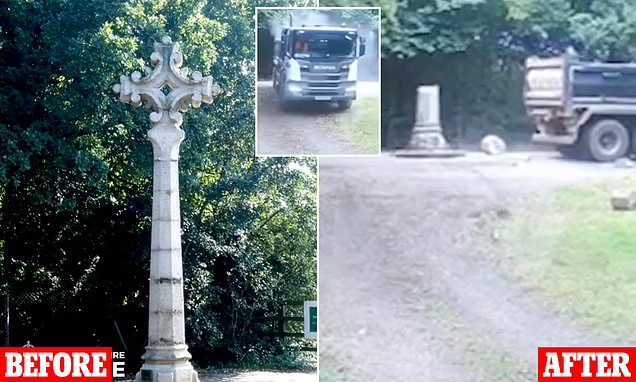
The destruction of historical monuments is always a cause for concern, particularly when it involves carelessness or negligence. In a recent incident that has left Warwickshire authorities and history enthusiasts dismayed, a lorry driver from Birmingham caused irreparable damage to the Grade II-listed 1800s William Gladstone memorial.
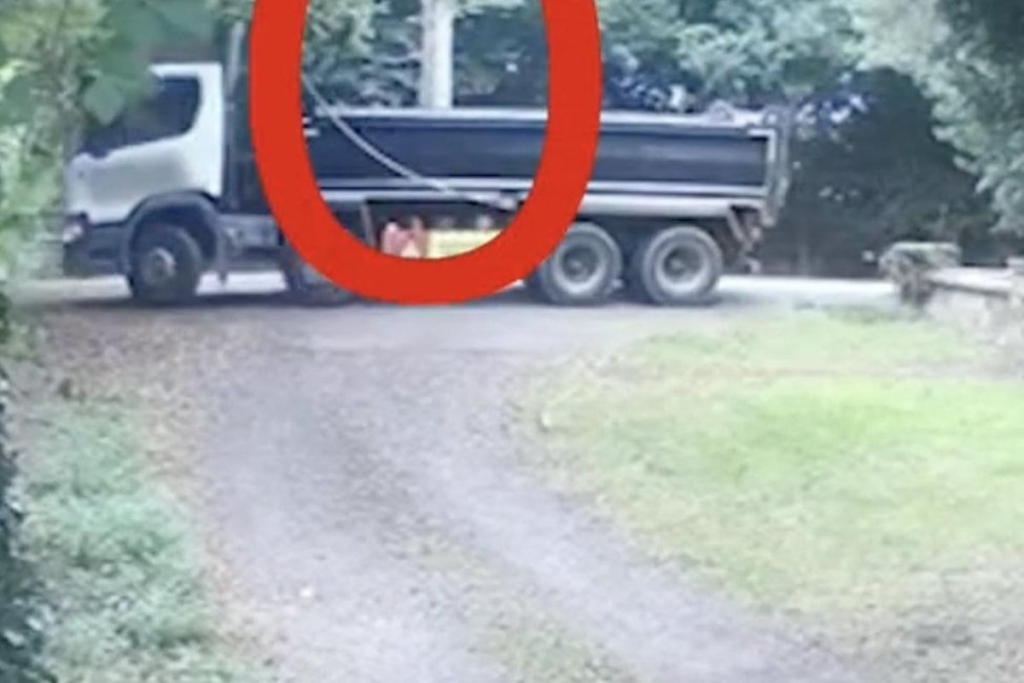
The shocking moment was captured on video, showing how a wrong turn and poor maneuvering resulted in extensive destruction.
The case has not only highlighted concerns regarding road safety and heritage conservation but has also sparked debates about accountability and penalties for such actions. The restoration of the monument is estimated to cost £40,000, making it a financially and historically significant loss.
The Incident: How It Happened
The unfortunate event took place on Church Lane, Lea Marston, a rural road not suited for heavy vehicles. The driver, unfamiliar with the area, mistakenly turned onto the narrow lane and found himself in a difficult situation.
Rather than performing a controlled multi-point turn, the driver attempted a hasty maneuver and reversed at speed. The result was catastrophic—his vehicle collided forcefully with the William Gladstone memorial, toppling the structure and even running over part of its column.
The impact left the monument in ruins, with shattered stone and debris scattered across the site. This act of negligence, caught on video, quickly spread across social media, drawing widespread criticism from the public.
Following the incident, local authorities and heritage groups expressed their distress at the loss of a historical structure that had stood for more than a century.
This video shows the moment a careless lorry driver caused £40,000 worth of damage to a Grade II-listed memorial—then drove off with it in the back of his vehicle!
— Yorkshire Victor Meldrew+his dog aka Ian Woulahan (@TheMeldrew) March 7, 2025
Despite the destruction, he walked away from court with just 7 points and a £246 fine! #UKcheckpoints pic.twitter.com/MPAIKbnGHz
The William Gladstone memorial was an important part of Warwickshire’s heritage, commemorating the legacy of one of Britain’s most notable politicians. Its sudden destruction has not only led to financial strain for restoration efforts but has also raised questions about the protection of such landmarks.
Legal Consequences and Public Reaction
The driver faced legal action for his recklessness, with a court case that concluded on March 5, 2025. He pleaded guilty to the charges and was penalized with seven points on his driving license.
Additionally, he was ordered to pay £246 in fines and court costs. However, many believe that the punishment does not adequately reflect the extent of the damage caused. Heritage preservationists argue that a mere financial penalty does little to deter such incidents in the future.
Read : After 16 Months of Wait, 300,000 Palestinians Return to ‘Destroyed’ Home in Gaza
Public reaction has been overwhelmingly critical. Many residents and history enthusiasts expressed their outrage over social media, questioning how such carelessness could result in the loss of an invaluable piece of Warwickshire’s heritage.
The Warwickshire Rural Crime Team also issued a statement, emphasizing the difficulty of the restoration process. They highlighted that reconstructing the monument would be both expensive and time-consuming, given the specialized work required to restore it to its former glory.
The legal proceedings have also reignited discussions about how well-protected historical monuments are. Some critics argue that better signage and clearer restrictions on vehicle access could prevent similar incidents in the future. Others believe that the penalties for damaging historical structures should be far more severe to reflect the cultural and financial loss.
Challenges in Restoration and Heritage Conservation
Restoring the William Gladstone memorial is expected to be an arduous and expensive process. Experts estimate that the cost will reach £40,000 due to the specialized craftsmanship required.
Reconstructing a historical monument is not as simple as replacing broken stones; it involves sourcing the correct materials, using period-accurate techniques, and often consulting historical records to ensure authenticity.
One of the main challenges in the restoration effort is finding skilled artisans capable of handling such work. Many traditional stone masonry techniques are rare today, and specialists who can faithfully recreate the monument’s details are in high demand. The Warwickshire Rural Crime Team has already indicated that the restoration process will be long and costly, requiring patience and financial backing.
This incident also highlights the broader issue of heritage conservation in the UK. While many historical sites are well-protected, accidents and acts of vandalism still occur, sometimes leaving irreparable damage.
The destruction of the William Gladstone memorial serves as a reminder that historical preservation requires continuous effort, including better awareness among drivers and the general public about the importance of such landmarks.
In response to this incident, local authorities may consider implementing additional protective measures, such as barriers or bollards, around sensitive historical sites.
There may also be discussions about increasing penalties for individuals responsible for damaging heritage structures. Ultimately, this case serves as a wake-up call for both authorities and the public to take stronger steps in safeguarding the country’s cultural and historical treasures.