
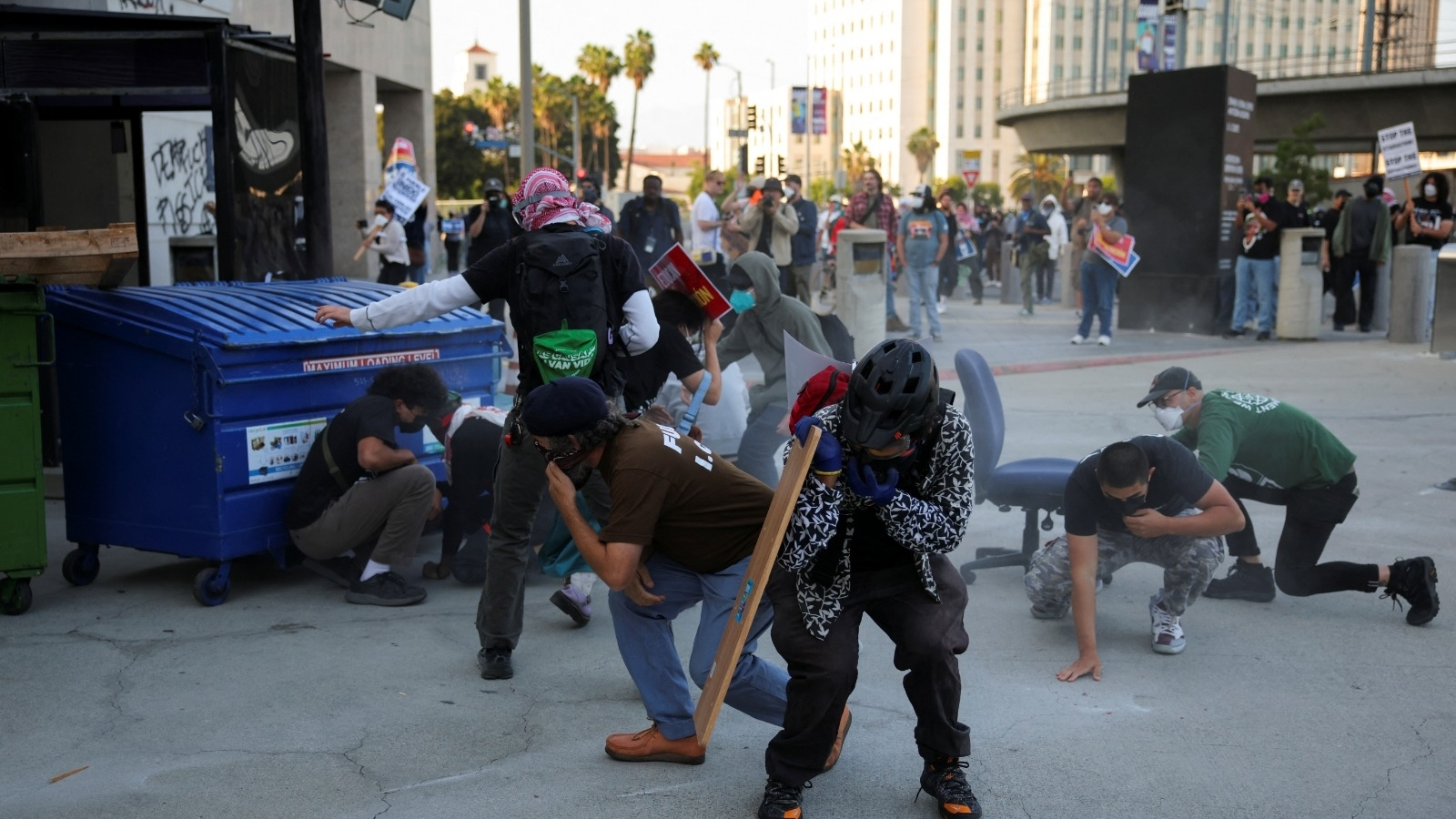
A wave of unrest has gripped Los Angeles in the wake of federal immigration raids, culminating in fierce Anti-ICE Protests across the city. Tensions exploded after Immigration and Customs Enforcement (ICE) carried out multiple workplace raids, triggering widespread outrage, violent clashes, and the deployment of riot-control measures.
As streets in cities like Paramount turn into battlegrounds, the protests have reignited the nation’s bitter debate over immigration enforcement.
Anti-ICE Protests Turn Violent
The fuse for this volatile episode was lit when federal agents launched large-scale raids in Los Angeles’ fashion district and other locations on June 6, targeting undocumented immigrants in workplaces. These operations quickly escalated, drawing hundreds of protesters into the streets of Paramount, California. Videos circulating online show demonstrators blocking roadways and attempting to physically prevent Border Patrol agents from making arrests, particularly near a Home Depot where several detentions took place.
Protesters gathered in droves after learning about the ICE sweep, confronting federal agents and forming human chains to block transport vans. As tensions intensified, agents in riot gear deployed flash-bang grenades to scatter crowds that refused to disperse. Clashes broke out in multiple parts of the city, most notably in front of a federal law enforcement building that protesters surrounded late Friday night.
The chaos unfolded rapidly, reportedly outpacing the local police response. The Department of Homeland Security (DHS) released a scathing statement blaming the Los Angeles Police Department (LAPD) for failing to act swiftly. “It took the LAPD 2 hours to respond,” the statement read, expressing concern over what federal officials describe as growing hostility toward ICE personnel. “Over 1,000 rioters surrounded a federal law enforcement building and assaulted ICE law enforcement officers, slashed tires, defaced buildings, and taxpayer-funded property.”
ICE leaving with heavily damaged cars courtesy of rioters.
— Spitfire (@DogRightGirl) June 7, 2025
If we cant hold anyone responsible when we have control of DHS and the FBI……there will never be any control. Pure anarchy. pic.twitter.com/Jk48EKelz6
According to the DHS, assaults against ICE officers have surged by 413% in recent months. More troublingly, ICE reports that some of its officers’ family members have been doxed — their personal information exposed online — in what officials say is a coordinated campaign of harassment. These revelations have fueled concerns about the safety of federal agents and their families amid a rapidly deteriorating situation.
National Guard Mobilized Amid Political Firestorm
The federal government’s response to the unrest was swift and aggressive. On Saturday, June 7, Acting ICE Director Tom Homan announced that the National Guard would be mobilized to help restore order. “We’re going to bring the National Guard in tonight. We’re going to continue doing our job,” Homan said during an appearance on Fox News. “We’re going to push back on these people, and we’re going to enforce the law.”
This decision marks a turning point in the federal response to immigration protests, signaling a more militarized approach. Homan’s remarks make it clear that ICE views the protests not as peaceful dissent, but as violent riots that jeopardize national security and law enforcement. The federal narrative portrays the protesters as aggressors emboldened by political rhetoric that demonizes immigration enforcement.

DHS pointed fingers at Democratic leaders, citing politicians such as House Minority Leader Hakeem Jeffries, Boston Mayor Michelle Wu, Minnesota Governor Tim Walz, and Los Angeles Mayor Karen Bass. The agency accused them of contributing to a hostile climate by publicly criticizing ICE’s tactics. “These riots in Los Angeles and increased assaults on ICE officers come after Democrat politicians… have villainized and demonized ICE law enforcement,” the DHS statement asserted.
Mayor Bass, in particular, has found herself in the spotlight. Known for her advocacy for immigrant rights and criticism of ICE’s practices, Bass now faces mounting pressure from both sides — federal authorities demanding cooperation and constituents calling for protection of undocumented communities. Whether the mayor will alter her stance or double down on defending immigrant populations remains to be seen.
The involvement of the National Guard adds a new layer of tension to an already volatile environment. While federal officials argue that such action is necessary to ensure public safety, civil liberties groups have condemned the move as an overreach. “Militarizing our streets in response to protests only escalates the situation,” said a spokesperson for the American Civil Liberties Union of Southern California. “What we need is dialogue, not domination.”
A Nation Divided: Law, Resistance, and Identity
The events unfolding in Los Angeles are a microcosm of the broader national debate on immigration, law enforcement, and civil rights. For many, the protests are a form of resistance against what they see as inhumane immigration policies that tear families apart and criminalize vulnerable populations. Signs reading “Abolish ICE” and “No human being is illegal” have become rallying cries in the streets.
At the same time, federal authorities maintain that immigration laws must be enforced, regardless of public sentiment. For ICE, workplace raids are part of a strategy to uphold labor laws and deter illegal immigration. The agency argues that such actions are essential for maintaining the integrity of the legal immigration system. But for critics, these raids often disproportionately target communities of color and stoke fear among immigrants, documented or not.
Rioters try to kill ICE agents as hurl rocks in face at point-blank range
— Sael (@084Gsael) June 8, 2025
Wild cheers from 'holy f*ck' mob with massive Mexican flags — pic.twitter.com/3DMZCaI2xU
The protests reflect more than just anger over a single set of raids; they are part of a deeper struggle over national identity, justice, and the role of government in regulating who gets to belong. Many of the demonstrators include immigrant youth brought to the U.S. as children — DACA recipients, undocumented students, and allies — all of whom see ICE as a symbol of oppression.
In Paramount and beyond, people have formed community watch groups, legal aid tents, and safe havens to protect those at risk of detention. These grassroots efforts have gained momentum, especially as news spreads of increasingly aggressive federal operations. Social media has played a crucial role in mobilizing support, with real-time updates, videos, and live streams exposing what many describe as heavy-handed tactics by federal agents.
Yet, even within Los Angeles, there is no consensus. Some residents support ICE’s mission, citing concerns about border security and the rule of law. “We are a nation of laws,” one bystander told local media. “If you break the law, there are consequences. That includes illegal immigration.” This dichotomy underscores the complexity of the debate — where empathy and enforcement often collide.
For now, Los Angeles remains in a state of high alert. The National Guard presence is expected to continue through the weekend, and tensions show no signs of abating. As ICE promises more raids in the coming weeks, the city may be bracing for further confrontations between protesters and law enforcement.
Ultimately, what is happening in Los Angeles is not just a local disturbance — it is a flashpoint in the broader American conversation about immigration, resistance, and the future of democratic dissent.
we’re going to shoot and bomb these ice pigs