

Lucas Pinheiro Braathen has emerged as one of the most compelling figures in alpine skiing, combining technical brilliance with a personal story that transcends national boundaries. His recent triumph in Hafjell, Norway, where he secured the World Cup giant slalom crystal globe, marks another defining chapter in a career already shaped by bold decisions and remarkable resilience.
Competing on the slopes where he was raised, Braathen delivered a performance of composure and precision, finishing comfortably ahead of his rivals and capitalizing on a rare misstep by a dominant competitor. The victory not only underscored his status as a world-class skier but also highlighted the significance of his journey from representing Norway to embracing his Brazilian heritage on the global stage.
A Career Defined by Talent and Transformation
Lucas Pinheiro Braathen’s rise in alpine skiing has been characterized by both natural ability and a willingness to challenge convention. Born and raised in Norway, a country deeply rooted in winter sports excellence, he developed his skiing skills on some of the most demanding slopes in the world. From an early age, his aggressive yet controlled style set him apart, particularly in technical disciplines like giant slalom and slalom, where precision and rhythm are critical.
His breakthrough came as a young competitor when he began consistently finishing on World Cup podiums. His performances were marked by a fearless approach, often pushing the limits in pursuit of speed while maintaining remarkable balance. This combination earned him recognition as one of the sport’s brightest talents. By 2023, he had already secured a World Cup slalom title, confirming his place among the elite.
However, Braathen’s career took an unexpected turn when he parted ways with the Norwegian ski federation following a dispute over sponsorship rights. The decision to step away from a well-established system was not without risk, as it meant sacrificing immediate competitive opportunities and navigating uncertainty about his future in the sport. He chose to sit out an entire season, a move that could have derailed his momentum.
Read : World’s Longest Nail Holder Reveals Daily Challenges: Eating, Working, and More
Instead, this period became a turning point. Drawing on his dual heritage, Braathen opted to represent Brazil, his mother’s home country, marking a rare and symbolic shift in alpine skiing. His return to competition under a new flag brought renewed focus and motivation. Rather than diminishing his competitive edge, the transition seemed to strengthen his resolve, adding a deeper sense of purpose to his performances.
Historic Triumphs and the Hafjell Breakthrough
Braathen’s victory in Hafjell stands as one of the most significant achievements of his career. Competing on familiar terrain, he entered the race with confidence and delivered a commanding first run that set the tone for the event. Holding onto the lead in the second run required not only technical excellence but also mental discipline, particularly given the high stakes of the season-long title.
Read : Skier Tony Christensen Falls Eight Feet Into Hole After Snow Collapse at White Pass
The race carried additional drama due to the presence of a leading rival who had dominated much of the season. With the standings tightly contested, the outcome hinged on fine margins. When his competitor failed to complete the first run, the door opened for Braathen, but the opportunity still required execution. He responded with a composed and calculated performance, finishing 0.58 seconds ahead of his closest challenger.
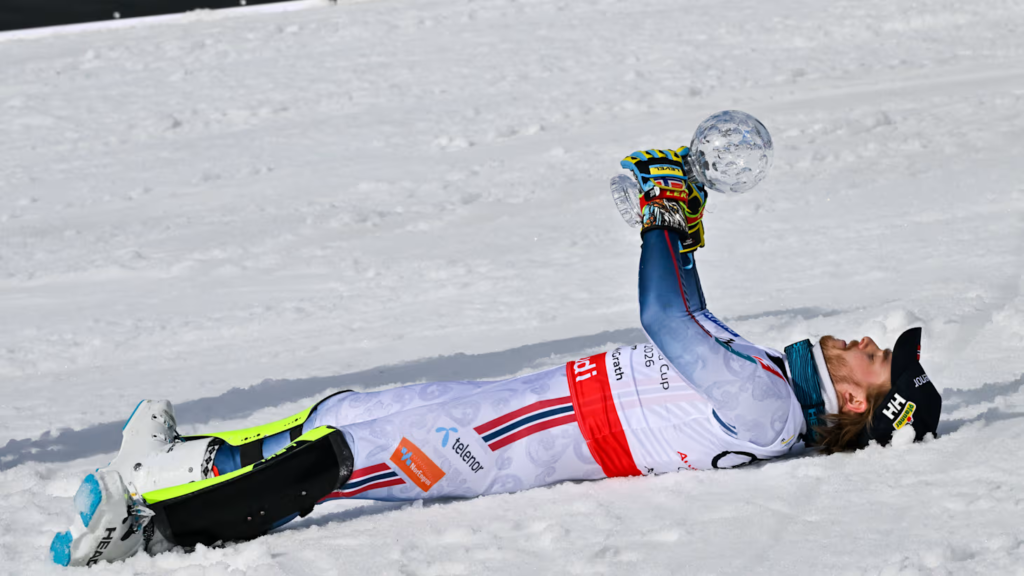
His reaction at the finish line captured the emotional weight of the moment. Celebrating with visible passion, he acknowledged the crowd before shouting in triumph, reflecting both personal relief and national pride. The victory secured the giant slalom crystal globe, adding to his growing list of accolades and reinforcing his reputation as one of the sport’s most dynamic competitors.
The race also highlighted his consistency throughout the season. Unlike one-off victories, the crystal globe represents sustained excellence across multiple events, demanding adaptability to different conditions and courses. Braathen’s ability to perform at a high level over time demonstrated maturity and strategic awareness, qualities that have become increasingly evident in his skiing.
Beyond individual success, the achievement carries broader significance. Representing Brazil, a nation not traditionally associated with alpine skiing, Braathen’s victories challenge established narratives within the sport. His success brings attention to the possibility of broader geographic diversity in winter sports, inspiring athletes from non-traditional backgrounds to pursue similar ambitions.
Rivalries, Challenges, and the Road Ahead
The competitive landscape of alpine skiing is defined by intense rivalries, and Braathen’s career has unfolded alongside some of the most accomplished athletes of his generation. His recent triumph was shaped in part by the absence of a dominant contender who failed to finish, illustrating how unpredictable the sport can be. Yet, Braathen’s ability to capitalize on such moments speaks to his readiness and competitive instinct.
Read : 2 Dead, 5 Injured in Avalanche That Swept 25 Skiers on Hohe Ferse Slopes
Another dimension of his journey is the relationship with fellow competitors, including close friendships that add complexity to the rivalry. Finishing alongside a childhood friend on the podium underscores the interconnected nature of the skiing community, where shared histories coexist with fierce competition. These dynamics contribute to the emotional richness of the sport, where victories are often intertwined with personal connections.

Looking ahead, Braathen faces the challenge of maintaining his position at the top in a highly competitive field. The final events of the season continue to test his versatility, particularly in slalom, where he remains a strong contender for another title. Balancing multiple disciplines requires not only physical endurance but also mental adaptability, as each race demands a distinct approach.
External factors, such as changing snow conditions and the physical toll of a long season, also play a role in shaping outcomes. Spring races, often characterized by softer snow, can introduce unpredictability, favoring skiers who can adjust their technique accordingly. Braathen’s recent performances suggest that he possesses the adaptability needed to navigate these challenges effectively.
His journey also raises broader questions about identity and representation in sports. By choosing to compete for Brazil, Braathen has redefined his professional narrative, blending personal heritage with athletic ambition. This decision has not only influenced his own career but also contributed to a wider conversation about the global nature of modern sports.
As his career progresses, Braathen’s influence is likely to extend beyond his results on the slopes. His story resonates with themes of resilience, independence, and the pursuit of authenticity, offering a compelling example for aspiring athletes. Whether competing in future World Cup events or major international competitions, he remains a figure to watch, capable of shaping the direction of alpine skiing in the years to come.
The trajectory of Lucas Pinheiro Braathen illustrates how success in sport is rarely linear. It is shaped by moments of triumph, periods of uncertainty, and decisions that carry both risk and opportunity. His recent achievements, including the giant slalom crystal globe, represent the culmination of years of dedication and the beginning of a new phase defined by confidence and ambition.