

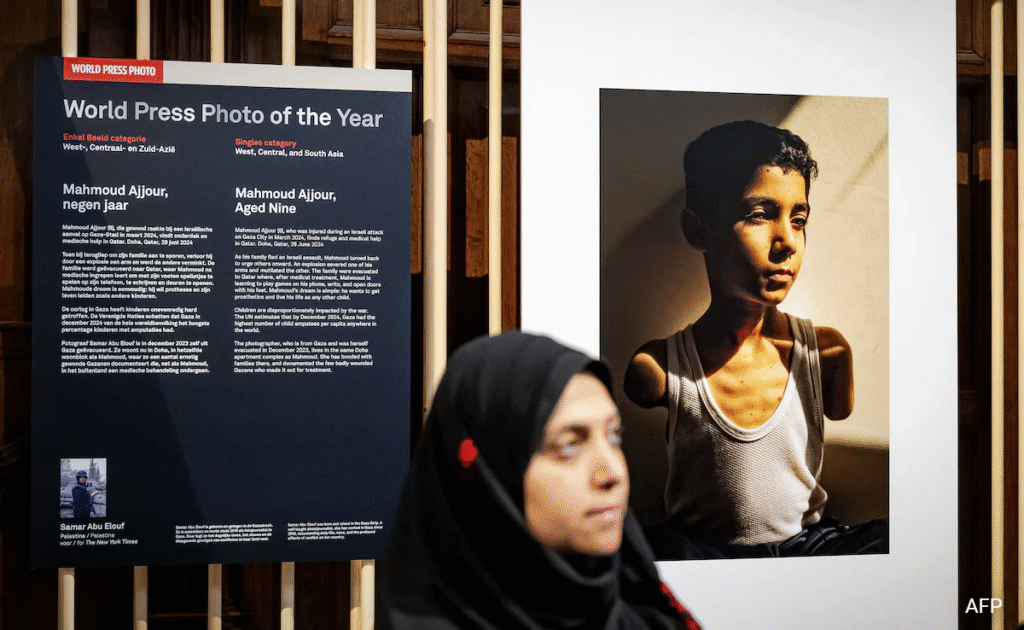
The image of nine-year-old Mahmoud Ajjour, who lost both arms in an Israeli airstrike in Gaza, has become a powerful symbol of war’s human cost and the resilience of its youngest victims.
Captured by Palestinian photojournalist Samar Abu Elouf, the photo has been awarded the 2025 World Press Photo of the Year, earning global recognition for its emotional depth and historical relevance. Abu Elouf, a freelance journalist from Gaza, managed to take the photograph in June 2024, months after she herself escaped the besieged territory.
She had found herself living in the same apartment complex as Mahmoud in Doha, Qatar, where the boy and his family were staying while he received medical care. This moment of shared space gave Abu Elouf the rare opportunity to portray the quiet strength and suffering of a child forever changed by war.
Mahmoud Ajjour’s story is not unique, yet it encapsulates the collective suffering of Gaza’s children, thousands of whom have been injured, orphaned, or killed since the conflict intensified. The image stands not only as a work of art but also as a visual document of survival, trauma, and the human spirit’s ability to persist even when the body is broken.
A Photographer’s Journey from Gaza to Global Recognition
Samar Abu Elouf’s journey to this moment has been anything but easy. From 2010 until the end of 2023, she courageously covered every major development in the Gaza Strip, often working in dangerous conditions with little protection.
In a 2016 interview, she revealed how she crafted her own press gear out of a saucepan and plastic bags due to the lack of resources for freelance journalists.
Read : 14-Year-Old Palestinian-American Citizen Amer Mohamad Saada Rabee Killed in the West Bank
Despite the hardships, Abu Elouf has steadily built a reputation as one of Gaza’s most prominent photojournalists. In 2023, she was honored with the prestigious Polk Award for her work documenting the lives of civilians during Israel’s military operations. One of her widely recognized images captured children sheltering in a Gaza school, their eyes filled with terror as explosions echoed around them.
The #WPPh2025 Photo of the Year is ‘Mahmoud Ajjour, Aged Nine’ by @samarabuelouf, for @nytimes. The jury was moved by this portrait of a Palestinian boy which speaks to the devastating long-term costs of war on civilians. Read more: https://t.co/KHmkUjt2Rj pic.twitter.com/QP3lqEBWaR
— World Press Photo (@WorldPressPhoto) April 17, 2025
The following year, she received the Anja Niedringhaus Courage in Photojournalism Award from the International Women’s Media Foundation for a series of photos commissioned by The New York Times. The series documented the war’s impact on women and children, highlighting both their suffering and resilience.
Abu Elouf’s dedication to truth-telling is evident in every frame she captures. Her work is not only artistically powerful but also historically vital, preserving moments of humanity amid chaos. The image of Mahmoud Ajjour is a continuation of that mission—a quiet, piercing reminder of war’s youngest victims.
Gaza’s Journalists: A Profession Under Siege
The recognition of Abu Elouf’s work also shines a light on the perilous conditions faced by journalists in Gaza. According to the Costs of War project at Brown University, more than 220 media workers have been killed in Gaza since October 2023, making this the deadliest conflict for journalists in a century.
For freelancers like Abu Elouf, the danger is compounded by a lack of institutional support. In her 2016 interview, she voiced her frustration with international organizations that advocate press freedom in name but offer little in terms of actual protection on the ground. She spoke of a grim reality where journalists have no protective gear, no insurance, and no backup when they are injured—or worse.
Her words ring even more true today. While global media outlets feature images and reports from Gaza, the people producing this content are often working without the bare minimum of safety guarantees.
This raises urgent questions about the ethical responsibilities of media organizations and the international community toward frontline journalists, especially those operating in blockaded or occupied zones.
Even as she gains global recognition, Abu Elouf’s heart remains with Gaza. She continues to document the lives of displaced families in Doha, many of whom, like Mahmoud, were lucky enough to escape for treatment but carry the weight of loss, trauma, and uncertainty.
Beyond the Frame: Mahmoud’s Ongoing Journey
Mahmoud Ajjour’s life changed forever in March 2024, when an Israeli airstrike tore through his neighborhood in Gaza City, costing him both arms and leaving emotional scars that no surgery can heal. His evacuation to Qatar for medical care was a rare stroke of fortune in a place where such opportunities are few and far between.
Now in Doha, Mahmoud’s recovery is ongoing. He is one of several children whom Abu Elouf has continued to document—children trying to reclaim their childhoods in unfamiliar cities, surrounded by new technologies, languages, and people.
The tenderness with which Abu Elouf approached Mahmoud’s story is what gives the photo its emotional power. It is not just an image of suffering but also one of quiet dignity, resilience, and hope.
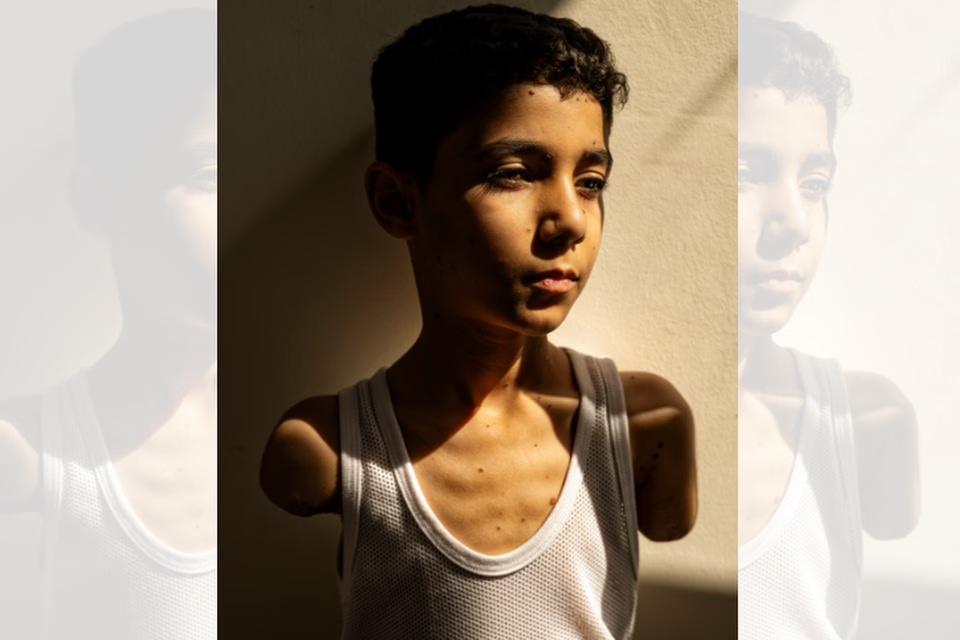
Her lens captured Mahmoud not as a victim, but as a survivor—a child who, despite having lost so much, still radiates presence and life. In doing so, she challenges viewers to see beyond the statistics and news headlines, and to confront the personal, lasting toll of war.
In the months ahead, Abu Elouf intends to continue her work from Doha and other regions where displaced Palestinians have sought refuge. Her goal remains the same: to make the invisible visible, and to ensure that the world does not look away from the stories that matter most.
Legacy of a Moment, Message to the World
The selection of this photograph as the World Press Photo of the Year is more than a professional accolade; it is a powerful act of witnessing. It ensures that Mahmoud Ajjour’s face—and by extension, the suffering of countless children in Gaza—is etched into the global conscience.
In honoring this image, the international community is also honoring the work of photographers who risk their lives to bear witness in places that most cannot or will not go. It is a tribute to the endurance of truth, even in the darkest of times.
As conflict continues to rage and as journalists remain in harm’s way, the story behind this image reminds us that journalism is not merely a profession—it is a lifeline. Through the lens of Samar Abu Elouf, the world sees Mahmoud Ajjour not as a symbol, but as a child. And that simple truth, captured in a single photograph, has the power to move the world.