
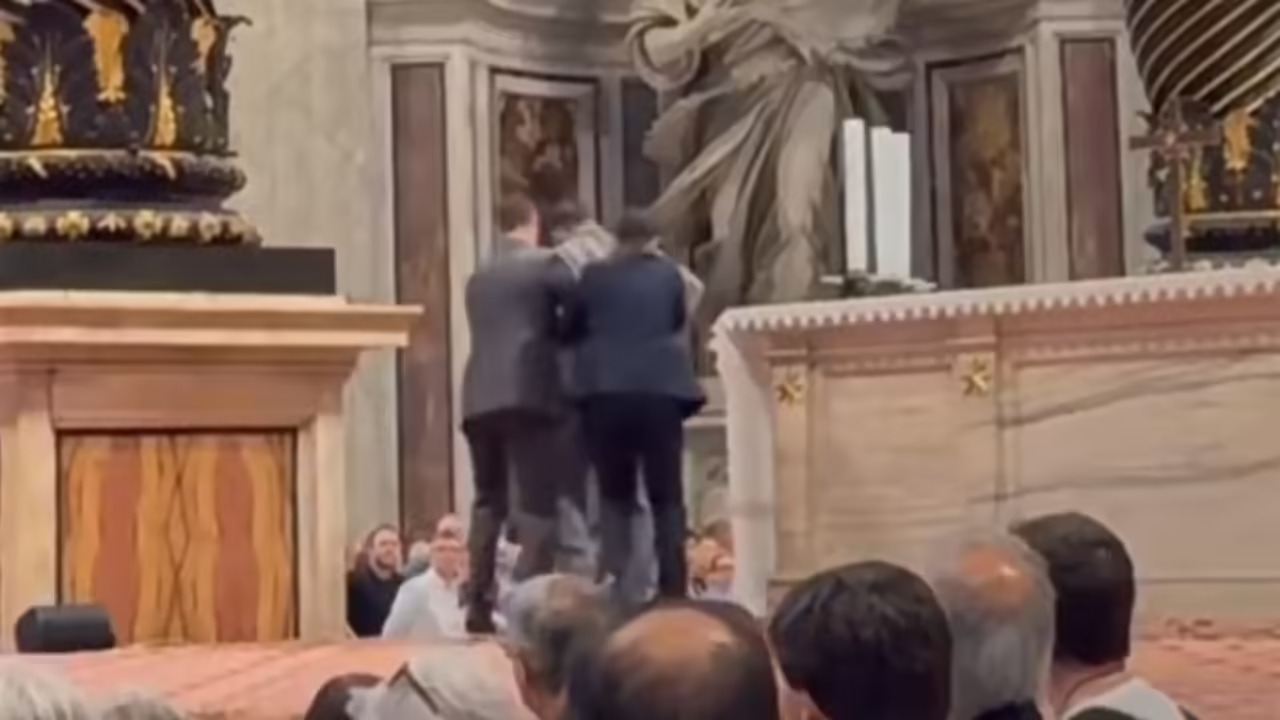
A shocking act of desecration at one of the holiest sites in Christianity has stirred global outrage and prompted swift action from the Vatican. On October 10, a man urinates on Altar of the Confession inside St. Peter’s Basilica in Vatican City, in full view of hundreds of onlookers. The incident, which was captured on video and quickly spread across social media, has drawn condemnation from both religious leaders and the public. Pope Leo XIV, visibly disturbed by the reports, immediately ordered a purification ceremony to restore the sanctity of the site.
The Disturbing Incident at the Heart of the Vatican
The event unfolded on Friday morning, around 9:30 a.m. local time, inside the iconic St. Peter’s Basilica — a spiritual and architectural masterpiece that serves as the symbolic center of the Catholic Church. According to Italian news outlet Il Tempo, the man managed to bypass the security barriers surrounding the Altar of the Confession, the sacred structure located directly above the tomb of St. Peter, the Church’s first pope and one of the apostles of Jesus Christ. Once he reached the altar, witnesses reported that he proceeded to urinate on it, shocking the tourists and worshippers present.
Security personnel and plainclothes Vatican police acted quickly, removing the man from the basilica and taking him into custody. The authorities have not yet released his name or nationality. However, Il Tempo confirmed that the act was caught on camera, and video footage circulated widely online, showing the crowd’s horrified reaction.
The Vatican has not yet issued a formal statement beyond confirming that the purification ritual took place. According to reports, Pope Leo XIV was informed of the incident shortly after it occurred. Sources close to the Vatican told The Telegraph that the pope expressed deep dismay and immediately met with Cardinal Mauro Gambetti, the Archpriest of St. Peter’s Basilica, to discuss the Church’s response. Together, they decided to perform a purification ceremony, a sacred rite intended to cleanse and reconsecrate the altar after acts of desecration.
The basilica was temporarily closed on Monday, October 13, as clergy performed the purification rite. The ceremony included prayers, recitations of psalms, and the sprinkling of holy water over the Altar of the Confession. The Vatican confirmed that the rite had been completed and that the basilica has since reopened to the public.
A Sacred Site Violated Again
This appalling incident marks the third desecration of the Altar of the Confession since 2023, underscoring growing concerns about security and mental health issues among individuals visiting religious sites. St. Peter’s Basilica, which welcomes millions of visitors each year, has faced several shocking acts of vandalism and disruption in recent years.
In February 2025, another man reportedly jumped onto the same altar and toppled six 19th-century candelabras, damaging artifacts worth more than $30,000. The Vatican police quickly intervened, and the suspect, identified as a Romanian national, was handed over to Italian authorities. Vatican Press Office Director Matteo Bruni later stated that the man suffered from “serious mental disabilities,” emphasizing the need for compassion alongside justice.
A year earlier, in 2023, a Polish man stripped naked and climbed onto the Altar of the Confession with the words “Save children of Ukraine” written across his back. His protest, though politically motivated, was also classified as an act of desecration by Church authorities. A purification ceremony was held then as well, led by Cardinal Gambetti, who called on the faithful to seek forgiveness and healing. “We are here to tell the Lord that we recognize that this structure of sin conditions the actions of God’s people,” he said during that ceremony. “Lord, we ask your forgiveness, purify us.”
Read : Pope Names Italian Nun Simona Brambilla as First Woman to Lead Major Vatican Office
The Altar of the Confession, constructed directly above the tomb of St. Peter, has long been considered the spiritual core of the basilica. Designed by Gian Lorenzo Bernini in the 17th century, it stands beneath Michelangelo’s majestic dome — a place where faith, history, and art converge. For Catholics worldwide, it represents not only the resting place of the Church’s founder but also the heart of Christian worship itself. To violate this altar, therefore, is seen not merely as vandalism but as a profound spiritual offense.
Read : Vatican City: The Centre of Christianity
Experts in Church liturgy and canon law note that such acts of desecration require formal purification rituals, as prescribed in the Rite of Dedication of a Church and an Altar. These rites involve prayers of reparation, blessings, and the sprinkling of holy water to signify the restoration of divine presence. The ritual underscores the belief that sacred spaces, once defiled, must be ritually cleansed before they can again serve as places of worship.
Security, Faith, and the Modern Challenge of Desecration
The recurring nature of these incidents has prompted questions about the adequacy of current security measures within St. Peter’s Basilica. Despite the presence of Vatican Gendarmerie officers and surveillance systems, the open and welcoming nature of the church — which receives thousands of visitors daily — makes it challenging to prevent isolated acts of disruption.
Vatican officials have long sought to balance accessibility with protection, ensuring that the basilica remains open to pilgrims and tourists while preserving its sacred character. However, recent events may push the Vatican to adopt stricter protocols. Discussions are reportedly underway about installing more advanced barriers around the altar area and increasing the number of plainclothes officers stationed within the basilica.
Beyond security, these acts have reignited broader conversations about reverence, mental health, and the pressures of modern society. Religious scholars argue that such incidents reflect a growing detachment from spiritual values in an era of digital spectacle and viral attention. The immediate circulation of videos from the latest desecration has only intensified debate over the role of social media in amplifying shocking behavior for public consumption.
Pope Leo XIV, who has emphasized dignity, compassion, and reconciliation throughout his papacy, is said to be deeply troubled by these recurring offenses. His decision to order purification rituals reflects not only adherence to Church tradition but also an effort to guide the faithful through collective reflection. According to sources quoted by The Telegraph, the pontiff’s private remarks to the clergy stressed forgiveness over anger. “We must heal through prayer and vigilance,” he reportedly said.
While the Vatican has not disclosed whether the man involved will face formal charges, it is likely that he will be handed over to Italian authorities, as has been customary in similar cases. Depending on his mental state and motive, he could face prosecution for public indecency and vandalism under Italian law.
St. Peter’s Basilica remains a global beacon of faith and a masterpiece of Renaissance architecture. Completed in 1615 under Pope Paul V, the basilica is home to works by Michelangelo, Raphael, and Bernini. Each year, millions of Catholics make pilgrimages to this sacred site, which houses the tombs of numerous popes and saints. For many, the recent incident represents not just a momentary act of defilement but a wound to the spiritual heart of Christianity.
In the wake of the purification ceremony, Vatican clergy have encouraged believers to respond with prayer rather than outrage. Daily Masses have resumed, and visitors continue to approach the Altar of the Confession with renewed reverence. The faithful see the ritual cleansing as a symbolic act of resilience — a reminder that even in the face of sacrilege, the Church’s spiritual integrity endures.
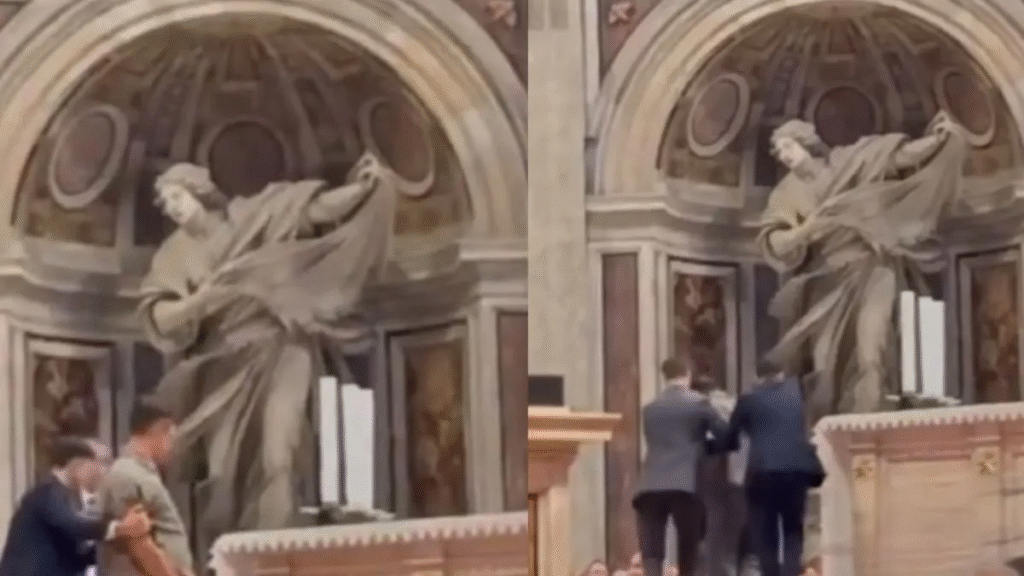
Religious historians note that desecrations, though deeply painful, have occurred throughout the Church’s long history. From iconoclasm in medieval Europe to modern vandalism, sacred spaces have repeatedly been tested by human frailty and rebellion. Yet, each act has also offered an opportunity for renewal and reaffirmation of faith. As Cardinal Gambetti remarked during the 2023 purification, “Every profanation reveals not only the sin of one but the need for all to seek purification.”
The latest incident, disturbing as it is, thus joins a long continuum of challenges faced by the Church — a test not only of its security but of its compassion, patience, and capacity for forgiveness. As the altar once again glistens with holy water and chants echo through Bernini’s colonnades, the Vatican stands at a familiar crossroads: between outrage and mercy, desecration and redemption.
The Altar of the Confession now stands restored, but the questions raised by this act linger. How can sacred spaces remain open to the world yet shielded from violation? How can the Church minister compassionately to those whose actions stem from instability or despair? These questions, difficult as they are, will shape the Vatican’s path forward.
In the end, what remains clear is the enduring significance of St. Peter’s Basilica — not merely as a building of marble and gold, but as a living symbol of faith that withstands even the most shocking acts of defilement. The desecration of its altar is a sobering reminder of humanity’s capacity for both offense and repentance. Yet, as history has shown, from the ashes of sacrilege often rises a deeper awareness of the sacred.
The purification rites led by Pope Leo XIV and Cardinal Gambetti serve not only to cleanse stone and bronze but also to call believers toward reflection — to see in this act of violation a moment to renew reverence for what is holy. For the Church, the altar has once again been sanctified. For the faithful, the challenge now is to sanctify their own hearts in response.
**mitolyn**
Mitolyn is a carefully developed, plant-based formula created to help support metabolic efficiency and encourage healthy, lasting weight management.
References:
Top slots and trains
References:
https://www.udrpsearch.com/user/stepash6
References:
Stanozolol steroid
References:
http://122.116.190.233:3001/lenoreburgmann/lenore2006/wiki/Dianabol-for-Weight-Gain%3A-How-Dbol-Boosts-Muscle-Mass-and-Strength-Effectively
References:
Online casino sites
References:
https://de.kzen.dev/index.php/user/flockiris54
References:
Winstrol pre workout
References:
https://www.fcla.de/index.php/;focus=STRATP_com_cm4all_wdn_Flatpress_38266970&path=&frame=STRATP_com_cm4all_wdn_Flatpress_38266970?x=entry:entry250128-222210%3Bcomments:1
References:
How to get bigger without steroids
References:
https://www.amc-reilingen.de/PRESSEMITTEILUNGEN/index.php/;focus=STRATP_com_cm4all_wdn_Flatpress_39651172&path=?x=entry:entry230318-135827%3Bcomments:1