
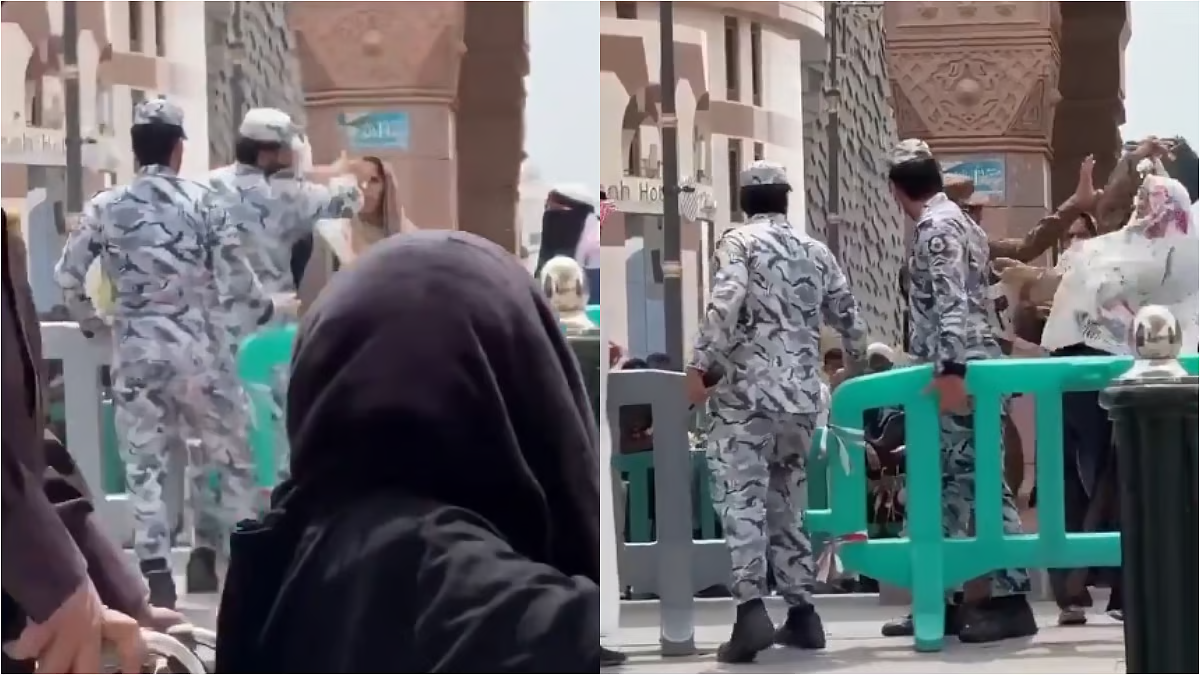
In a shocking incident that has taken social media by storm, a viral video captures a dramatic confrontation between a burqa-clad woman and a security officer inside Masjid An-Nabawi, the revered Prophet’s Mosque in Medina, Saudi Arabia.
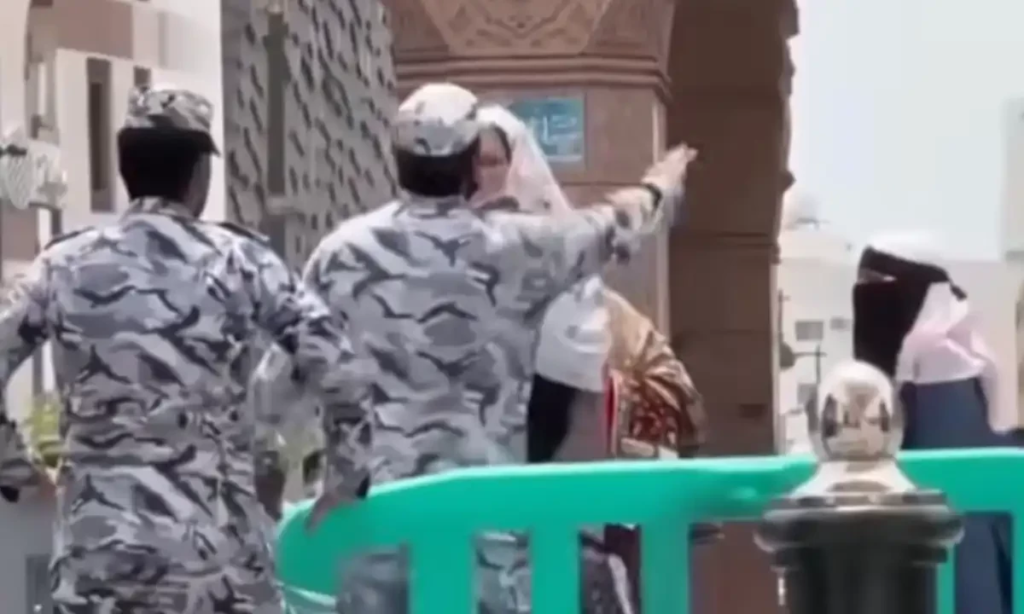
The footage shows the woman aggressively slapping the security officer after he attempted to prevent her from entering a restricted area within the mosque. In response, the officer retaliated by slapping her multiple times before bystanders intervened.
The incident has sparked heated debates on social media regarding security measures at the holy site, appropriate responses from law enforcement, and the broader implications of such encounters in sacred spaces.
The Incident Unfolds
The video, which quickly went viral, shows the woman walking briskly toward a restricted area in Masjid An-Nabawi. A security officer stationed there attempts to stop her, blocking her path and gesturing for her to turn back.
However, the woman appears determined to proceed and ignores the officer’s directives. As tensions escalate, she tries to maneuver past him, prompting the officer to step in front of her again, firmly signaling her to change direction.
The situation takes a dramatic turn when the woman, visibly frustrated, suddenly slaps the officer across the face. The guard, seemingly taken aback for a moment, immediately retaliates by striking her back multiple times.
Read : Explosion During Prayer at Nowshera Mosque in Pakistan, 5 Killed
The repeated slaps continue until bystanders rush in to separate the two, bringing the intense altercation to an abrupt end. This exchange has since ignited discussions over the conduct of both the woman and the security personnel involved.
Reactions from Authorities and Public Opinion
Medina Police swiftly responded to the circulating footage, confirming that an investigation into the incident was underway. According to their statement, the authorities are currently reviewing the case to determine the circumstances that led to the altercation and whether legal actions will be taken against those involved.
The police emphasized the importance of respecting security personnel as they carry out their duties, particularly in sensitive locations like Masjid An-Nabawi, which attracts millions of worshippers annually.
Haramain, the official authority overseeing the Two Holy Mosques, also issued a statement condemning any form of assault against security officers while they are on duty. They reiterated that such actions are considered serious offenses that could lead to detention and severe legal consequences.
Don't enter here.
— Gomina Habib (@GominaHabib) March 29, 2025
But she kept on walking there to the extend of slapping an officer.
You'll notice that she has been doing it either to her husband or her maid if nt for a woman to raise her hand to slap a man and nt just a man but a uniform officer in the holy ground of macca. pic.twitter.com/r3lHB4X6Wj
Additionally, Saudi Arabia’s legal framework outlines that assaulting a security officer, damaging official property, or obstructing law enforcement activities are punishable by strict penalties under the Criminal Procedure Law.
Public reactions to the video have been divided. While some argue that the woman’s actions were inappropriate and unlawful, others believe that the security officer’s response was excessive and unprofessional.
Many social media users pointed out that security personnel should be trained to de-escalate situations rather than resorting to physical retaliation, especially in a place of worship. On the other hand, some argue that the officer was merely defending himself after being physically attacked.
The Debate Over Security Protocols at Holy Sites
The incident has reignited a broader discussion about the role and responsibilities of security personnel at religious sites. Masjid An-Nabawi, one of the holiest places in Islam, is visited by millions of pilgrims and worshippers each year, making security enforcement a critical aspect of maintaining order.
Security officers are tasked with ensuring that religious sanctity is preserved, preventing unauthorized access to restricted areas, and responding to any threats or violations.
However, the manner in which security personnel handle confrontations has now come under scrutiny. Critics argue that while strict security measures are necessary, officers must also be trained in conflict resolution and crowd management to avoid unnecessary physical altercations.
The use of excessive force, even in response to provocation, can damage public trust and lead to widespread criticism. Conversely, proponents of strong security enforcement maintain that without firm action, such incidents could escalate and pose greater risks to public safety.
This case also raises questions about the need for clearer communication regarding restricted areas within the mosque. Some argue that better signage, multilingual instructions, and awareness campaigns could help prevent misunderstandings and reduce conflicts between visitors and security personnel.
Others suggest that security officers should be equipped with body cameras to provide clearer evidence in cases of disputes, ensuring accountability on all sides.
As authorities continue their investigation, the incident serves as a reminder of the challenges faced in maintaining security at religious sites, the fine line between law enforcement and excessive force, and the responsibilities of worshippers to adhere to established regulations.
Whether or not legal action is taken, this confrontation has undoubtedly left a lasting impact on discussions surrounding security measures in one of Islam’s most sacred locations.