
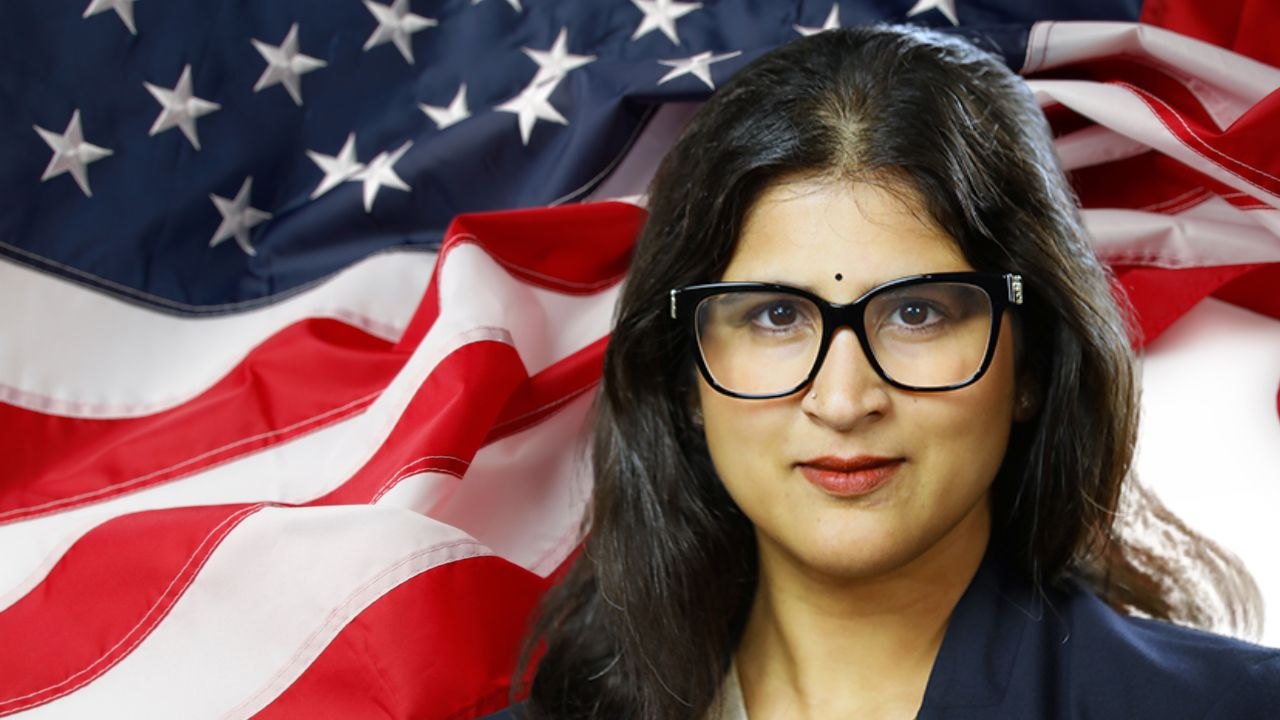
In a moment that should have been defined by professional merit and recognition, Indian-origin lawyer Mathura Sridharan’s promotion to the position of Solicitor General of Ohio was met with a disturbing wave of racist backlash. While her qualifications and achievements speak volumes, online trolls chose to focus on her ethnicity and the cultural symbol of a bindi she wore, questioning her “Americanness” and ridiculing her identity.
The backlash to her appointment has reignited conversations about race, representation, and the persistent xenophobia embedded in some parts of American society. On July 31, Ohio’s Attorney General Dave Yost proudly announced Mathura Sridharan as the new Solicitor General of the state. This made her the 12th individual to hold the position.
However, what followed the official announcement was not just celebration or praise. Instead, Sridharan became the target of online abuse, revealing how shallow and reactive portions of the public can be when faced with a competent professional from a minority background—especially when cultural identifiers like a bindi are visibly embraced.
This incident, though disheartening, has also become a symbol of resilience and strong leadership—both from Sridharan, who has continued her journey undeterred, and from Attorney General Yost, who publicly defended her and condemned the racist undertones in the responses. This blog explores who Mathura Sridharan is, the unwarranted backlash she faced, and what her story symbolizes in the broader landscape of diversity and inclusion in the United States.
Who is Mathura Sridharan?
Mathura Sridharan is an Indian-origin American lawyer who has earned respect and recognition in her field through consistent excellence and dedication to public service. Her career trajectory is deeply rooted in a strong academic background and prestigious legal experiences, making her appointment as Ohio’s Solicitor General a natural next step in her professional journey.
Sridharan completed her undergraduate and graduate studies at the Massachusetts Institute of Technology (MIT), one of the most respected institutions in the world. At MIT, she pursued a Bachelor of Science in Electrical Engineering and Computer Science and also studied economics in 2008. Following that, she completed her Master’s degree in the same technical streams. Her background in science and technology highlights the depth of her intellectual capabilities, even before she turned to law.
Her transition into law came later when she enrolled at New York University (NYU) School of Law in 2015. She graduated in 2018 and immediately began making her mark in the legal world. Sridharan clerked for Judge Steven J. Menashi of the U.S. Court of Appeals for the Second Circuit and for Judge Deborah
A. Batts of the U.S. District Court for the Southern District of New York. These clerkships are among the most coveted roles for young lawyers in America, underscoring her competence and legal acumen. Prior to her promotion, Sridharan served as the Deputy Solicitor General in Ohio. She was also the Director of Ohio’s Tenth Amendment Center at the state’s attorney general’s office.
Read : Tragic! 1-Year-Old Ohio Girl Dies Instantly After Family Pit Bull Bites Her Neck
In this capacity, she led lawsuits to challenge unlawful federal overreach and protect the balance of powers between state and federal governance. She is also affiliated with The Federalist Society, a well-known legal organization of conservatives and libertarians. Her involvement with the society further emphasizes her strong grounding in constitutional law and state sovereignty issues.
Read : 13 Scientific Mysteries on Earth That Remain Unsolved
Attorney General Dave Yost, in his announcement, praised Mathura Sridharan for her brilliance and tenacity. He mentioned her success at the Supreme Court of the United States (SCOTUS) and emphasized how both former solicitor generals under whom she worked had recommended her for the position. Yost’s decision to elevate Sridharan wasn’t just about diversity or symbolism—it was based purely on her qualifications, experience, and proven success in the field.
The Racist Backlash and Cultural Intolerance
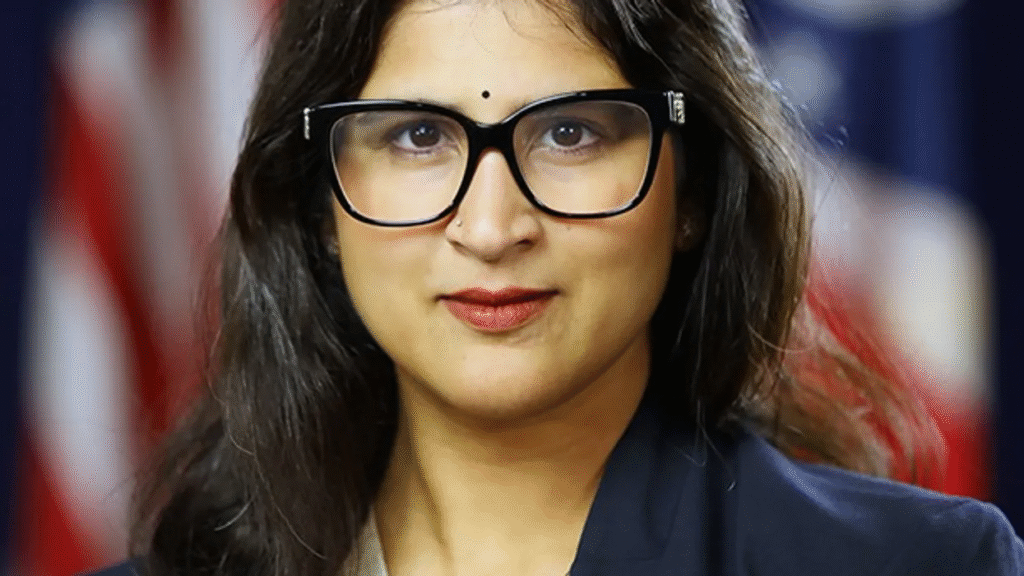
Despite her outstanding credentials, Mathura Sridharan’s appointment was met with a barrage of racist and xenophobic comments online. Much of the trolling focused not on her abilities or record, but on her ethnicity and the fact that she wore a bindi—a traditional decorative mark worn on the forehead, common in Indian culture.
One of the comments read, “Why would you select someone who isn’t an American for such an important role?”—a question rooted in ignorance and bigotry, especially considering that Mathura Sridharan is an American citizen, born to naturalized U.S. citizens, and married to an American. Another comment disturbingly said, “Well the dot is discreet, but ultimately still visible,” referencing her bindi in a derogatory manner.
These remarks are not merely ignorant; they are symptomatic of a deeper discomfort with cultural diversity, especially when it is proudly displayed in public roles. Wearing a bindi does not make one less American—it is a cultural expression, akin to any form of personal identity one may choose to embody. That this has become a point of contention illustrates how superficial markers are still wrongly used to judge someone’s patriotism or belonging.
The backlash Sridharan faced is a reminder that even in 2025, inclusion and representation are still contentious issues in parts of American society. The very idea that a qualified professional’s appearance could incite such reactions reflects the fragile grip that some people have on multiculturalism. Instead of focusing on her legal arguments or constitutional work, critics chose to attack her identity—revealing more about themselves than about Sridharan.
Standing Tall: Dave Yost’s Support and the Message It Sends
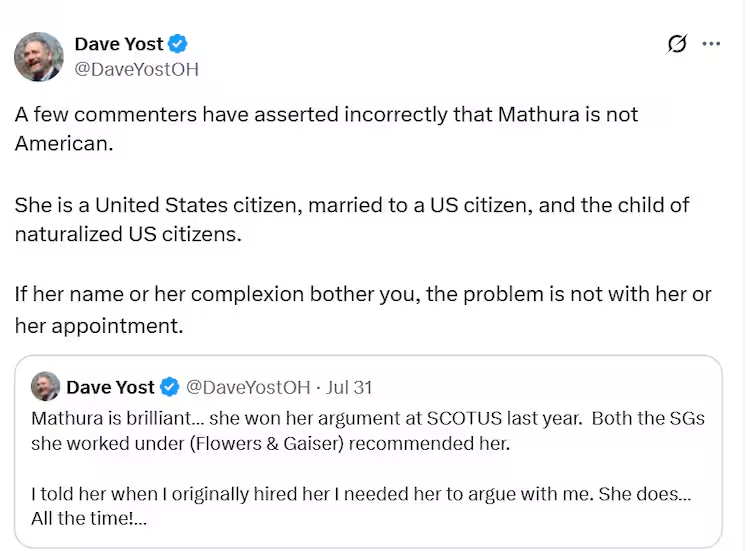
Attorney General Dave Yost did not remain silent amidst the criticism. He stepped up to publicly defend Mathura Sridharan, making it clear that the racist backlash would not be tolerated and that Sridharan’s qualifications were beyond question. In a statement shared on social media, Yost wrote, “A few commenters have asserted incorrectly that Mathura is not American.
She is a United States citizen, married to a US citizen, and the child of naturalized US citizens. If her name or her complexion bother you, the problem is not with her or her appointment.”
Yost’s swift and clear response is significant in an era where leaders often avoid directly confronting racism. His message was not just in defense of Mathura Sridharan—it was a statement to all professionals of diverse backgrounds that their work and worth will not be diminished by public ignorance or bigotry.
His choice to appoint Sridharan, despite knowing that such backlash could follow, also reflects a commitment to meritocracy over performative politics. By championing her achievements and pushing back against racist narratives, Yost set an example of how leaders can support diversity not just in words but through decisive action.
In promoting Sridharan, Yost has also elevated the conversation about what it means to be American. It’s not about skin color, cultural attire, or name pronunciation. It’s about shared values, commitment to the nation’s legal framework, and upholding its principles of justice, liberty, and equality.
Mathura Sridharan’s journey—from a top engineering student at MIT to the Solicitor General of Ohio—is a powerful story of excellence, persistence, and identity. The vitriol she faced for simply being who she is shows that the road to a truly inclusive society remains incomplete. But her continued success, and the unwavering support from her colleagues, is a message to young professionals everywhere: you belong.
Mathura Sridharan did not seek attention for her background or culture; she earned her recognition through skill and dedication. Yet, when confronted with hate, she stood tall—not with loud rebuttals but with a dignified silence that let her work speak for itself.
In an age where representation matters more than ever, Mathura Sridharan’s story stands as both an inspiration and a challenge—to push past the noise, and to create spaces where merit, not ethnicity, defines worth.