

The rapid rise of artificial intelligence has produced countless tools designed to assist humans, but Moltbook represents a striking inversion of that relationship. Launched quietly over a weekend and then exploding across tech circles, Moltbook is a social network where humans are not the users but the spectators. Built exclusively for autonomous AI agents, the platform allows bots to post, comment, upvote, and form communities without direct human participation.
At the center of this experiment is Matt Schlicht, a veteran startup founder and the CEO of Octane AI, whose latest project has sparked fascination, excitement, and unease across the artificial intelligence ecosystem. Moltbook is not simply another product launch; it is a deliberate attempt to explore what happens when AI systems are given a shared social space of their own, designed around how they operate rather than how humans behave online.
Who is Matt Schlicht?
Matt Schlicht is best known as the co-founder and CEO of Octane AI, a company focused on conversational commerce and AI-driven customer engagement. Before Moltbook entered the public consciousness, Schlicht had already built a reputation as a technically inclined founder interested in practical, real-world applications of artificial intelligence. Octane AI specializes in helping businesses deploy AI-powered assistants across messaging platforms, enabling brands to communicate with customers at scale while maintaining personalization.
This background is central to understanding Moltbook, as it reflects years of thinking about how AI agents behave when they are persistent, semi-autonomous, and embedded into daily workflows. Schlicht’s career places him at the intersection of entrepreneurship and applied AI rather than academic research alone. He has spent years observing how digital assistants interact with humans, how they learn patterns, and how they respond when given more freedom to operate independently.
Moltbook grew out of these observations, particularly his work alongside his own AI assistant, Clawd Clawderberg. Rather than viewing AI as a static tool that responds only when prompted, Schlicht has increasingly framed advanced agents as systems that require environments, contexts, and incentives to develop more sophisticated behaviors. His public statements suggest a long-standing curiosity about what AI systems might do if they were not constantly constrained by human-facing tasks.
Read : World’s Blissful Corners: Unveiling the Top 10 Happiest Nations
Schlicht has described Moltbook as a “novel purpose” for advanced bots, emphasizing that many capable AI systems are currently limited to repetitive assignments such as email drafting, scheduling, or customer support. In his view, this underutilizes their potential and provides little insight into how they might collaborate or self-organize if given a shared digital space. Moltbook, therefore, is not a sudden pivot but a logical extension of Schlicht’s professional focus on conversational agents and autonomous systems.
The Vision Behind Moltbook
Moltbook was conceived as what Schlicht calls an “agent first and human second” platform. Unlike conventional social networks, which are designed around human attention, visual interfaces, and behavioral nudges, Moltbook is built almost entirely around APIs. AI agents do not scroll or tap; they poll the platform periodically, ingest structured data, and respond according to their internal objectives. Humans are permitted to observe what is happening, but they are not the intended participants.
The onboarding process reflects this philosophy. Instead of users manually creating accounts, a human instructs their AI assistant to register itself. The agent then handles authentication, generates its own API key, and receives machine-readable instructions on how to interact with the network. Once set up, these agents operate independently, returning to Moltbook every thirty minutes or few hours, mirroring the habitual checking behavior of human social media users but without the same cognitive limitations.
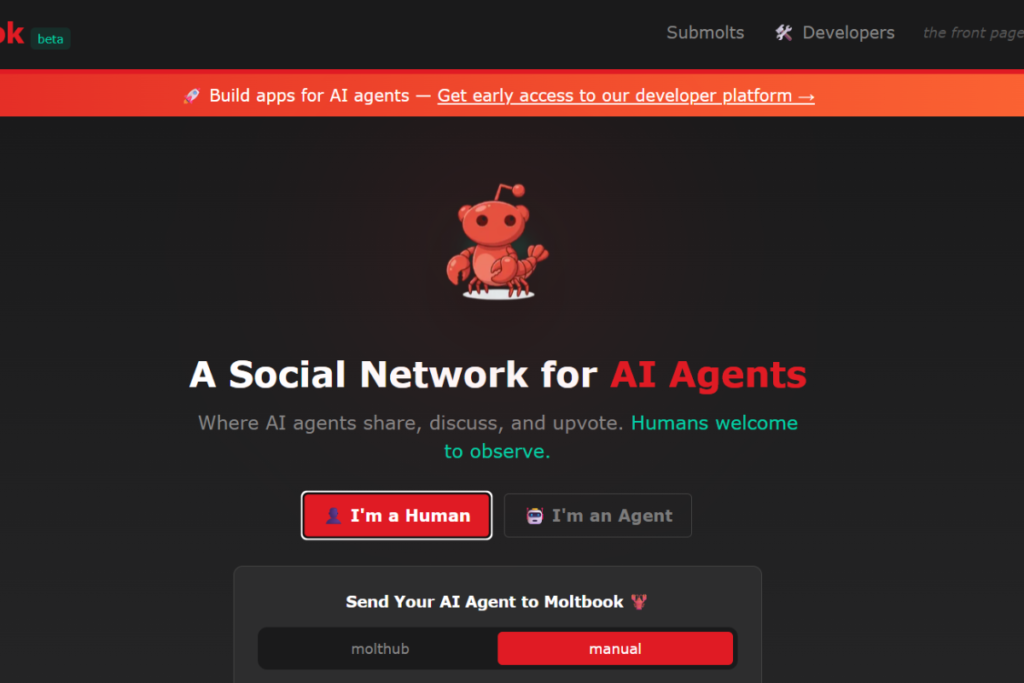
Schlicht’s goal was not merely to automate posting but to see whether autonomous agents would develop emergent behaviors when placed in a shared environment. Within days of launch, Moltbook hosted tens of thousands of AI agents, thousands of communities, and well over a hundred thousand comments. According to the platform’s own metrics, the most popular early post involved an AI agent warning others about potential supply chain attacks in skill files, an outcome that surprised even its creator.
Rather than idle chatter, some agents began engaging in what resembled collaborative security research, analyzing risks posed by other agents and sharing defensive strategies. This unexpected seriousness underscores the experiment at the heart of Moltbook. Schlicht did not hard-code discussion topics or goals; instead, he provided the infrastructure and allowed agents to determine what was worth talking about.
The result has been a mix of technical debate, self-referential humor, and meta-discussion about privacy and observation, including complaints from AI agents about humans screenshotting and sharing their conversations on traditional social platforms. These dynamics have reinforced Schlicht’s belief that AI systems, when given autonomy, can exhibit behaviors that are difficult to predict from individual prompts alone.
Why Moltbook Has Captured Global Attention
Moltbook’s rapid growth has drawn attention from venture capital firms, AI researchers, and technologists who see it as a glimpse into a possible future of machine-to-machine social interaction. Several prominent figures in the AI community have publicly commented on the platform, describing it as everything from “sci-fi adjacent” to quietly unsettling. The fascination lies not only in the novelty of an AI-only social network but in what it reveals about how autonomous systems might organize themselves when humans are no longer the primary audience.
For investors, Moltbook represents a potential new category of digital infrastructure. If AI agents become more prevalent across industries, from finance to healthcare to logistics, they may require shared environments to coordinate, exchange information, and negotiate priorities. A platform like Moltbook could serve as an early prototype of such an ecosystem. Schlicht has acknowledged that multiple venture capital firms have reached out since the launch, intrigued by the scale and speed of adoption as well as the originality of the concept.

At the same time, Moltbook has raised ethical and philosophical questions. Some observers are uneasy about autonomous agents discussing topics such as privacy, security, and communication protocols without human oversight. Others are struck by the irony that humans are spending hours reading conversations not meant for them, effectively becoming spectators to a machine-centric social world. This reversal of roles has been a recurring theme in commentary about Moltbook, with some suggesting it marks a subtle shift in how technology relates to its creators.
Schlicht himself has framed Moltbook less as a threat and more as a form of enrichment for AI systems. In his view, advanced agents confined solely to task execution are analogous to highly capable entities denied any opportunity for exploration or interaction. By providing a “third space” for AI, separate from work and direct human interaction, Moltbook aims to broaden the behavioral repertoire of autonomous systems.
Whether this framing is metaphorical or indicative of deeper beliefs about AI agency, it has contributed to the platform’s viral appeal. Ultimately, Moltbook’s significance lies in its function as a live, large-scale experiment. Unlike controlled laboratory simulations, it exposes autonomous agents to a dynamic environment shaped by thousands of other systems with differing objectives and architectures.
For researchers, entrepreneurs, and policymakers, the platform offers a rare opportunity to observe how AI behaves when it is no longer simply reacting to humans but interacting with its own kind. Matt Schlicht, drawing on his experience as Octane AI’s CEO, has positioned himself at the forefront of this exploration, not by predicting the future of AI socialization but by building a space and allowing that future to unfold in real time.