
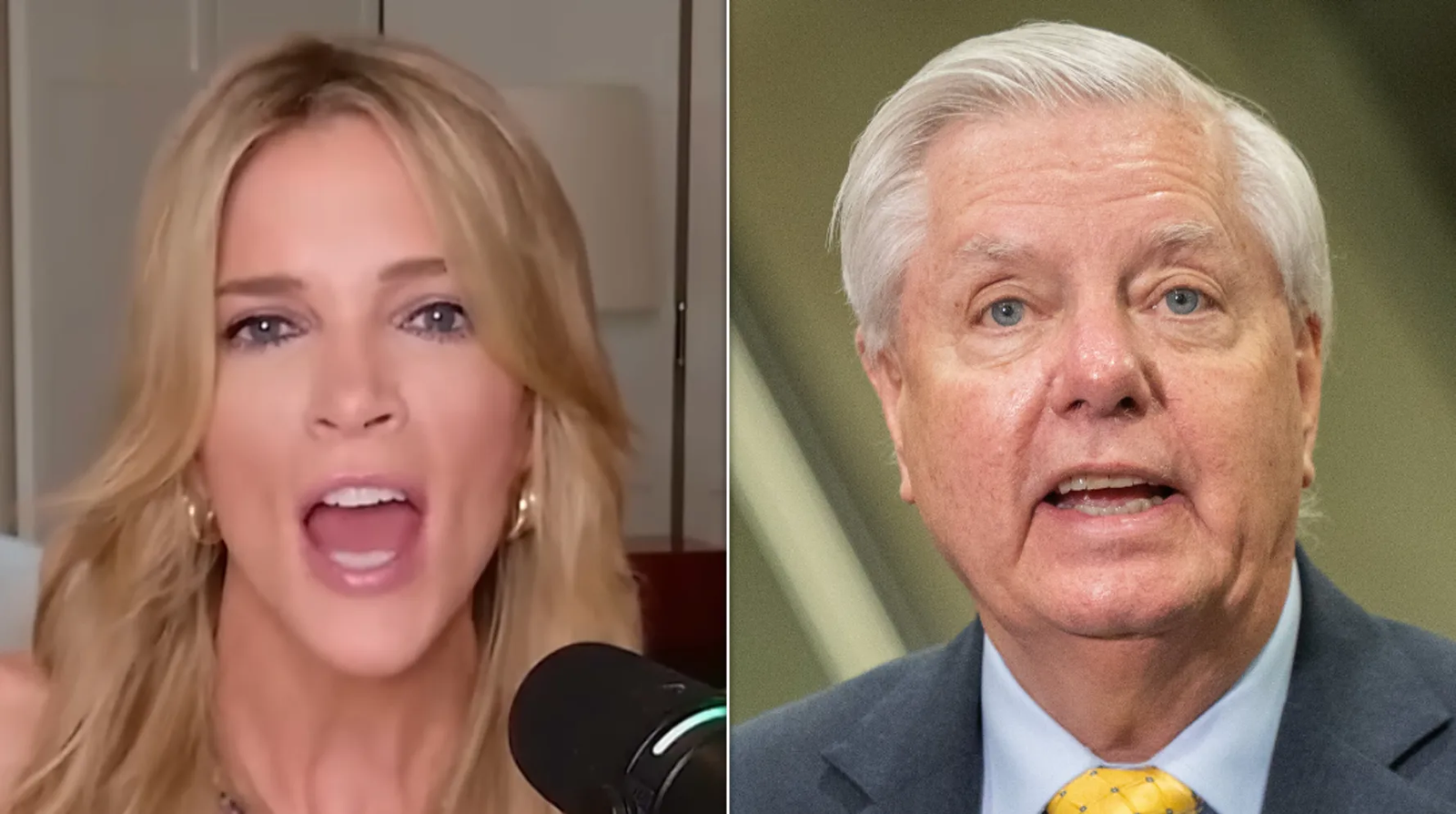
A fierce public dispute has emerged among prominent conservative voices in the United States after broadcaster Megyn Kelly sharply criticized Senator Lindsey Graham over his support for recent military actions involving Iran and other geopolitical flashpoints. The controversy reflects growing divisions within the American right regarding foreign policy, particularly as tensions escalate in the Middle East following coordinated U.S. and Israeli strikes on Iranian targets.
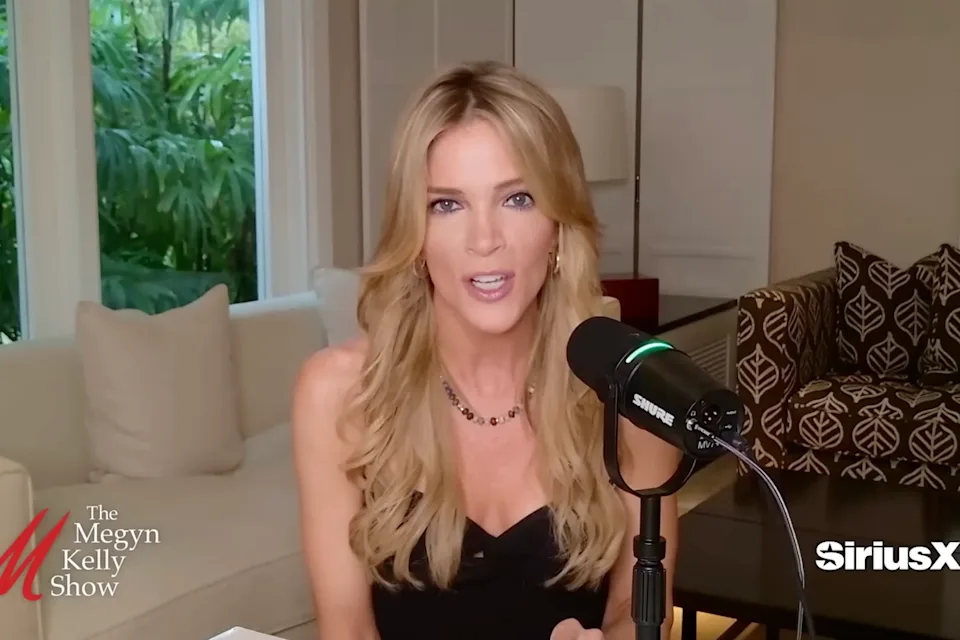
Megyn Kelly’s remarks, delivered on her SiriusXM program, were unusually blunt and directed personally at Graham, whom she accused of aggressively promoting military confrontation across multiple regions within a short span of time. The criticism comes amid a rapidly evolving international situation in which U.S. and Israeli forces have conducted strikes against Iranian targets, reportedly resulting in significant casualties. According to local officials in Iran, more than one thousand people have been killed since the campaign began.
These developments have intensified debate within American political circles about the appropriate scope of U.S. involvement abroad. Megyn Kelly’s attack on Graham illustrates how that debate has now spread into conservative media and among figures who generally share similar domestic political positions but diverge sharply on foreign policy. Kelly argued that the United States’ involvement in the strikes was driven largely by Israeli interests rather than direct American strategic necessity.
She cited public comments and media reports indicating that Israeli leaders had played a central role in persuading U.S. leadership to approve the operation. Her remarks also referenced statements attributed to Graham that appeared to encourage broader military engagement beyond Iran, including possible action related to Lebanon and other regions. The exchange has drawn attention because it highlights an increasingly visible rift between interventionist Republicans and those aligned with a more isolationist or “America First” approach.
Rising Tensions Over U.S. Military Action in Iran
The immediate backdrop to the dispute is the ongoing military campaign targeting Iranian facilities and assets. The operation, reportedly approved in late February, was carried out with support from Israel and was framed by its supporters as a necessary step to counter Iran’s nuclear ambitions and regional influence. Advocates of the strikes have long argued that Iran’s government poses a serious threat to both Israel and broader stability in the Middle East, making decisive action necessary.
Lindsey Graham has been one of the most outspoken advocates for a confrontational approach toward Iran for many years. He has repeatedly argued that the Iranian government should not be allowed to develop nuclear weapons capability and has supported various forms of military and diplomatic pressure to achieve that goal. In interviews and public appearances following the strikes, Graham praised the operation and suggested that strong military responses were essential to deter further aggression from Tehran.
According to reporting referenced by Megyn Kelly during her broadcast, Graham had recently traveled to Israel and held discussions with Israeli leaders about the situation. During those conversations, he reportedly received intelligence briefings related to Iran that were later shared with American officials. The reports suggested that these briefings played a role in persuading U.S. leadership to authorize the airstrikes that launched the current phase of the conflict.
Megyn Kelly strongly rejected the notion that the United States should be drawn into a broader regional conflict on behalf of another country’s strategic goals. During her program she argued that the decision to participate in the strikes was primarily driven by pressure from Israel rather than by direct American interests. In her view, statements from multiple political figures, including Graham, suggested that the operation would not have occurred without Israeli involvement.
MEGYN KELLY TO GRAHAM: “SHUT THE FUCK UP”
— ADAM (@AdameMedia) March 11, 2026
Kelly told Graham to “get off the national scene.”
Megyn Kelly also called out the “bloodlust” coming from Trump regime officials.
You know it’s bad when even Megyn Kelly is disgusted. pic.twitter.com/050RSxIZic
The host’s criticism intensified when she discussed comments attributed to Graham about expanding military pressure beyond Iran itself. Reports indicated that he had raised the possibility of targeting Iranian or allied elements operating within Lebanon and had spoken about shaping geopolitical outcomes during what he described as a pivotal moment in world history. Kelly interpreted those remarks as evidence that Graham was encouraging the United States to widen the conflict across multiple fronts.
Kelly’s Explosive Criticism and Political Fallout
Kelly’s response to Graham’s position was unusually severe, even within the often combative environment of political media. On her SiriusXM show she referred to the senator as someone whose appetite for war appeared limitless and accused him of relentlessly pushing the United States toward new military confrontations. Her language escalated further as she described him as a “homicidal maniac” and said that his desire for military action reflected an “insatiable bloodlust.”
She argued that Graham had played a key role in encouraging the strikes on Iran and warned that he was now advocating for further intervention in additional regions. Megyn Kelly expressed particular concern about comments suggesting potential involvement in conflicts connected to Lebanon or other Middle Eastern countries. She also questioned whether Graham’s rhetoric hinted at future confrontations in places far removed from the immediate conflict.
During the broadcast, Kelly also criticized Graham’s influence within conservative political circles. She suggested that he should be kept at a distance from key decision-makers and argued that his advice should not shape the direction of U.S. foreign policy. According to Megyn Kelly, allowing such voices to dominate the discussion risked pushing the country into prolonged military engagements that many Americans do not support.

Her criticism did not stop with the radio program. Kelly later posted clips and commentary on social media highlighting additional statements made by Graham during a television interview. In those remarks, the senator voiced strong support for Israel and made comments about potential defense arrangements with regional allies. Kelly interpreted these statements as further evidence that he was positioning himself as an aggressive advocate for expanding military commitments.
The broadcaster also reacted to Graham’s criticism of European allies that had declined to assist certain aspects of the military campaign. In particular, she highlighted comments directed at Spain after it reportedly refused to allow the use of its airbases for strikes against Iranian targets. Kelly suggested that the senator’s remarks resembled the behavior of a national leader issuing threats rather than that of a legislator offering policy opinions.
Her remarks attracted significant attention because Kelly has historically been associated with conservative media and has often supported many Republican policy positions. The intensity of her criticism therefore underscored the depth of disagreement within the right over how the United States should approach conflicts overseas.
Divisions Within the Conservative Movement
The clash between Kelly and Graham reflects a broader ideological divide that has been growing within conservative politics for several years. One faction continues to support an assertive foreign policy that relies on military power to counter perceived threats and maintain international influence. Another faction has increasingly questioned whether such interventions serve the interests of ordinary Americans.
Read : World is Waiting for Trump to Stop Wars in Gaza and Lebanon: Iran
Supporters of the more interventionist approach argue that failing to confront adversaries such as Iran could allow them to expand their power and threaten allies across the Middle East. From this perspective, decisive military action is necessary not only to protect Israel but also to maintain regional stability and deter future aggression. Advocates of this view often point to Iran’s history of supporting militant groups and pursuing nuclear capabilities as evidence that a strong response is required.
By contrast, those aligned with the “America First” perspective emphasize the costs of prolonged overseas conflicts. They argue that past interventions in regions such as Iraq and Afghanistan drained resources, caused extensive loss of life, and failed to produce lasting stability. For this group, the priority should be strengthening the domestic economy and avoiding entanglement in wars that do not directly threaten American territory.
Kelly’s comments echoed many of these concerns. During her broadcast she suggested that the United States risked repeating the mistakes of earlier conflicts by becoming deeply involved in another Middle Eastern war. She warned that expanding the campaign could ultimately lead to demands for additional troops, increased military spending, and potentially even the reinstatement of military conscription if the conflict escalated dramatically.
Other conservative figures have expressed similar worries. Some commentators and former officials have criticized the administration for leaving open the possibility of broader military commitments while declining to rule out measures such as a draft in the event of a large-scale war. These concerns have fueled growing skepticism among voters who supported promises to avoid what they describe as “forever wars.”
The debate has also revealed political tensions within the Republican Party itself. While some leaders continue to advocate strong alliances with Israel and a tough stance toward Iran, others worry that escalating military involvement could alienate voters who expected a more restrained foreign policy. This internal disagreement has become increasingly visible in public statements, media appearances, and online discussions.
As the conflict with Iran continues to develop, the dispute between Kelly and Graham illustrates how foreign policy questions can fracture political coalitions that otherwise share many domestic priorities. The intensity of Kelly’s criticism shows that disagreements over war and military intervention can provoke strong reactions even among allies within the same ideological movement.