
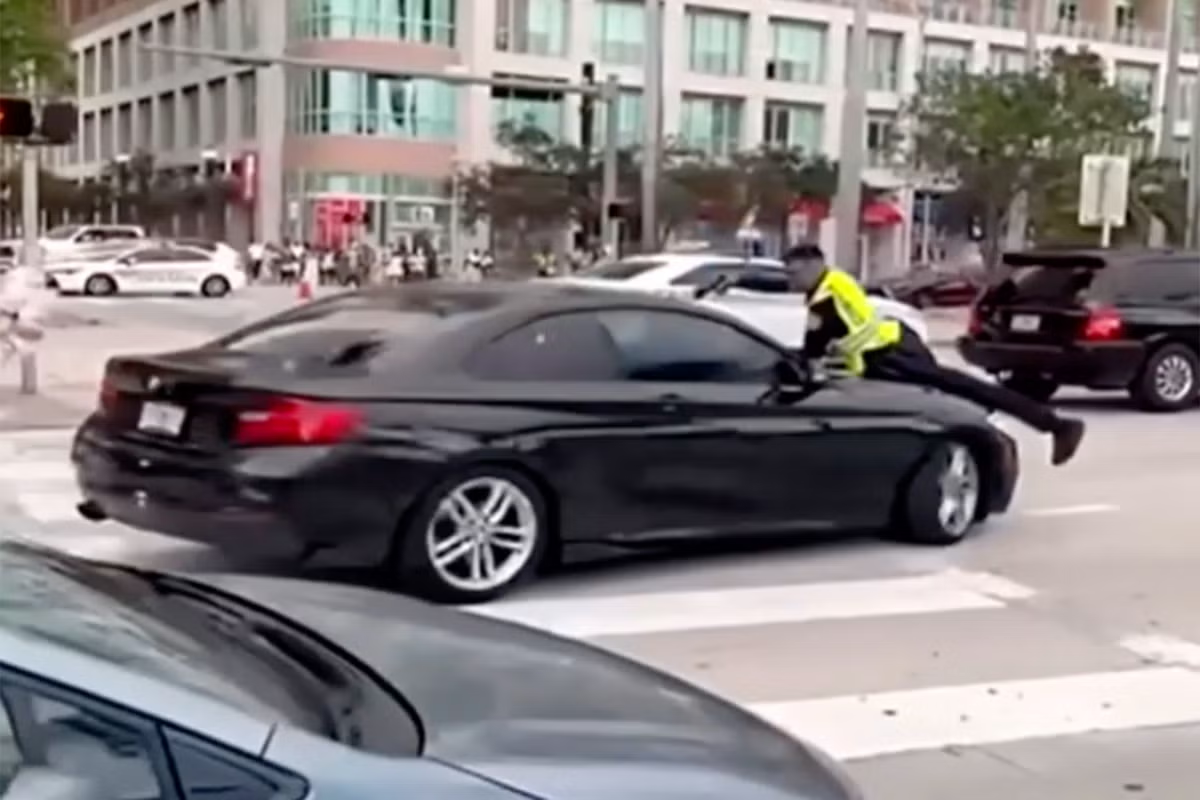
The normally festive atmosphere of Bayfront Park in Miami turned chaotic and terrifying this past Sunday, as a dramatic and violent police encounter unfolded near the Best of the Best music festival. In a scene more reminiscent of a high-stakes action film than a community event, bystanders captured on video the moment a Miami Cop Fires on Driver multiple times While on the Hood of Moving Car Near Best of the Best Festival.
The suspect, identified as 21-year-old Menelek Clarke, was seen with visible blood stains on his back before being apprehended by police and transported to a local hospital. The shocking footage, recorded by a witness, quickly circulated online and through news outlets, raising serious questions about the officer’s use of force and the circumstances that led to the intense confrontation.
As festivalgoers scrambled for safety amid the sound of gunfire, the scene highlighted not only the sudden danger but also the tensions that can erupt in public gatherings when law enforcement actions take a violent turn.
What the Footage Reveals
The incident began when the officer, whose name has not been released, was reportedly directing traffic along Biscayne Boulevard near the entrance to Bayfront Park. Cellphone footage obtained by Local 10 News shows the officer on the hood of the BMW as it moved forward. With his weapon drawn, the officer fired several shots directly into the windshield from his precarious position.
According to police, Clarke’s vehicle had made physical contact with the officer, prompting the dramatic response. However, what’s missing from the footage—and crucial to understanding the context—is what led up to the encounter. The video does not show how or why the officer ended up on the hood of the vehicle in the first place.
Read : Miami-Dade Bus Driver Shot Dead Two Passengers in Dispute Over Bringing Bike on Board
Shortly after being shot, Clarke stopped the vehicle and exited with his hands up. Another video shows him complying with officers’ commands to roll over. Blood is visible on his shirt as he is handcuffed and taken into custody. His condition following hospitalization has not been fully disclosed, but his injuries were described as multiple gunshot wounds.
Family Speaks Out
Menelek Clarke’s sister, Sherlyann Clarke, who was reportedly with him during the incident, gave an emotional account of the moments leading up to the shooting. Speaking to Local 10 News, she stated that they were simply looking for parking when the officer signaled for other vehicles to pass. She claims that without warning, the officer positioned himself in front of her brother’s car and then opened fire.
“My brother said he felt like he was gonna die,” she told the outlet. “I feel like he was wrongfully shot multiple times in his vehicle with no weapon.”
Clarke’s vehicle had multiple bullet holes in the front windshield, and no weapon has yet been reported to have been found on him or in the car. This detail is likely to become a focal point in the ongoing investigation, as it raises critical questions about whether lethal force was justified under the circumstances.
Witnesses near the scene described panic and fear as the gunshots rang out. Pedestrians attending the Best of the Best festival could be seen running in various directions, trying to distance themselves from the chaos. For many, the celebration quickly turned into a scene of confusion and fear.
Investigation Underway and Public Reactions
In the aftermath of the shooting, Assistant Police Chief Armando Aguilar addressed the media but offered few definitive answers. “We don’t know exactly what happened,” he said. “We do know there was physical contact between the officer and the vehicle.”
This ambiguous statement has done little to quell public concern. The Florida Department of Law Enforcement (FDLE) has since taken over the investigation, as is standard protocol in officer-involved shootings. The body camera footage, if any, has not yet been released, and authorities are continuing to collect witness statements and additional video evidence.
The incident has sparked debate both in Miami and online, with many questioning the proportionality of the officer’s response. Critics have asked whether the officer’s decision to fire while on the moving car’s hood endangered not only the suspect but also the public in such a crowded area.
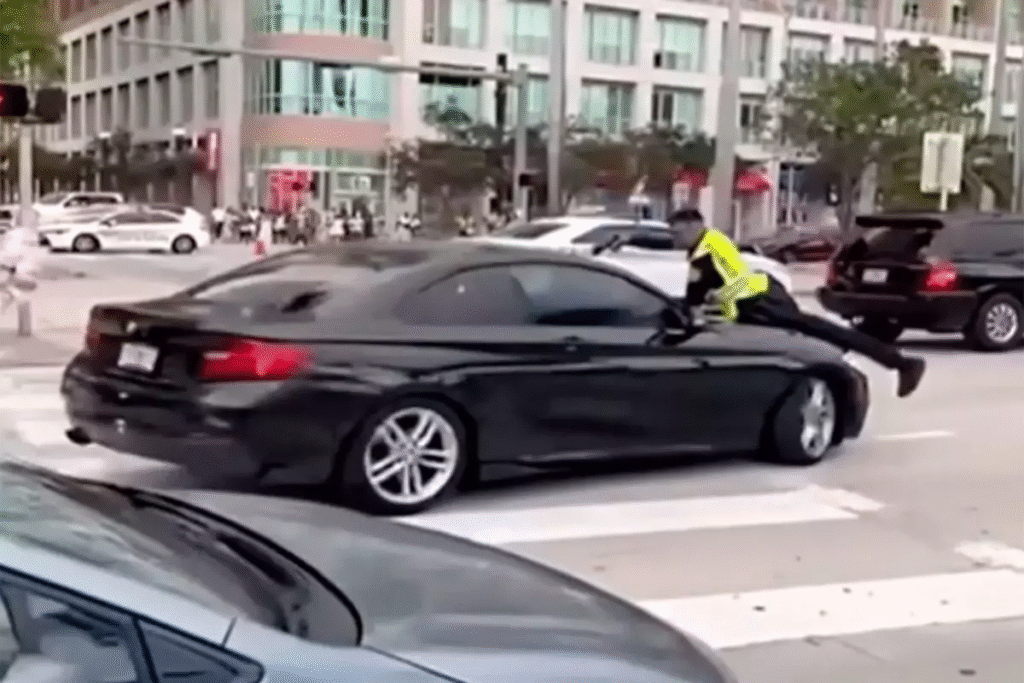
Others, however, have pointed to the inherent risks officers face in such dynamic and unpredictable situations. The footage clearly shows the officer already on the hood, a dangerous position that may have led him to believe he was in imminent danger. If that was the case, some argue, the use of force might be seen as defensive.
Nonetheless, legal analysts note that the law places high scrutiny on police use of force, particularly when the threat is ambiguous or could have been avoided through de-escalation. Much will depend on whether the officer followed proper protocol and whether he was placed in harm’s way by his own actions.
Civil rights advocates have already begun calling for transparency and accountability in the investigation. They are demanding the immediate release of all body camera footage, dispatch audio, and a timeline of the events that led up to the shooting.
Broader Implications and Community Impact
This latest incident is part of a broader national conversation about police conduct and the use of force, particularly in situations involving unarmed individuals. Miami, like many U.S. cities, has faced its share of public scrutiny over law enforcement practices. High-profile cases have led to demands for reform, more comprehensive training, and increased accountability.
The fact that this incident occurred in a highly public space, during a major cultural event, adds another layer of urgency. Community leaders have voiced concerns not only for the safety of individuals directly involved but also for the broader public who were put at risk.
The Best of the Best music festival is known for drawing large crowds and celebrating Caribbean culture. The presence of violence, especially involving police, casts a shadow over what should have been a joyous occasion. Organizers have yet to comment on the shooting, but public sentiment suggests that safety and police presence at future events will be heavily scrutinized.
In the days to come, much will depend on the transparency of the investigation and whether the FDLE can provide a clear, unbiased account of what transpired. The video evidence available to the public thus far has raised more questions than answers, and only a full release of all materials can begin to offer clarity.
For now, the community waits—some with outrage, others with concern, but all with the hope that justice, in whatever form it takes, will be served. Whether the officer acted in line with department policy or overstepped the bounds of reasonable force is a question that will ultimately be answered through a combination of legal scrutiny, forensic evidence, and public accountability.
The case of Menelek Clarke and the Miami police officer who shot him while perched on the hood of his car is a stark reminder of the complex and often dangerous interactions that can arise between law enforcement and civilians. It underscores the urgent need for clear protocols, better training, and a justice system that responds swiftly and fairly to incidents that shake the public’s trust.