
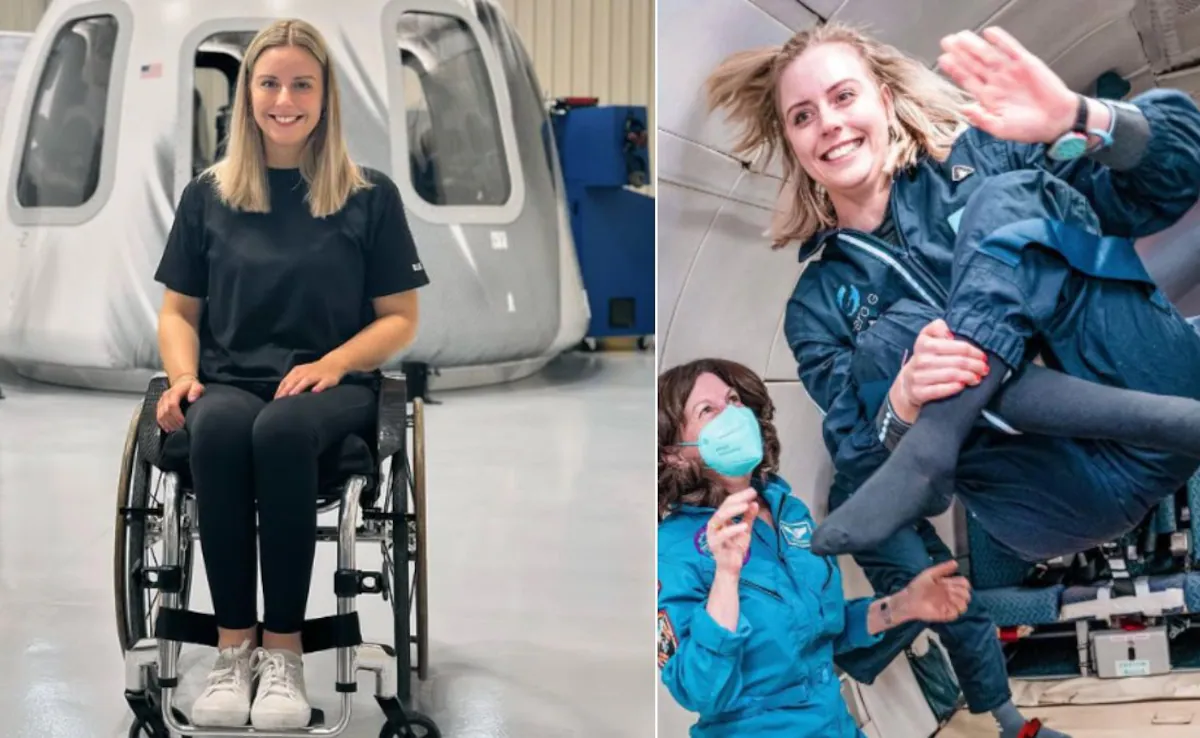
Michaela Benthaus’s journey to becoming the first wheelchair user to travel to space represents a significant moment in the evolving history of human spaceflight. At 33, the German engineer joined a select group of private space travelers when she launched aboard Blue Origin’s New Shepard rocket from west Texas, crossing the threshold of space and experiencing weightlessness above Earth.
Her flight was not only a technological achievement but also a symbolic milestone, challenging long-standing assumptions about who can participate in space exploration. Michaela Benthaus’s experience highlighted how advances in spacecraft design, combined with changing attitudes toward accessibility, are gradually widening the boundaries of human presence beyond Earth. Her story is rooted in technical expertise, personal resilience, and a determination to ensure that space, like society on Earth, becomes more inclusive.
From Engineering Ambitions to a Life-Altering Accident
Born in Germany, Michaela Benthaus pursued a career path firmly grounded in science and engineering long before spaceflight entered her personal horizon. She trained as an engineer and later became part of the European Space Agency’s graduate trainee program in the Netherlands, a competitive initiative designed to prepare young professionals for technical and operational roles within Europe’s space sector. Her academic and professional background placed her squarely within the “space bubble,” a community of scientists, engineers, and researchers who contribute to space missions from the ground.
Even within that environment, however, spaceflight itself remained a distant aspiration, largely reserved for a small number of elite astronauts selected through rigorous physical and operational criteria. Seven years before her Blue Origin flight, Michaela Benthaus’s life changed abruptly following a mountain biking accident that severely injured her spinal cord. The injury left her paraplegic and unable to walk, requiring the permanent use of a wheelchair.
For Michaela Benthaus, the accident did more than alter her physical mobility; it appeared to close off possibilities she had never fully allowed herself to imagine. Human spaceflight has historically demanded extreme physical capabilities, and there was no precedent for someone with a spinal cord injury traveling beyond Earth. Benthaus herself later acknowledged that even as a “super healthy person,” she had considered spaceflight impossibly competitive. After the accident, the absence of any historical example reinforced the assumption that space was no longer within reach.
Despite these limitations, Michaela Benthaus continued to build her career within the space sector. She gained experience through research, training, and simulated missions, including a parabolic flight out of Houston in 2022 that allowed her to experience brief periods of weightlessness. Less than two years later, she took part in a two-week simulated space mission in Poland, an immersive program designed to replicate aspects of life and work in space.
Michaela Benthaus, 33, accompanied five other passengers launching from West Texas with Jeff Bezos’ company Blue Origin.
— The Independent (@Independent) December 20, 2025
The 10-minute space-skimming flight required only minor adjustments to accommodate Benthaus, according to the company, as the autonomous New Shepard capsule… pic.twitter.com/9DFJoaGoQz
These experiences did not involve actual orbital or suborbital flight, but they demonstrated her technical competence and adaptability, as well as her willingness to engage with demanding environments despite physical constraints. While these opportunities did not yet translate into a realistic prospect of spaceflight, they laid important groundwork by showing that disability did not preclude meaningful participation in space-related activities.
The Blue Origin Flight and Breaking New Ground
The opportunity that ultimately carried Benthaus to space emerged through private spaceflight rather than a government-led astronaut program. Blue Origin, the aerospace company founded by Amazon billionaire Jeff Bezos, has positioned itself as a pioneer in commercial suborbital tourism. Its New Shepard rocket and capsule system is fully autonomous, designed to carry passengers on brief flights above the Kármán line, the internationally recognized boundary of space at approximately 62 miles (100 kilometers) above Earth.
Since its first passenger flight in 2021, Blue Origin has flown a diverse range of participants, including individuals with limited mobility, impaired sight or hearing, and passengers in their nineties. Benthaus’s flight was sponsored and organized with the involvement of Hans Koenigsmann, a retired SpaceX executive also born in Germany. Koenigsmann, who had long-standing experience in launch operations and spacecraft systems, approached Michaela Benthaus with the idea of flying on New Shepard. Initially, she suspected a misunderstanding, given the lack of precedent for wheelchair users in space.
When it became clear that the invitation was genuine, she accepted immediately. The mission was private and did not involve the European Space Agency, distinguishing it from ESA’s parallel efforts to assess the feasibility of astronauts with disabilities, such as reserve astronaut John McFall, an amputee cleared for a future International Space Station mission. Preparing for Michaela Benthaus’s flight required only minor modifications to the New Shepard system, underscoring how accessibility can often be achieved through thoughtful design rather than fundamental redesign.

Blue Origin added a patient transfer board that allowed Benthaus to move independently between the capsule’s hatch and her seat. An elevator was already available at the launch pad, enabling all passengers to ascend the seven-story tower to the capsule. Michaela Benthaus practiced the transfer process extensively in advance, with Koenigsmann participating in the design and testing phase. The company’s engineers emphasized that the capsule had been designed with accessibility in mind from the outset, making it more adaptable than traditional crewed spacecraft.
On launch day, Michaela Benthaus left her wheelchair behind as the rocket lifted off from west Texas. During the approximately ten-minute flight, the capsule soared more than 65 miles (105 kilometers) above Earth, providing over three minutes of weightlessness. Benthaus later described laughing all the way up and attempting to turn upside down while floating freely inside the capsule.
After landing, Blue Origin’s recovery team unrolled a carpet across the desert floor to ensure immediate wheelchair access. Koenigsmann and Blue Origin engineer Jake Mills assisted her out of the capsule and down the steps, fulfilling a pre-designated emergency support role. Michaela Benthaus’s post-flight reaction captured both personal joy and broader significance, as she described the experience as “the coolest” of her life.
Redefining Accessibility in Space and Beyond
Michaela Benthaus’s flight resonated far beyond the brief minutes she spent above Earth. As the first wheelchair user to reach space, she challenged deeply embedded assumptions about physical ability and exploration. Historically, human spaceflight has been shaped by military aviation standards and medical criteria developed during the Cold War, emphasizing physical uniformity and maximal resilience.
While these standards were once necessary due to technological limitations, modern spacecraft automation and improved safety systems have opened the door to reassessing who can safely fly. Benthaus’s experience demonstrated that with appropriate planning and modest adaptations, people with significant physical disabilities can participate in spaceflight without compromising safety.
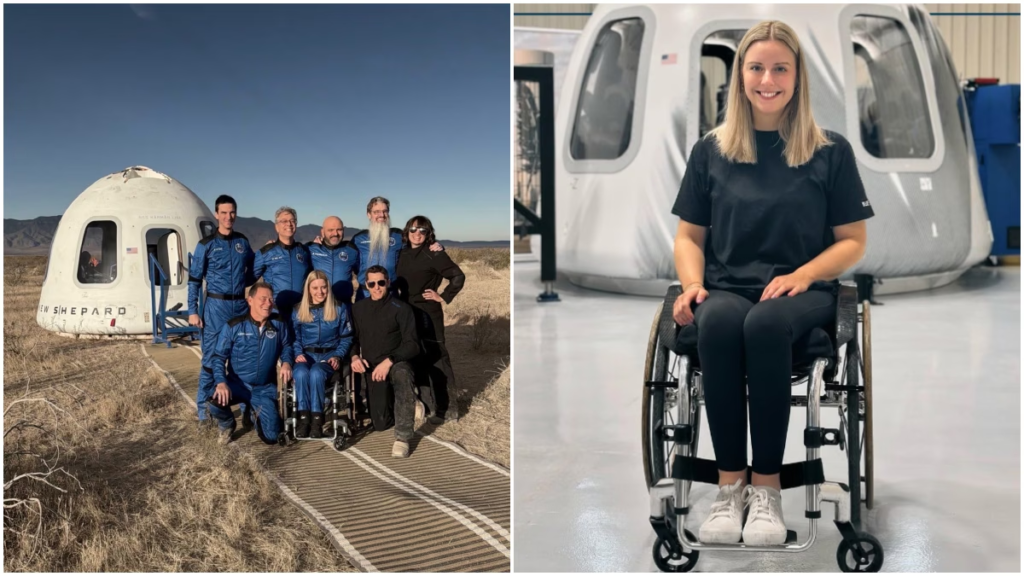
Her flight also intersected with broader institutional changes underway in the global space community. The European Space Agency’s decision to clear John McFall, a former British Paralympian and amputee, for a future International Space Station mission marked an important step toward inclusivity within government astronaut programs. While McFall’s physical condition differs from Benthaus’s, the parallel developments suggest a growing willingness to reconsider long-standing medical and operational assumptions. Benthaus’s mission, although private, provided a tangible example that such reconsideration is not merely theoretical.
Beyond its implications for spaceflight, Benthaus has emphasized that her goal extends to improving accessibility on Earth. She has spoken about the contrast between the supportive environment within the space community and the less inclusive attitudes she sometimes encounters elsewhere. By insisting on doing as much as possible independently, she aimed to demonstrate both capability and the importance of design choices that empower users rather than limit them. In her view, making space accessible to disabled people is inseparable from making society more accessible overall, as both rely on recognizing diverse needs and incorporating them into planning from the beginning.
Benthaus has also been careful to frame her achievement not as an endpoint but as a starting point. While her flight drew widespread attention and praise, she has expressed hope that it will encourage others with disabilities to imagine themselves in roles traditionally considered out of reach. Her presence aboard New Shepard added to Blue Origin’s growing list of space travelers, which now stands at 86, but its symbolic weight far exceeded the numerical milestone. By becoming the first wheelchair user in space, Benthaus expanded the narrative of who belongs in the story of exploration.
In reflecting on her experience after touchdown, Benthaus urged others not to abandon their dreams, a message grounded not in abstraction but in lived reality. Her journey combined technical expertise, personal resilience, and institutional openness, illustrating how progress often emerges at the intersection of individual determination and systemic change. As private and public spaceflight continue to evolve, Michaela Benthaus’s flight will remain a reference point, marking the moment when the boundary of space became, in a small but meaningful way, more inclusive.
Thank you for sharing excellent informations. Your web site is so cool. I’m impressed by the details that you have on this website. It reveals how nicely you understand this subject. Bookmarked this web page, will come back for more articles. You, my friend, ROCK! I found simply the information I already searched all over the place and simply couldn’t come across. What a perfect site.
References:
Play online roulette
References:
https://letterbun7.werite.net/instant-access-to-real-money-games
References:
Best legal anabolic steroids
References:
https://git.sskuaixiu.com/tiffinydown77
References:
How to get ripped without steroids
References:
https://isowindows.net/user/chainnumber7/
References:
Neteller brasil
References:
https://atomcraft.ru/user/childcrate5/
References:
Illegal testosterone booster
References:
https://www.grenzlandgruen.de/Blog;focus=TKOMSI_com_cm4all_wdn_Flatpress_22892279&path=&frame=TKOMSI_com_cm4all_wdn_Flatpress_22892279?x=entry:entry230624-071308%3Bcomments:1
References:
Casino australia
References:
https://pikidi.com/seller/profile/jacketbuffer2
References:
Reliable steroid source
References:
https://postsportverein-leipzig.de/Abteilungen/Tamburello/index.php/;focus=STRATP_com_cm4all_wdn_Flatpress_24132922&path=&frame=STRATP_com_cm4all_wdn_Flatpress_24132922?x=entry:entry200920-170502%3Bcomments:1
References:
Bodybuilding getting lean
References:
https://www.pfadfinder-iserlohn.de/Startseite/index.php/;focus=STRATP_com_cm4all_wdn_Flatpress_11083477&frame=STRATP_com_cm4all_wdn_Flatpress_11083477?x=entry:entry210823-185852;comments:1