

When Lucy Isaac, a 32-year-old teacher from Oxford, found out she was expecting her second child, she and her husband Adam were overjoyed. But what was meant to be a smooth journey into motherhood turned into a life-threatening ordeal—one that required an almost inconceivable medical intervention.
Against all odds, their baby, Rafferty Isaac, was not only born but born twice. His story is one of determination, innovation, and the remarkable strength of the human spirit.
A Shocking Diagnosis at 12 Weeks
Lucy’s pregnancy started like any other. She attended routine checkups, maintained a healthy lifestyle, and prepared for the birth of her second child with joy.
But at just 12 weeks pregnant, a routine ultrasound unveiled something unexpected and deeply alarming: Lucy had ovarian cancer. The diagnosis came as a complete shock. She showed no symptoms and had no reason to suspect anything was wrong.
Doctors at the John Radcliffe Hospital in Oxford, where Lucy was being treated, knew the stakes were incredibly high. Ovarian cancer is known for its stealth and late diagnosis. In the UK, about 7,000 women are diagnosed with ovarian cancer each year, with two-thirds of cases caught at a late stage. Over 4,000 women lose their lives to the disease annually.
Read : The Truth Behind The Baby Born With Four Inch Long Tail In China
The medical team determined that delaying cancer treatment until after childbirth would put Lucy’s life in grave danger. However, treating her cancer during pregnancy presented a terrifying challenge: how could they access and remove the cancerous tissue without harming the unborn baby?
A Groundbreaking Surgical Decision
Standard cancer treatment was off the table. Due to the advanced stage of Lucy’s pregnancy and the location of her tumours, keyhole surgery was not a viable option. The tumour was growing rapidly, and waiting any longer could cause it to spread.
Faced with this urgent dilemma, a team of specialists led by surgeon Dr Soleymani Majd proposed something extraordinary—a surgery that had been attempted only a handful of times worldwide.
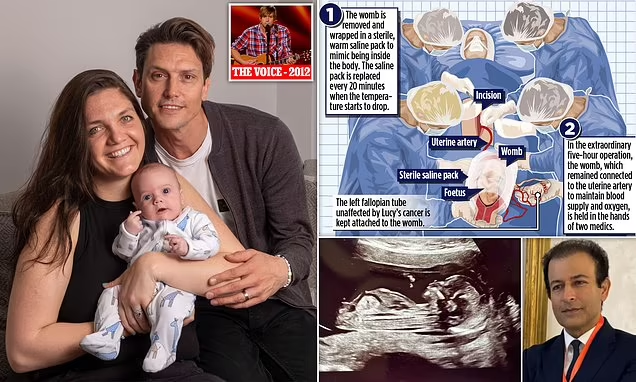
The plan was unprecedented and fraught with risk: they would temporarily remove Lucy’s womb, which still contained baby Rafferty, operate on the surrounding organs to eliminate the cancer, and then return the womb back into her body. The womb would remain connected to Lucy’s vital blood vessels and tissues throughout the surgery to ensure the baby remained safe and alive.
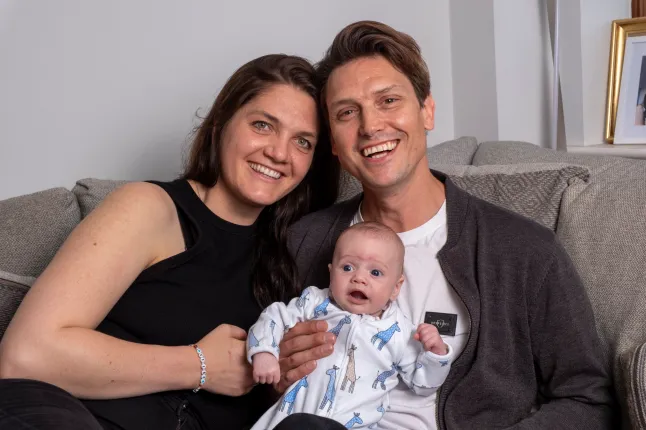
With immense trust in the medical team and incredible bravery, Lucy and Adam gave their consent for the operation. In October, when Lucy was 20 weeks pregnant, she was taken into surgery. Over the course of five hours, a team of 15 highly skilled medical professionals worked to save both her life and her unborn son’s.
During the delicate procedure, Lucy’s womb, with Rafferty Isaac safely inside, was wrapped in a warm saline pack to maintain a stable temperature. This pack was replaced every 20 minutes to ensure Rafferty didn’t get too cold. Meanwhile, two medical professionals were assigned the sole responsibility of monitoring the womb and the baby’s condition throughout the operation.
Surgeons carefully removed a tumour sample for analysis, which confirmed that Lucy had a grade two ovarian cancer. After identifying and excising the cancerous tissue, Dr Majd and his team gently repositioned Lucy’s womb back into her abdomen. The womb had remained outside her body for nearly two hours—longer than in any of Dr Majd’s previous similar procedures.
A Triumph of Medical Science and Maternal Strength
Following the successful surgery, Lucy was closely monitored for the remainder of her pregnancy. Months passed as she and her family hoped for the best. Then, in late January, the moment they had been praying for finally arrived. Rafferty Isaac was born at full term, weighing a healthy 6lb 5oz.
The birth of Rafferty Isaac marked not only the end of a harrowing journey but also the triumph of maternal love and medical science. For Lucy and Adam, the experience was deeply emotional. Just two years earlier, Adam himself had undergone a kidney transplant, and now they were celebrating the arrival of their miracle baby.
“To finally hold Rafferty in our arms after everything we have been through was the most amazing moment,” said Adam. Shortly after the birth, Lucy and Rafferty returned to the John Radcliffe Hospital to thank Dr Majd and the entire surgical team who had made the impossible possible.
The emotional reunion highlighted the bond that had formed between the family and their caregivers. Dr Majd, who described the case as the most complex of his career, expressed how touching it was to meet Rafferty Isaac again and to witness the outcome of such a rare and risky procedure.
Reflecting on her journey, Lucy said she felt “incredibly lucky” to have been diagnosed and treated in time, especially since she had shown no symptoms. She hopes that sharing her story will encourage other women to undergo regular health checks and not ignore potential warning signs.
The success of this rare surgery not only saved Lucy’s life but also contributed to the growing field of maternal-fetal medicine. While surgeries involving the temporary removal of the womb during pregnancy are exceedingly rare, each successful case provides valuable insights for future treatments. It also brings hope to other expectant mothers facing complex medical challenges.
In the world of modern medicine, stories like that of Rafferty Isaac stand as milestones. They showcase the incredible advancements in surgical techniques, the importance of multidisciplinary collaboration, and the unyielding courage of patients and families.
Rafferty Isaac may have been born just once in the eyes of the law, but in the hearts of all who followed his journey, he was truly “born twice”—once into the womb of danger, and again into the arms of love.