
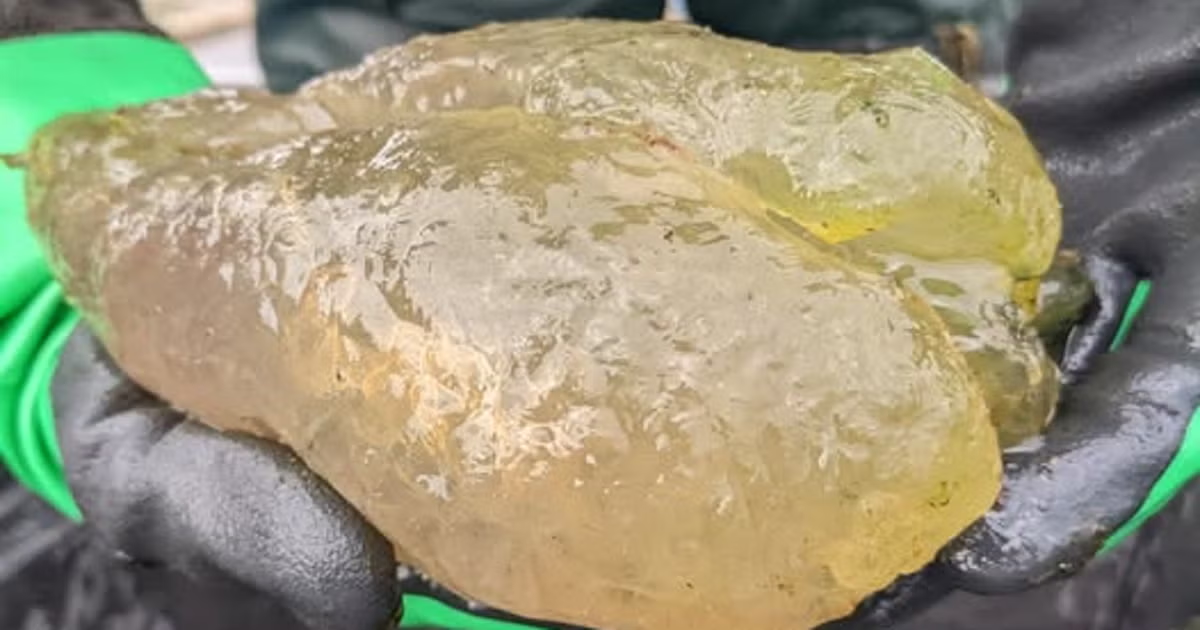
In early August 2025, a peculiar discovery in Michigan’s Lake Huron captured the attention of both scientists and the public. A large, gelatinous blob, described as resembling a “cursed gummy bear” or a “mutant brain,” was spotted floating in the lake’s waters. Initially sparking intrigue and even alarm among kayakers and onlookers, the mysterious mass was soon identified by wildlife officials as a magnificent bryozoan, scientifically known as Pectinatella magnifica. Far from being a sci-fi nightmare or an alien invader, this blob is a fascinating, ancient organism with a vital role in freshwater ecosystems.
A Startling Discovery in Lake Huron
The story began when kayakers in Lake Huron, one of the Great Lakes straddling the U.S.-Canada border, encountered an unusual sight: a large, squishy, translucent blob floating in the water. Its appearance was so bizarre that it prompted comparisons to a “cursed gummy bear,” a “pile of frog eggs,” or even a “mutant brain.” The discovery, first reported in early August 2025, sent ripples of curiosity through local communities and beyond. The U.S. Fish and Wildlife Service (USFWS), specifically the Alpena Fish and Wildlife Conservation Office in Michigan, quickly stepped in to investigate.
On August 17, 2025, the USFWS shared a close-up image of the blob on social media, sparking widespread fascination. The agency’s post humorously addressed the blob’s eerie appearance, stating, “Cursed Gummy Bear? Nope, just a magnificent bryozoan doing its thing.”
The photo showed a gelatinous, tan-colored mass, roughly the size of a soccer ball, held up by a gloved hand. The post reassured the public that there was no cause for alarm, explaining that the blob was not a science experiment gone wrong or an extraterrestrial visitor but a natural part of the lake’s ecosystem. This identification quelled fears but only deepened the public’s curiosity about what exactly a bryozoan is and why it looks so otherworldly.
Read : Discovering Nature’s Giants: A Guide to the Largest Lakes Around the Globe
The discovery wasn’t an isolated incident. Similar blobs have been spotted in other U.S. waterways, including in the Pacific Northwest, the Midwest, and even Delaware. However, the Lake Huron sighting garnered particular attention due to its striking appearance and the playful comparisons it inspired. For many, it was a reminder of how much mystery still lurks in familiar environments like the Great Lakes, where creatures like the bryozoan can go unnoticed despite their ecological importance.
The Biology of the Magnificent Bryozoan
To understand the “cursed gummy bear” blob, we need to dive into the biology of Pectinatella magnifica, the magnificent bryozoan. Bryozoans, sometimes called “moss animals,” are aquatic invertebrates that form colonies composed of thousands of tiny individuals known as zooids. Each zooid is smaller than a grain of rice, measuring no more than 4 millimeters wide, and is equipped with a crown of tentacles used for filter-feeding. These zooids work together in harmony, creating a single, gelatinous colony that can grow over a foot in diameter, as was the case with the Lake Huron specimen.
The structure of a bryozoan colony is both delicate and resilient. The colony’s body is made up of calcium carbonate and chitin, the same material found in crab shells, giving it a squishy yet slightly rigid texture. This structure allows the colony to float freely or attach to submerged surfaces like rocks or docks. The Lake Huron bryozoan, for instance, was found floating, pulsing gently with the lake’s currents, a behavior typical of Pectinatella magnifica.
The colony’s translucent or tan appearance, combined with its soft, spongy feel, explains why it might be mistaken for a gummy candy or a pile of frog eggs at first glance. Bryozoans are ancient creatures, with a fossil record dating back over 480 million years, predating the dinosaurs.

They are found in both freshwater and marine environments worldwide, thriving in lakes, ponds, rivers, and even kelp beds. Pectinatella magnifica is particularly common in freshwater habitats, where it forms large, bulbous colonies during the late summer and early fall, when water temperatures and food availability are optimal. These colonies are not a single organism but a community of zooids, each contributing to the collective’s survival by filtering microscopic plankton, bacteria, and diatoms from the water.
One of the most remarkable features of bryozoans is their ability to reproduce and regenerate. In the fall, colonies produce tiny, seed-like structures called statoblasts, which sink to the lake or river bottom to survive the winter. These statoblasts are incredibly durable, capable of withstanding freezing, drying, and other harsh conditions. In spring, they “wake up” and develop into new colonies, ensuring the species’ persistence. Additionally, if a piece of a bryozoan colony breaks off, it can form an entirely new colony, making bryozoans highly adaptable and resilient.
Ecological Importance and Public Perception
Despite their unsettling appearance, bryozoans like Pectinatella magnifica play a crucial role in freshwater ecosystems. By filter-feeding on plankton and organic matter, they act as natural water purifiers, helping to maintain the clarity and health of lakes and rivers. Their presence is often a positive indicator of water quality, as they thrive in environments rich in microscopic life but free from heavy pollution. In Lake Huron, the discovery of a bryozoan colony suggests that the lake’s ecosystem is supporting a diverse array of organisms, even if some, like the bryozoan, go unnoticed by the average observer.
The ecological benefits of bryozoans extend beyond water purification. Their colonies provide shelter for small aquatic creatures, such as tiny crustaceans and insect larvae, and serve as a food source for certain fish and invertebrates. This makes them an integral part of the freshwater food web, contributing to the overall biodiversity of lakes like Huron. The USFWS emphasized this in their social media post, noting that bryozoans “breathe life into freshwater” and are a “secret world hidden in plain sight.”
Public perception of bryozoans, however, is often shaped by their odd appearance. The Lake Huron discovery, with its “cursed gummy bear” moniker, highlights how unfamiliarity can lead to fear or fascination. The USFWS and other environmental agencies have urged the public to leave bryozoan colonies undisturbed, as they pose no threat to humans and do not carry diseases or parasites. For boaters or kayakers who encounter a colony attached to their equipment, experts recommend gently scraping it off to avoid harming the delicate zooids, though ideally, the colonies should be left alone to continue their ecological work.
The viral nature of the Lake Huron discovery underscores the power of social media in raising awareness about lesser-known species. The USFWS’s playful caption and vivid imagery captured the public’s imagination, turning a potentially overlooked organism into a topic of widespread discussion.
Similar sightings in other regions, such as the Nisqually National Wildlife Refuge in Washington or waterways in Ohio and Missouri, have prompted local agencies to educate the public about bryozoans, dispelling myths and highlighting their ecological value. This increased visibility is a double-edged sword: while it fosters appreciation for biodiversity, it also risks drawing unwanted interference from curious onlookers.
The “cursed gummy bear” blob found in Lake Huron is a testament to the wonders hidden in our natural world. What initially appeared as a bizarre, almost alien-like mass turned out to be Pectinatella magnifica, a magnificent bryozoan with a history stretching back nearly half a billion years. Composed of thousands of tiny zooids working in unison, these colonies are not only harmless but also vital to the health of freshwater ecosystems.
Their ability to filter water, provide habitat, and persist through harsh conditions makes them unsung heroes of lakes and rivers. The Lake Huron discovery, amplified by social media and the USFWS’s engaging outreach, has sparked a renewed interest in bryozoans and the ecosystems they inhabit.
It serves as a reminder that even in well-explored places like the Great Lakes, there are still surprises waiting to be uncovered. Rather than fearing these “mutant brains” or “cursed gummy bears,” we should celebrate their role in maintaining the delicate balance of our waterways. The next time you’re kayaking or strolling by a lake, keep an eye out for these gelatinous marvels—not as sci-fi nightmares, but as ancient, magnificent contributors to the environment.