

NASA astronaut recently returned from a historic 235-day mission on the International Space Station (ISS) and was taken to a hospital due to an unspecified medical issue.
This mission, carried out with SpaceX’s Crew Dragon spacecraft, faced challenges that tested both the endurance of the crew and the limits of the spacecraft.
A Historic Mission with Unforeseen Challenges
The returning crew, which included U.S. astronauts Matthew Dominick, Michael Barratt, and Jeanette Epps, along with Russian cosmonaut Alexander Grebenkin, spent nearly eight months in orbit.
This duration, slightly longer than the typical six-month ISS mission, marked the longest space station stay yet for a Crew Dragon capsule, a testament to SpaceX’s dedication to providing safe and reliable transport for NASA missions. Crew Dragon has been integral to U.S. space missions since NASA’s retired space shuttle program.
Elon Musk’s SpaceX remains NASA’s only option for crewed transport to and from the ISS, with Boeing’s Starliner still facing technical delays.
Read : Sahara Desert Turning Green from Arid Yellow on Recent Pic Shared by NASA
After 235 days in space, the crew experienced a more extended wait before returning due to unpredictable weather, including two hurricanes affecting the U.S. southeast, which postponed splashdown by several weeks. This wait likely added physical and mental strain on the crew, who had adapted to a life without Earth’s gravity for such a long period.
On Wednesday, they finally undocked from the ISS and began reentry, experiencing a successful landing despite minor issues. However, shortly after splashdown in the Gulf of Mexico, one NASA astronaut was taken to the hospital in Pensacola, Florida, for further observation and treatment.
Read : 22-Year-Old Kashmiri Techie Earns Spot in NASA’s Hall of Fame
While NASA has not disclosed specific details about the astronaut’s condition, they confirmed the individual was in stable condition.
Crew Dragon: The Workhorse of NASA’s Astronaut Transport
This mission marked Crew Dragon’s fifth spaceflight and recorded 702 days in orbit since its initial flight. Despite a flawless landing, the mission wasn’t without its technical hiccups. Richard Jones, deputy manager of NASA’s Commercial Crew Program, shared that the braking parachutes of the capsule had a minor debris strike during descent.
Additionally, one of the four parachutes took longer than anticipated to unfurl, a concern for spacecraft engineers. However, Jones assured that neither of these issues compromised crew safety, and the landing conditions were optimal for recovery efforts.
SpaceX has made significant advancements in reusable space technology, maintaining a fleet of Crew Dragons ready for multiple missions. SpaceX’s record of 44 trips to the ISS, including this one, has proven essential to NASA’s ongoing partnership. Crew Dragon’s capability to withstand multiple flights and long-duration missions brings NASA closer to its vision of regularly scheduled human spaceflights.
SpaceX’s work is essential to the continuity of U.S. space operations, especially as NASA eagerly awaits the operational capabilities of Boeing’s Starliner. NASA remains confident in Crew Dragon’s design and safety protocols, even as minor issues like parachute timing are thoroughly evaluated for improvement.
The Road to Astronaut Recovery: Medical and Operational Precautions
Immediately following the splashdown, the entire crew was transported to a medical center as a precautionary measure. The reentry phase of any mission poses potential health risks for astronauts, particularly after extended stays in microgravity.
Astronauts undergo rigorous physical and medical testing to counteract the effects of prolonged exposure to space, including muscle atrophy, bone density loss, and cardiovascular strain. Such changes in the body are common in long-duration missions and can make the immediate post-mission period crucial for the health and safety of returning astronauts.
NASA has chosen not to disclose the nature of the medical issue affecting the astronaut, citing privacy, but the agency confirmed the individual is in stable condition and remains under observation at Ascension Sacred Heart Pensacola hospital. The three other crew members have already left the hospital and are reportedly doing well, having since returned to Houston.
In contrast, Russia’s space agency, Roscosmos, shared an image of cosmonaut Alexander Grebenkin smiling and standing, providing reassurance regarding his post-mission health.
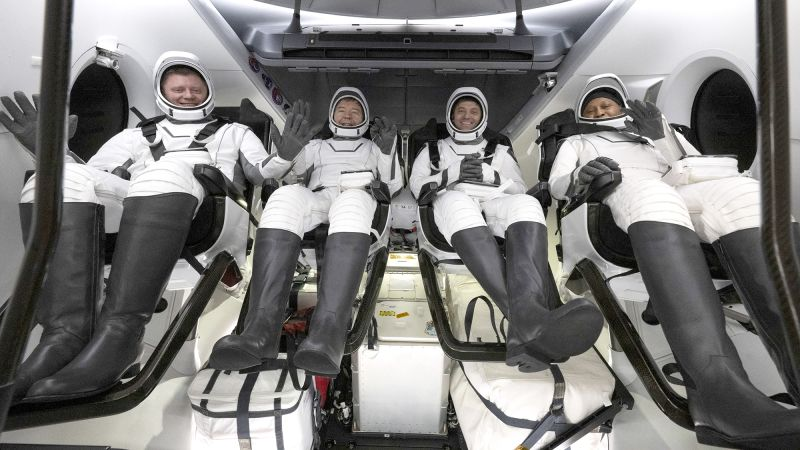
NASA’s commitment to crew health goes beyond in-orbit care, extending to recovery and observation post-mission. The health protocols in place include close monitoring and a reconditioning process designed to help astronauts gradually readapt to Earth’s gravity.
This approach ensures that astronauts can safely recover from the physical toll of prolonged space missions while providing valuable data for future space exploration, especially for more extended missions, like those proposed for lunar or Mars expeditions.
The mission’s conclusion highlights both the triumphs and the complexities of human space travel. While the astronaut’s condition remains undisclosed, the situation underscores the challenges of returning to Earth after months in orbit.
Such missions reveal critical insights into the physical toll of space on human health and pave the way for improvements in safety and recovery protocols.
SpaceX’s Crew Dragon continues to showcase its resilience and reliability, contributing to NASA’s ambitions for the future of human spaceflight. As the agency assesses the minor technical issues from this mission, the collaborative work between NASA, SpaceX, and, in the future, Boeing, remains essential.
This collaboration is crucial as NASA aims for more sustainable and frequent space missions, with ambitions for the Artemis lunar missions and eventual Mars expeditions that will push the boundaries of human endurance even further.