
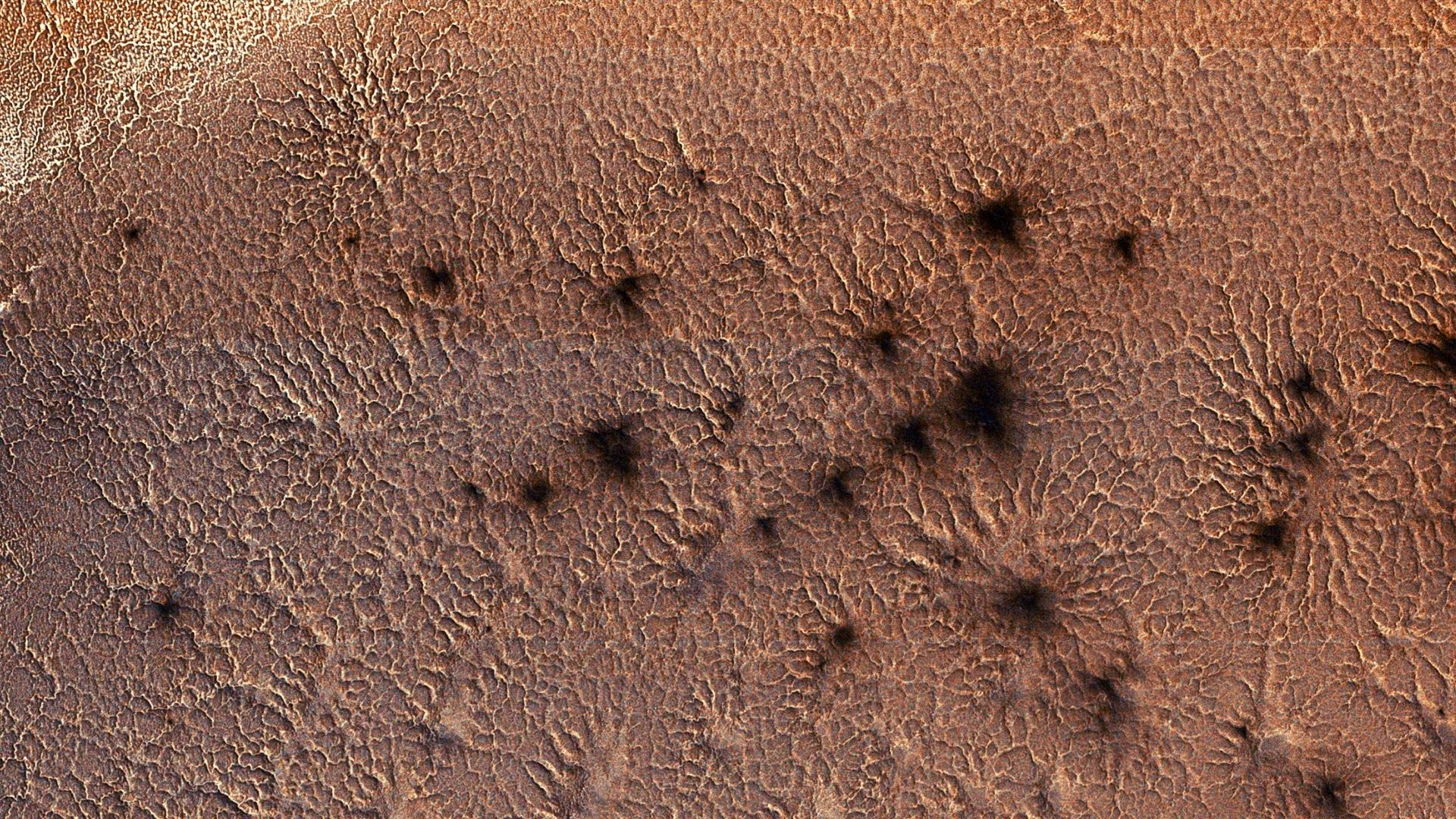
NASA scientist, working tirelessly on unraveling the mysteries of Mars, has re-created a stunning phenomenon for the first time in a lab on Earth: the eerie and fascinating “spiders” observed on Mars.
These strange features, seen on the Martian surface, puzzled space enthusiasts and scientists alike. While they may appear like creepy, black tendrilled creatures, they are not actual spiders but rather geologic formations that occur under Mars’ unique environmental conditions.
These Martian Spiders, known scientifically as araneiforms, form in the southern polar region during Mars’ spring. By re-creating them in the lab, NASA scientists hope to learn more about their formation and the alien landscape of the red planet.
The Mystery Behind Martian Spiders
NASA scientists were intrigued by the satellite images of these spider-like formations, which appear to spread out in dark, branching patterns on the surface of Mars. The exact process of their formation remained elusive for years.
These Martian Spiders, or araneiforms, are visible only in the southern polar region of Mars, particularly when the planet enters its spring. For a long time, scientists speculated about how these spiders formed every Martian year, wondering what triggered these unique structures.
In collaboration with NASA’s Jet Propulsion Laboratory, planetary scientist Lauren Mc Keown took a leading role in understanding these mysterious formations.
Read : China’s Wuhan Lab Once Blamed for COVID-19 Creates Nasal Vaccine for Future Pandemics
Read : Sunita Williams and Butch Wilmore to Vote in US Election from Space : Process is Here
She explained, “The Martian Spiders are strange, beautiful geologic features in their own right.” The goal of the research was to recreate these Martian spiders in a controlled laboratory environment to better understand their behavior and the factors influencing their formation.
The Role of Carbon Dioxide in Creating Martian Spiders
NASA scientists had long hypothesized that the Martian Spiders were the result of sublimation—a process where carbon dioxide transitions directly from a solid state to a gas without turning into a liquid. This phenomenon occurs because of Mars’ cold, frigid atmosphere, where temperatures plummet so low that carbon dioxide from the atmosphere freezes on the surface.
The most widely accepted explanation for the formation of these Martian spiders is the Kieffer model, named after geophysicist Hugh Kieffer.
According to this model, during the Martian winter, carbon dioxide accumulates in frozen deposits on the planet’s surface. As Mars enters spring, these deposits begin to heat up, but instead of melting, the frozen carbon dioxide sublimates directly into gas.
This process is particularly interesting because carbon dioxide does not have a liquid state under the environmental conditions on Mars.
The NASA scientist and her team theorized that this transition from solid to gas leads to the pressure build-up beneath the frozen slabs of carbon dioxide.
The trapped gas needs an escape route, and as the pressure increases, cracks form in the ice. Once the ice cracks, it causes small explosions, which allow the carbon dioxide gas to escape, carrying with it darker material from beneath the surface. This dusty material then leaves behind a spider-like scar on the Martian landscape.
Recreating Martian Spiders in the Lab
To further investigate the formation of these Martian spiders, NASA scientist Mc Keown and her colleagues sought to recreate them in the lab for the first time.
They designed a special experiment called the Dirty Under-vacuum Simulation Testbed for Icy Environments, or DUSTIE. This testbed simulates the extreme conditions found on Mars, including temperature and atmospheric pressure.
The researchers began by mixing minerals to replicate the dirt found on Mars, then cooled the mixture using liquid nitrogen to bring it to the freezing temperatures seen in Martian winters.
Once the dirt was prepared, the team placed it in a chamber tuned to replicate Mars’ atmospheric pressure and temperature. They then released carbon dioxide into the chamber, allowing it to freeze onto the simulant soil.
After freezing the carbon dioxide, the team gradually warmed up the chamber to mimic the transition from Martian winter to spring. The result? Just as they had hypothesized, the ice slabs exploded under pressure, releasing gas and dark material that created spider-like formations on the surface.
Read : Ranking the World’s Top 10 Strongest Space Agencies
With this experiment, the NASA scientist successfully recreated Martian Spiders on Earth for the first time, providing groundbreaking insights into how these unique formations come to life on the red planet.
Understanding Mars’ Alien Landscape
NASA scientists continue to work on refining their models of how spiders form on Mars, but this experiment brings them one step closer to understanding the planet’s alien landscape.
The successful recreation of Martian spiders in the lab highlights the importance of studying planetary processes under controlled conditions. By doing so, NASA scientist Mc Keown and her team can improve their understanding of the geological features that define Mars’ southern polar region.
These experiments have also opened the door to further study of other unexplained phenomena on Mars. Understanding how the planet’s geology interacts with its atmosphere—especially with carbon dioxide—could provide new clues about the history and future of the red planet. Mc Keown and her colleagues believe that these insights may also shed light on Mars’ potential for past or present life.
The findings from these experiments not only enhance our knowledge of Mars but also help scientists prepare for future missions. As NASA continues to plan its upcoming manned missions to Mars, understanding the planet’s unique landscape and environmental processes will be crucial for ensuring the success of future explorers.
Implications for Future Mars Exploration
The groundbreaking work conducted by NASA scientists in recreating Martian spiders in a lab has far-reaching implications for future Mars exploration.
The ability to replicate planetary phenomena here on Earth allows scientists to test theories, refine models, and plan for upcoming missions with greater precision. It also demonstrates the complexity of Mars’ environment, which continues to surprise scientists with its unexpected and dramatic processes.
As NASA prepares for future missions, including potentially sending humans to Mars, understanding these geologic features will help determine the safest and most viable locations for landing and establishing habitats.
Studying Martian spiders, which appear in the planet’s southern polar regions, could provide vital information about the composition of the Martian surface, the behavior of its atmosphere, and the role of carbon dioxide in shaping its landscape.
In addition, the success of this experiment will likely inspire further studies on the unique conditions of other planets and moons in our solar system.
By simulating the environments of these distant worlds in labs on Earth, NASA scientists can explore the intricate processes that shape the geology and atmospheres of other celestial bodies. The lessons learned from Mars may one day apply to missions exploring icy moons or even distant exoplanets.
NASA scientist Mc Keown and her team have made a significant breakthrough in understanding the mysterious spiders of Mars by recreating them in a lab on Earth. These araneiforms, once a mystery, are now understood to be the result of carbon dioxide sublimation, driven by the unique conditions on Mars.
By simulating Mars’ extreme environment, NASA scientists have brought us one step closer to uncovering the secrets of the red planet. This research not only enhances our knowledge of Mars but also lays the groundwork for future exploration and discovery.