

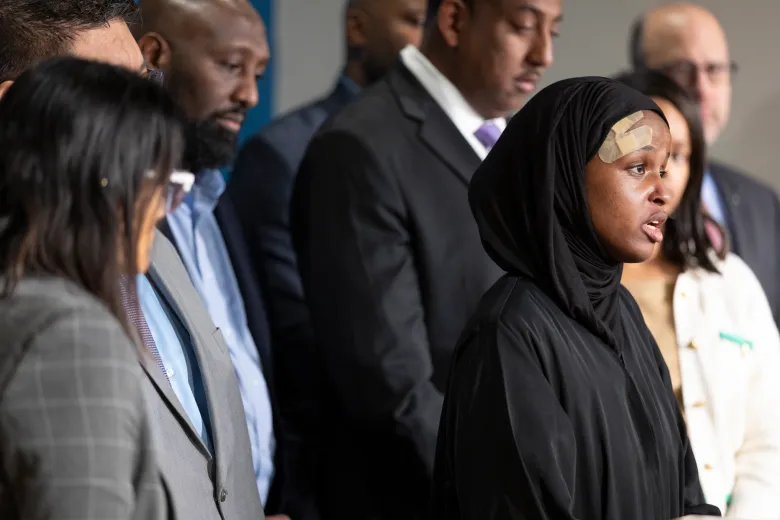
Nasra Ahmed, a Somali-American woman whose impassioned remarks about identity and immigration went viral online, has been arrested in Minnesota amid heightened tensions surrounding Immigration and Customs Enforcement operations. Known widely on social media as the “bananas and rice” woman, Ahmed first gained national attention after a video circulated of her speaking at a public news conference in St. Paul, where she described her personal encounter with ICE agents and reflected on what it means to be Somali in the United States.
Her arrest, announced by U.S. Attorney General Pam Bondi, places Nasra Ahmed at the center of an ongoing national debate over immigration enforcement, protest activity, and the limits of lawful resistance to federal authorities. The case has drawn significant attention because of Ahmed’s visibility as an activist, the symbolic weight of her viral remarks, and the broader political context in which the arrest occurred. According to federal officials, Ahmed was among a group arrested for allegedly obstructing or impeding ICE officers during protests in Minneapolis.
Supporters describe her as a community advocate speaking out against what she views as unjust enforcement practices, while federal authorities maintain that the arrests are about enforcing the law and ensuring that officers can carry out their duties without interference. Understanding who Nasra Ahmed is, how she rose to prominence, and what led to her arrest requires looking closely at her background, her viral moment, and the events that unfolded before federal action was taken.
From Viral Video to Public Figure
Nasra Ahmed came to national attention after a video of her remarks at a Minnesota State Capitol news conference began circulating widely on social media platforms. In the clip, Ahmed spoke candidly about her identity as a Somali-American and her experiences with immigration enforcement. While attempting to explain cultural identity and belonging, she referenced “bananas and rice,” a phrase that resonated online and quickly became associated with her name.
The phrase, drawn from a personal and cultural context, was widely shared, remixed, and discussed, transforming Ahmed into a recognizable figure far beyond Minnesota. The viral spread of the video coincided with growing public scrutiny of ICE operations in the Midwest and across the United States. Ahmed’s remarks were made during a period when protests against immigration enforcement were increasing, particularly in cities with large immigrant communities.
Her words struck a chord with many viewers who saw her as articulating fear, frustration, and cultural displacement experienced by immigrant communities. Others viewed the viral moment more critically, focusing on the tone and symbolism of her remarks rather than the substance of her claims. Ahmed used the increased visibility to speak more openly about her personal encounter with ICE.
Nasra Ahmed lied about ICE agents assaulting her and calling her the N-word at a press conference in Minneapolis last week.
— johnny maga (@_johnnymaga) January 28, 2026
Now, she’s in federal custody for assaulting officers.
This is just too good. pic.twitter.com/L8qlBqRY98
At the Capitol news conference, she alleged that federal agents approached her in her St. Paul neighborhood, took her into custody, and detained her for approximately two days. She claimed that during this detention she suffered a concussion and was subjected to a racial slur, and she described the experience as frightening and traumatic. These allegations amplified attention around her story, prompting both support and skepticism, and drawing responses from advocacy groups as well as federal officials.
Through these appearances, Ahmed became known not simply as a viral figure but as an activist voice within Minnesota’s Somali-American community. She attended protests and community events focused on immigration issues and spoke publicly about her opposition to ICE enforcement tactics. Her supporters viewed her as someone willing to speak openly about personal harm and systemic issues, while critics questioned the accuracy of her claims and argued that viral fame was being used to inflame tensions around law enforcement.
The Events Leading to the Arrest
The arrest of Nasra Ahmed was announced publicly by Attorney General Pam Bondi as part of a broader federal response to protests and resistance aimed at ICE operations in Minnesota. Bondi stated on social media that Ahmed was among 16 individuals arrested on federal charges for allegedly obstructing, resisting, or impeding federal officers during anti-ICE demonstrations in Minneapolis. According to the Justice Department, the arrests were tied to specific incidents in which protesters allegedly interfered with officers carrying out their lawful duties.
Read : Norman Lee Johnson Accused of Murdering Cousin and His Wife Who Adopted His 7-Year-Old Daughter
Federal authorities have framed the arrests as a matter of enforcing existing laws rather than suppressing protest activity. Bondi emphasized that the Department of Justice would continue to pursue cases against individuals who, in the government’s view, cross the line from lawful protest into unlawful obstruction. She stated that nothing would stop the administration from enforcing immigration laws and protecting federal officers during operations.

Details released publicly indicate that Ahmed’s arrest is connected to protest activity rather than solely to her earlier viral statements. Officials allege that she played a role in blocking ICE officers or otherwise interfering with enforcement actions. Specific charges have not been fully detailed in public statements, but the language used by the Justice Department suggests allegations related to obstruction or resistance.
Ahmed’s arrest has intensified debate because of her prior claims about mistreatment by ICE. Supporters argue that her detention reflects a pattern of targeting outspoken activists, particularly women of color who challenge immigration enforcement. They point to her earlier allegations of injury and racial abuse as evidence of a hostile environment faced by critics of ICE. Federal officials, however, have not publicly addressed those earlier claims in detail and maintain that the recent arrests are based on conduct during protests rather than on speech or identity.
The timing of the arrest, following weeks of heightened protest activity in Minneapolis, has also fueled controversy. Minneapolis and the broader Twin Cities area have seen repeated demonstrations related to immigration enforcement, policing, and civil rights. In that environment, federal authorities have taken a more visible stance, signaling that interference with operations will be met with arrests and prosecutions. Ahmed’s prominence made her arrest especially newsworthy, but officials have stressed that she is one of several individuals facing similar allegations.
Public Reaction and Broader Implications
The arrest of Nasra Ahmed has prompted strong reactions from multiple sides, reflecting deep divisions over immigration policy and protest rights in the United States. Advocacy groups and community organizers have rallied around Ahmed, portraying her as a symbol of resistance against what they view as aggressive and unjust enforcement practices. For these supporters, her viral “bananas and rice” moment represents an attempt to humanize immigration debates by grounding them in lived experience and cultural identity.
Read : Who Is Shelby Kuyawa, 34-Year-Old Sommelier Killed in Bombardier Challenger Private Jet Crash?
Within Minnesota’s Somali-American community, reactions have been mixed but intense. Some community members see Ahmed as bravely speaking out about fear and mistreatment, while others worry that the attention surrounding her case could bring increased scrutiny or backlash against the community as a whole. Somali-American leaders have called for transparency and due process, emphasizing the need to separate lawful protest from unlawful conduct while also protecting civil liberties.
On the other side, supporters of stricter immigration enforcement have pointed to the arrest as evidence that federal authorities are enforcing the law consistently. They argue that obstructing federal officers is a serious offense regardless of the underlying cause being protested. From this perspective, Ahmed’s viral status and activist role do not exempt her from legal consequences if she interfered with ICE operations.
The case also highlights the growing role of social media in shaping public narratives around legal disputes. Ahmed’s rise to prominence was driven largely by a short viral clip, and that visibility has influenced how her arrest is perceived and reported. The blending of activism, personal testimony, and online virality complicates efforts to assess events strictly through legal or factual lenses, as public opinion often forms rapidly and emotionally.
More broadly, Ahmed’s arrest underscores ongoing tensions between federal immigration authorities and local communities. As ICE operations continue in various parts of the country, protests and resistance efforts remain a common feature, raising recurring questions about the balance between enforcement, free expression, and public safety. Cases like Ahmed’s illustrate how individual activists can become focal points for national debates, even when the underlying legal issues revolve around specific actions during protests.
As legal proceedings move forward, much will depend on how the charges against Ahmed are defined and adjudicated. Her supporters are likely to continue framing the case as one of civil rights and accountability, while federal authorities will emphasize statutory violations and the need to deter obstruction. Regardless of the outcome, the story of Nasra Ahmed reflects the complex intersection of identity, activism, law enforcement, and viral media in contemporary American public life.
**mounja boost official**
MounjaBoost is a next-generation, plant-based supplement created to support metabolic activity, encourage natural fat utilization, and elevate daily energywithout extreme dieting or exhausting workout routines.