

On April 10, 2025, a sightseeing helicopter operated by New York Helicopter Tours plummeted into the Hudson River, claiming the lives of all six people aboard—a Spanish family of five and their pilot.
The tragedy, which unfolded just off Jersey City near Lower Manhattan, has led to the immediate shutdown of the company’s operations, as announced by the Federal Aviation Administration (FAA) on April 13.
The crash, the deadliest of its kind in New York City in over seven years, has reignited debates about the safety of helicopter tourism, prompted calls for stricter regulations, and left a grieving community searching for answers.
A Tragic Flight’s Final Moments
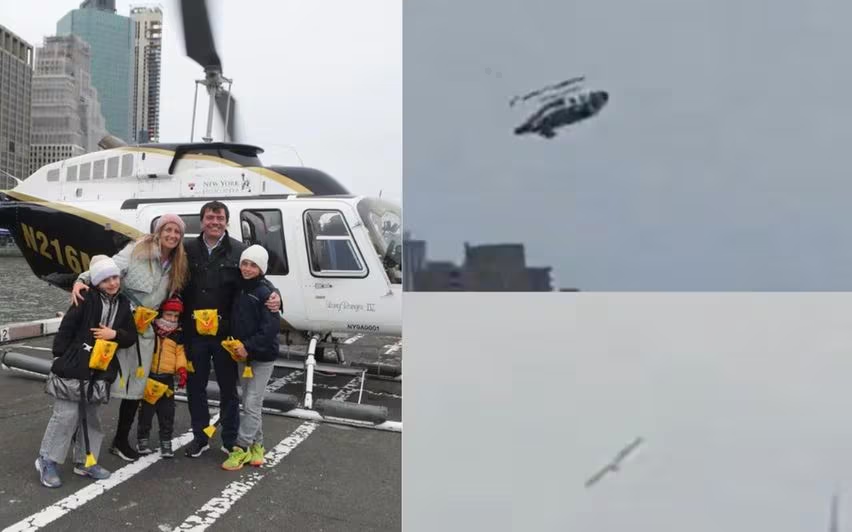
The ill-fated helicopter, a Bell 206 LongRanger IV, took off from the Downtown Manhattan Heliport at 2:59 p.m. on Thursday, carrying Agustín Escobar, 49, his wife Mercè Camprubí Montal, 39, and their three children—Victor, 4, Mercedes, 8, and Agustín, 10—along with pilot Seankese Johnson, 36.
The family, visiting from Barcelona to celebrate Camprubí’s 40th birthday, had booked a 20-minute tour to see Manhattan’s iconic skyline, including a flyover of the George Washington Bridge.
The helicopter followed a standard route: circling the Statue of Liberty, heading north along the Hudson, and turning south near the bridge. At 3:17 p.m., just 18 minutes into the flight, disaster struck.
Witnesses reported hearing a loud noise, like something breaking, before seeing the helicopter’s main rotor detach midair. The aircraft flipped upside down and plunged into the river near Hoboken’s Pier A Park, scattering debris across the water.
Emergency responders, including NYPD divers and FDNY boats, pulled all six victims from the wreckage, but four were pronounced dead at the scene, and the two children succumbed at Jersey City Medical Center.
The National Transportation Safety Board (NTSB) noted the helicopter lacked flight recorders, complicating the investigation, though divers recovered the cockpit, cabin, and parts of the tail by April 11. The search continues for the main rotor and gearbox, critical to determining why the aircraft broke apart.
FAA Statement⁰⁰New York Helicopter Tours — the company involved in the deadly crash on the Hudson earlier this week — is shutting down their operations immediately.⁰ ⁰We will continue to support @NTSB’s investigation. Additionally, the FAA will be launching an immediate…
— The FAA ✈️ (@FAANews) April 14, 2025
The victims’ identities added a layer of heartbreak. Escobar, president of Siemens Spain’s rail infrastructure division, and Camprubí, a Siemens executive, were described as devoted parents. Their children’s ages underscored the loss of young lives, with Mercedes set to turn 9 the next day.
Johnson, a Navy SEAL veteran who earned his commercial pilot’s license in 2023, had logged 788 flight hours and recently moved to New York for a fresh start. The crash’s suddenness—described by Jersey City resident Dani Horbiak as the helicopter “falling to pieces”—left authorities scrambling to understand a failure that turned a joyful excursion into a catastrophe.
A Troubled History and Swift Shutdown
New York Helicopter Tours, a small operator in the competitive aerial tourism market, faced immediate scrutiny after the crash. The FAA’s announcement on April 13 that the company was ceasing operations came hours after Senator Chuck Schumer urged regulators to revoke its operating certificate, citing a “deadly track record.”
Public records reveal a checkered past: a 2013 emergency landing in the Hudson due to power loss, with no serious injuries, and a 2015 “hard landing” in New Jersey after a helicopter spun out of control during hover. The 2015 incident involved an “unairworthy” drive shaft, previously damaged in a 2010 crash in Chile, raising questions about maintenance practices.
The company, led by CEO Michael Roth, also faced financial woes. Court filings show lawsuits from lenders alleging unpaid debts, including $83,000 owed in 2025, and disputes with heliport operators over access and payments.

Roth’s reputation for litigation—suing maintenance firms and heliport managers—painted a picture of a struggling operation, overshadowed by larger competitors with newer fleets.
The Bell 206, built in 2004 and leased from Louisiana’s Meridian Helicopters, had a valid airworthiness certificate until 2029 and a major inspection on March 1, 2025. Yet, its eighth flight of the day hints at heavy usage, a potential factor under NTSB review.
The shutdown, while abrupt, reflects mounting pressure from regulators and public outcry. The FAA is launching a review of the company’s safety record and license, alongside supporting the NTSB’s probe, which includes examining maintenance logs and Bell Textron’s manufacturing.
Schumer’s call for increased “ramp inspections”—surprise safety checks—at other tour operators signals a broader reckoning. New York Helicopter Tours issued a statement expressing devastation and pledging cooperation, but Roth has not commented publicly. For now, the company’s website remains active, redirecting inquiries to federal agencies, as its helicopters stay grounded.
Safety, Tourism, and a City’s Skies
The Hudson River crash is the latest in a string of helicopter incidents that have fueled debate over New York’s sightseeing tours, which number 30,000 annually. Since 1977, at least 38 people have died in city helicopter crashes, including a 2009 collision with a plane that killed nine and a 2018 “doors-off” tour crash in the East River that drowned five passengers.
The 2018 incident, caused by a tether snagging the fuel switch, led to tighter FAA rules, yet critics argue enforcement lags. Groups like Stop the Chop, citing noise and climate concerns, have long pushed to ban nonessential flights, but operators relocated to New Jersey after a 2016 cap on Manhattan heliport takeoffs.
Mayor Eric Adams, a defender of helicopter tourism, argued on April 11 that the flights are vital for business and the “New York experience,” with most operating safely. He contrasted with Schumer’s push for restrictions, highlighting the economic draw of tours offering views of the Statue of Liberty and World Trade Center for as little as $114 per person.
However, the crash’s toll—especially the loss of children—has amplified calls for reform. Councilwoman Amanda Farías urged a moratorium on nonessential flights from city heliports, while former DOT inspector Mary Schiavo told CNN the Hudson’s helicopter risks have been ignored for decades.
The investigation’s challenges, including no flight data and missing wreckage, underscore systemic issues. The Bell 206, a reliable model per aviation expert Greg Feith, depends on rigorous maintenance, yet New York Helicopter’s past suggests gaps.
The FAA’s planned April 22 safety panel will address nationwide helicopter hotspots, but public trust is shaken. Social media posts on X reflect grief and frustration, with some praising the FAA’s swift action and others questioning why it took a tragedy to act.
For tourists like Lionel Carles from France, who flew the same helicopter earlier that day, the crash is a haunting reminder of chance, while locals mourn a family’s loss and a pilot’s promise cut short.
The closure of New York Helicopter Tours marks a turning point, but questions linger: Will other operators face stricter oversight? Can safety keep pace with tourism’s allure? As divers scour the Hudson’s icy depths for answers, the city grapples with balancing its skyline’s magic against the risks of soaring too close to danger. The Escobar family and Seankese Johnson deserved better, and their memory demands a safer path forward.