
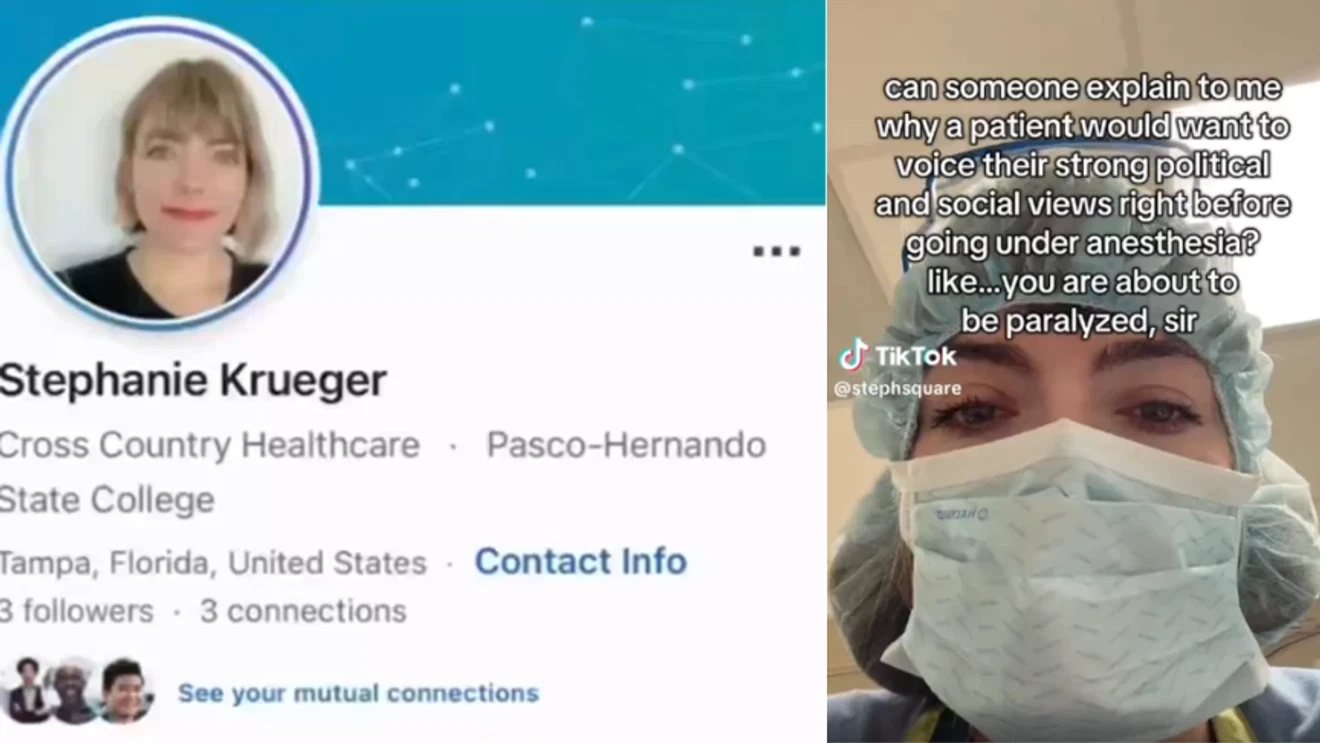
A Florida nurse is facing intense public scrutiny after a social media video sparked backlash from officials, employers, and the broader healthcare community. Stephanie Krueger, a Tampa-based nurse who previously worked with Cross Country Healthcare, became the focus of controversy after posting a TikTok video that questioned the political behavior of patients immediately before undergoing anesthesia. The post, which framed the situation with a tone many interpreted as dismissive or insensitive, quickly spread online and prompted strong reactions from state officials and healthcare organizations.
The incident has renewed debate about the boundaries of professional conduct on social media, particularly for medical workers whose roles depend heavily on trust, neutrality, and ethical responsibility. Public confidence in healthcare providers is closely tied to perceptions of impartiality and respect for patients, regardless of their personal beliefs or backgrounds. Against this backdrop, Krueger’s remarks triggered concerns not only about tone but also about the broader implications of healthcare professionals publicly commenting on patient attitudes in vulnerable medical settings.
The controversy did not unfold in isolation. It emerged amid heightened attention to healthcare workers’ online behavior in Florida, where another nurse had recently faced disciplinary action over separate social media remarks. Together, the incidents have intensified scrutiny over how professional standards are applied in the digital age and how regulators respond when public trust is perceived to be at risk.
Public Reaction and Professional Consequences
Stephanie Krueger’s TikTok video centered on her observations of patients expressing strong political views just before being placed under anesthesia for surgery. In the video, she questioned what she described as the irony of patients discussing serious ideological positions while about to be medically paralyzed for procedures. Although the remarks did not reference specific individuals, critics argued that the tone conveyed disrespect toward patients at a moment when they are physically vulnerable and dependent on medical professionals for care.
The video quickly circulated across social media platforms, where reactions ranged from criticism to calls for accountability. Many viewers expressed concern that such commentary could undermine patient confidence in medical staff. Others argued that public discussions about patients in clinical settings—even in general terms—risk eroding the perception that healthcare providers maintain professionalism and confidentiality at all times.
State leadership responded swiftly. Florida’s attorney general issued a strong statement condemning the video and emphasizing that patient safety must remain independent of political considerations. He warned that healthcare professionals who allow personal beliefs or attitudes to influence how they treat patients—or appear to do so—would not be tolerated. His comments reflected a broader concern that even perceived bias can damage the credibility of healthcare institutions and the integrity of medical practice.
Krueger’s employment status also became a central issue. Cross Country Healthcare publicly clarified that she no longer works for the organization and that her views do not reflect its values or standards. The company’s response highlighted how healthcare employers increasingly distance themselves from employees’ controversial online statements to protect institutional reputations and reassure patients of their commitment to ethical care.
Read : Prison Nurse Kymberley Finn Struck Off After Smuggling Mobile Phone into Prison
Employer reactions to such incidents often extend beyond immediate public relations concerns. Healthcare organizations operate in highly regulated environments where trust, compliance, and professional conduct are critical to maintaining licensure, accreditation, and patient confidence. When employees’ public behavior is perceived as inconsistent with professional standards, employers frequently act quickly to demonstrate accountability and reinforce organizational expectations.
BREAKING – The nurse who threatened to harm patients while they were under anesthesia for being conservative has been identified as traveling OR nurse Stephanie Krueger, who works for the Florida based healthcare staffing agency Cross Country Healthcare. pic.twitter.com/78j3LC29I0
— Right Angle News Network (@Rightanglenews) February 11, 2026
For many observers, the situation underscored the evolving relationship between professional identity and personal expression in the era of social media. Healthcare workers, like all individuals, maintain personal online presences. However, their professional roles carry ethical obligations that extend beyond the workplace. Statements made in personal contexts can still be interpreted through the lens of professional responsibility, particularly when they reference patient experiences or clinical environments.
A Pattern of Social Media Controversies in Florida Healthcare
Krueger’s case gained additional attention because it followed another widely publicized controversy involving a Florida nurse. A labor and delivery nurse from Boca Raton had previously drawn severe backlash after posting a TikTok comment directed at a prominent public figure. The remark, which involved wishing severe childbirth-related harm, was widely condemned as inappropriate for someone working in maternal healthcare.
That earlier incident prompted significant disciplinary action. State authorities announced that the nurse would no longer be allowed to practice nursing in Florida, citing ethical violations and conduct inconsistent with professional standards. Officials described the comments as incompatible with the responsibilities of a healthcare provider and emphasized that expressing harmful wishes toward others—particularly in connection with one’s clinical role—constitutes a serious breach of professional ethics.
The attorney general’s response to both incidents reflected a consistent stance: that termination of employment alone may not be sufficient when conduct raises questions about a healthcare worker’s ability to provide safe and unbiased care. In statements addressing the controversies, he characterized certain remarks as “vile” and emphasized that regulatory action may be necessary to maintain professional accountability and protect public trust.
These developments have contributed to a broader perception that Florida regulators are taking an increasingly assertive approach to monitoring healthcare professionals’ public behavior. While disciplinary processes traditionally focused on clinical performance and direct patient care, social media activity is now being examined as a potential indicator of professional judgment and ethical awareness.
Healthcare licensing boards across the United States have gradually expanded their attention to online conduct, but enforcement approaches vary widely by jurisdiction. Florida’s recent actions suggest a willingness to intervene when public statements raise concerns about impartiality, professionalism, or patient respect—even if the remarks occur outside clinical settings.
The pattern of consecutive controversies has also intensified public discussion about how professional standards should be defined in the digital era. Some commentators argue that strict enforcement is necessary to preserve public confidence in healthcare systems. Others contend that disciplinary responses must carefully balance professional accountability with individuals’ rights to personal expression.
Ethics, Trust, and the Digital Professional Identity
The central issue underlying the Krueger controversy extends beyond a single video or individual response. It reflects a broader transformation in how professional ethics are interpreted in a world where personal and professional identities often overlap online. Healthcare professionals are expected to maintain trust, empathy, and neutrality, but social media platforms encourage personal commentary, humor, and candid expression—sometimes in ways that blur traditional boundaries.
Medical ethics have long emphasized respect for patient dignity and the importance of maintaining professional decorum. Even indirect or generalized commentary about patients can raise concerns if it appears to diminish their experiences or portray them in a negative light. In clinical settings, patients often face anxiety, fear, and vulnerability, making sensitivity especially important. Public commentary that appears dismissive of those conditions can be interpreted as incompatible with the compassionate standards expected in healthcare.
The rise of social media has made these ethical considerations more visible and more complex. Posts that might once have been shared privately can now reach vast audiences instantly, often without context or clarification. A single remark can trigger widespread scrutiny, institutional responses, and regulatory attention. As a result, healthcare workers increasingly face expectations to consider how any public statement might be perceived by patients, employers, and licensing authorities.
Professional organizations have responded by issuing guidance on social media conduct, advising healthcare workers to avoid discussing patient interactions, refrain from posting content that could be interpreted as discriminatory or dismissive, and maintain a tone consistent with professional values. These guidelines are not merely recommendations; in many cases, they form part of the ethical framework used to evaluate professional conduct.
The Florida incidents illustrate how enforcement of these principles is evolving. Public trust remains a foundational element of healthcare systems. Patients must believe that their providers will treat them with fairness, respect, and impartiality, regardless of personal beliefs or social identity. When public statements appear to contradict those expectations, regulators and employers may intervene to preserve confidence in the profession as a whole.
At the same time, the ongoing debate reflects broader societal questions about the limits of personal expression in professional roles. Social media has expanded the visibility of individual voices, but it has also heightened scrutiny of how those voices align with institutional responsibilities. Healthcare professionals operate within ethical frameworks that prioritize patient welfare and public trust, and those frameworks increasingly extend into digital spaces where professional identity remains visible even outside clinical environments.