
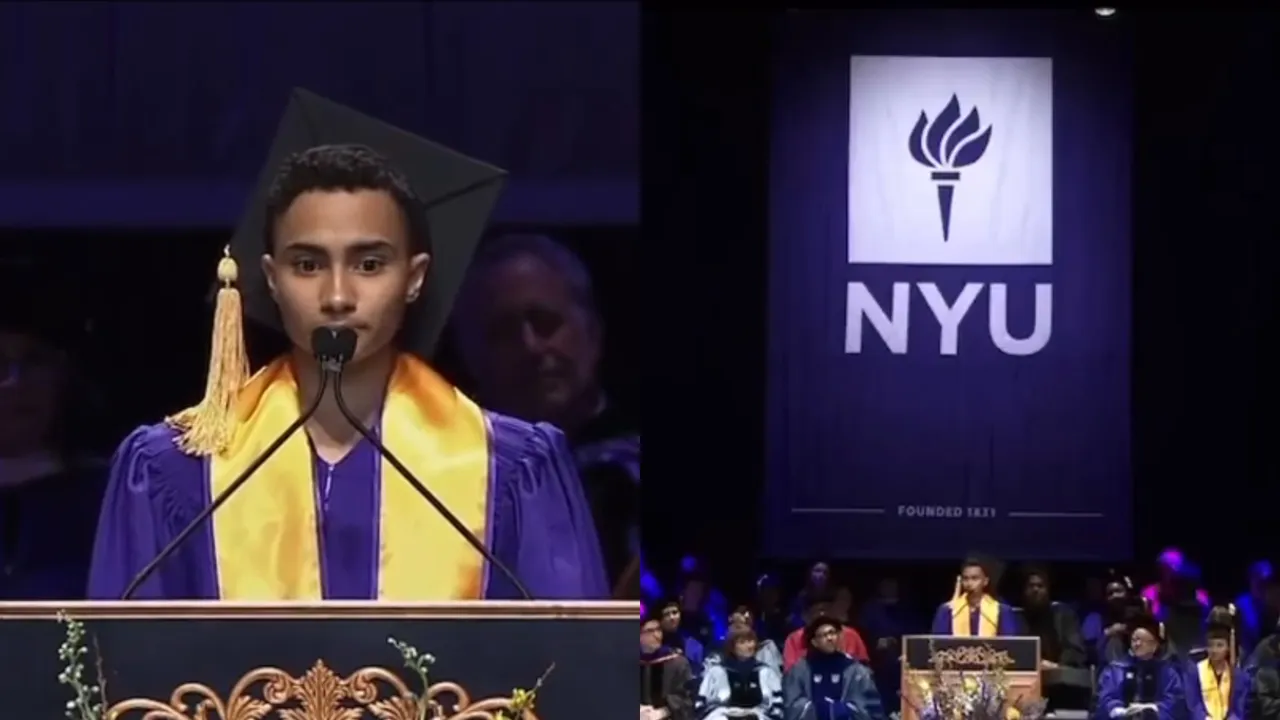
The prestigious commencement ceremony at New York University’s Gallatin School recently took a controversial turn when graduating student Logan Rozos delivered a speech that sparked national debate and institutional response.
Rozos, an actor and prominent member of the Gallatin Theatre Troupe, had been selected by his peers to represent the student body and deliver a speech during the graduation ceremony. What was meant to be a celebratory moment became a flashpoint in the ongoing discourse around free speech, academic freedom, and the political climate surrounding the war in Gaza.
Rozos used his platform to condemn Israel’s military operations in Gaza, referring to the situation as a “genocide” and directly implicating the United States in supporting it both politically and militarily. His remarks were met with applause from some and severe backlash from others.
Almost immediately, NYU’s administration responded by withholding Rozos’s diploma, citing that he had violated agreements regarding the content of his speech. The situation has since drawn the attention of advocacy groups, media outlets, faculty members, and the wider public, raising important questions about the limits of free expression in academic settings.
The Speech Heard Around NYU
Logan Rozos’s address was direct and unambiguous. He referred to the conflict in Gaza as a genocide, stating, “The genocide currently occurring is supported politically and militarily by the United States, is paid for by our tax dollars, and has been livestreamed to our phones for the past 18 months.”
Rozos’s words struck a chord with many who have been vocal in protesting the humanitarian crisis unfolding in Palestine. But others, particularly pro-Israel groups and university officials, viewed the speech as a violation of the guidelines governing student speakers.
According to NYU spokesperson John Beckman, Rozos had submitted a draft of his speech that did not include the controversial political content. Beckman asserted that Rozos “lied about the speech he was going to deliver and violated the commitment he made to comply with our rules.”
On this basis, the university chose to withhold his diploma while pursuing disciplinary action. Beckman further stated that Rozos had misused the graduation platform to share “personal and one-sided political views.”
@NYU is now withholding his diploma and wants to seek disciplinary action against the Valedictorian’s speech for speaking in the genocide in Gaza.
— yas_mina ياسمينة (@yasminbytheway) May 15, 2025
NYU Spokesperson John Beckman released a shameful statement following the speech:
"NYU strongly denounces the choice by a student at… pic.twitter.com/jl8lGxcIDH
Rozos’s speech did not contain any reference to Jewish people or the Jewish religion, but it has nonetheless been labeled as dangerous and inflammatory by groups like the Anti-Defamation League and #EndJewHatred. These organizations argued that the speech created an unsafe environment for Jewish students.
The ADL issued a statement saying, “No student – especially Jewish students – should have to sit through politicized rhetoric that promotes harmful lies about Israel during such a personal milestone.”
Backlash and Support: Divided Opinions Across the University and Beyond
The university’s decision to withhold Logan Rozos’s diploma has not gone unchallenged. Numerous NYU faculty members have expressed outrage at the administration’s response, viewing it as an infringement on free speech and academic freedom.
NYU professor Andrew Ross criticized the move, stating that the university was “bending over backward to crack down on speech that runs counter to what the current administration in Washington espouses.” Ross went on to describe the situation as “a very good example of an administration falling down on the job.”
Many students and activists have rallied behind Rozos, arguing that his speech represented a legitimate expression of political concern. For them, punishing a student for speaking out against what he sees as injustice not only undermines the principle of free expression but also reflects a broader pattern of censorship on university campuses.
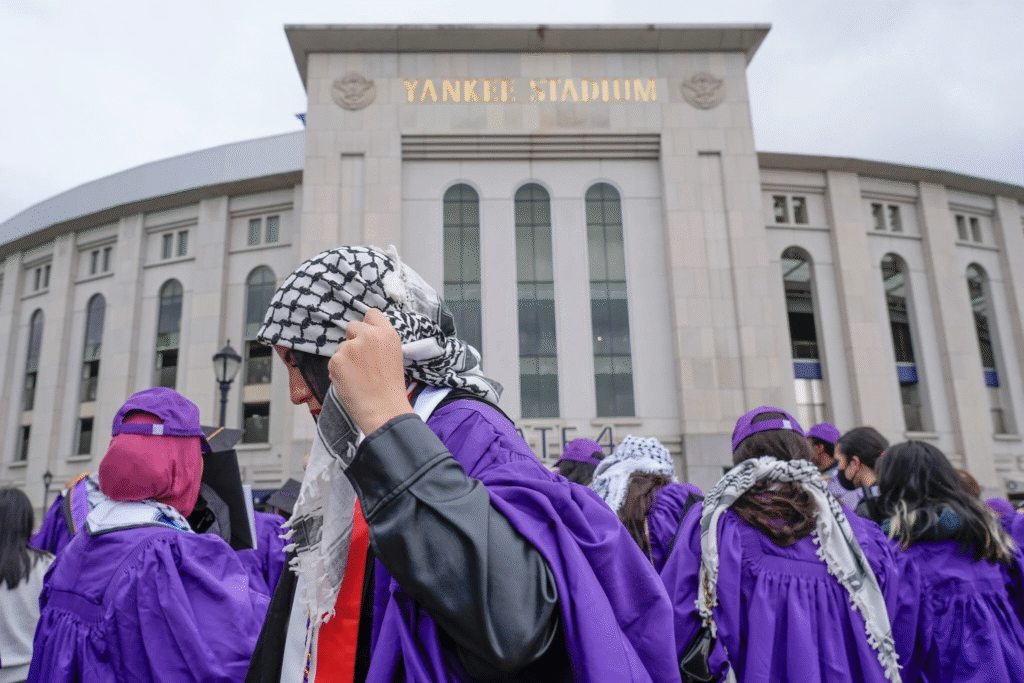
Social media has been flooded with support for Rozos, with hashtags like #JusticeForLogan and #FreeSpeechNYU trending among student groups and human rights organizations. At the same time, defenders of NYU’s actions argue that Rozos breached the trust placed in him as a student speaker.
They point out that graduation ceremonies are not the appropriate venue for delivering controversial political statements, particularly those that may alienate or discomfort attendees. They also note that institutions have a responsibility to ensure that such events remain inclusive and respectful to all students and families in attendance.
The Larger Conversation: Free Speech, Academic Institutions, and Political Discourse
The Logan Rozos incident at NYU is far from an isolated case. Across the United States, university campuses have become battlegrounds for debates over the Israeli-Palestinian conflict, with pro-Palestinian and pro-Israel voices often clashing in public demonstrations, lectures, and digital forums.
These tensions have placed institutions in the difficult position of balancing the rights of individuals to express their political views with the need to maintain a safe and respectful environment for all students.
Universities, long considered bastions of free thought and open dialogue, are increasingly being scrutinized for how they handle such conflicts. Critics argue that by disciplining Rozos for his speech, NYU is effectively aligning itself with one side of a deeply complex international issue, thereby stifling legitimate criticism and political dissent.
Others maintain that the university has every right to enforce rules and expectations for public speeches at official events, especially if those rules were clearly communicated in advance.
What makes this particular case more charged is the broader political context. The United States has been a staunch ally of Israel for decades, and recent military operations in Gaza have sparked global protests and fierce debate.
Rozos’s speech, therefore, tapped into a much larger conversation—one that involves questions of justice, foreign policy, and moral responsibility. That he chose to use his moment on stage to address these issues may be seen as an act of courage or a breach of decorum, depending on one’s point of view.
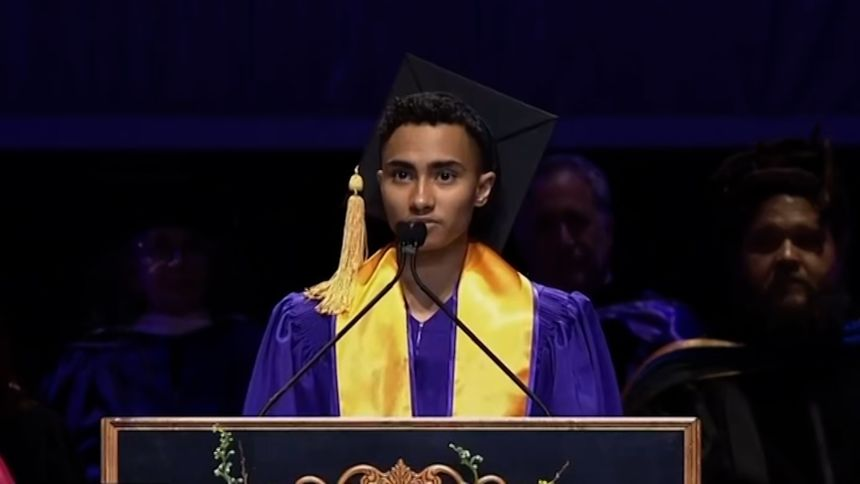
Meanwhile, the university’s decision to withhold a diploma—a student’s earned recognition after years of study—raises questions about the proportionality of the response. While disciplinary measures may be warranted in some cases, critics argue that denying a diploma as punishment for a speech that reflects genuine political concern is an overreach.
Legal experts and civil liberties advocates are also watching closely. Although private universities like NYU are not bound by the First Amendment in the same way public institutions are, they are still expected to uphold core principles of academic freedom and free expression. The outcome of this case may set a precedent for how universities across the country handle similar situations in the future.
Logan Rozos, for his part, has remained resolute in defending his speech. In follow-up statements, he reiterated his belief that what is happening in Gaza constitutes a humanitarian crisis and that it is the moral duty of young people, especially those in institutions of privilege and power, to speak out. Whether or not he ultimately receives his diploma, Rozos has already left a mark on his university and on the broader conversation about activism and accountability.
The controversy has become emblematic of the cultural and ideological divides that exist not just in universities, but in society as a whole. It underscores the challenges faced by academic institutions as they navigate increasingly polarized debates while striving to uphold principles of fairness, equity, and free expression.
As NYU deliberates on its next steps, all eyes remain on the institution to see whether it will uphold the spirit of dialogue and dissent that is fundamental to higher education—or succumb to the pressures of censorship and political conformity. Regardless of the outcome, the case of Logan Rozos has sparked an important and necessary discussion—one that will likely reverberate far beyond the confines of Washington Square Park.